On June 9, when the 13.14-kilometre-long Zojila Tunnel witnessed a construction breakthrough, Muhammad Shafi Sagar, 50, and Ashiq Wazir, 30, unknown to each other, experienced both relief and sadness. Relief that they and their friends will, in a couple of years, be able to travel between Ladakh’s Drass district and the Kashmir Valley relatively free of the fear of dangerous terrain. Sadness, because they had both lost loved ones in the treacherous Zojila Pass.
The Zojila Tunnel by-passes the pass that runs across 30 km, cutting through the vertical, craggy Himalayan range in Drass. In the district’s Pandrass village, the mountains are parallel walls; there are no trees in sight at this altitude of 10,800 feet. In winter, the temperature drops to less than -25 degrees Celsius. In summer, the peaks are still surrounded by snow, but the melting glaciers relent. They spring out waterfalls from elevated mountain sides, adding to the roar of the Drass river below.
Shepherds from the plains converge on the high-altitude meadows dotted with wild grass and fresh-water bodies. The children are out in Pandrass High School, the sun shining brightly over them and their L-shaped, single-storey campus, but piercing gusts still make wearing a wind-blocker necessary. The night temperature continues to dropbelow freezing point, even in June.
It is in these conditions that 1,200 people, working from a camp site, have been building the Zojila Tunnel, which will connect Baltal in Kashmir’s Ganderbal district and Minamarg in Ladakh’s Drass, on National Highway-1. In the past, the pass was rife with tragedy.
“Shooting stones, snow slides, sudden temperature dips, and avalanches have killed travellers on the Zojila Pass for centuries. Kargil (in Ladakh) is full of stories of loss and disappearances,” says Sagar, a teacher at the Pandrass High School, who is also an author of a book on the culture of the Shina tribe in Ladakh.
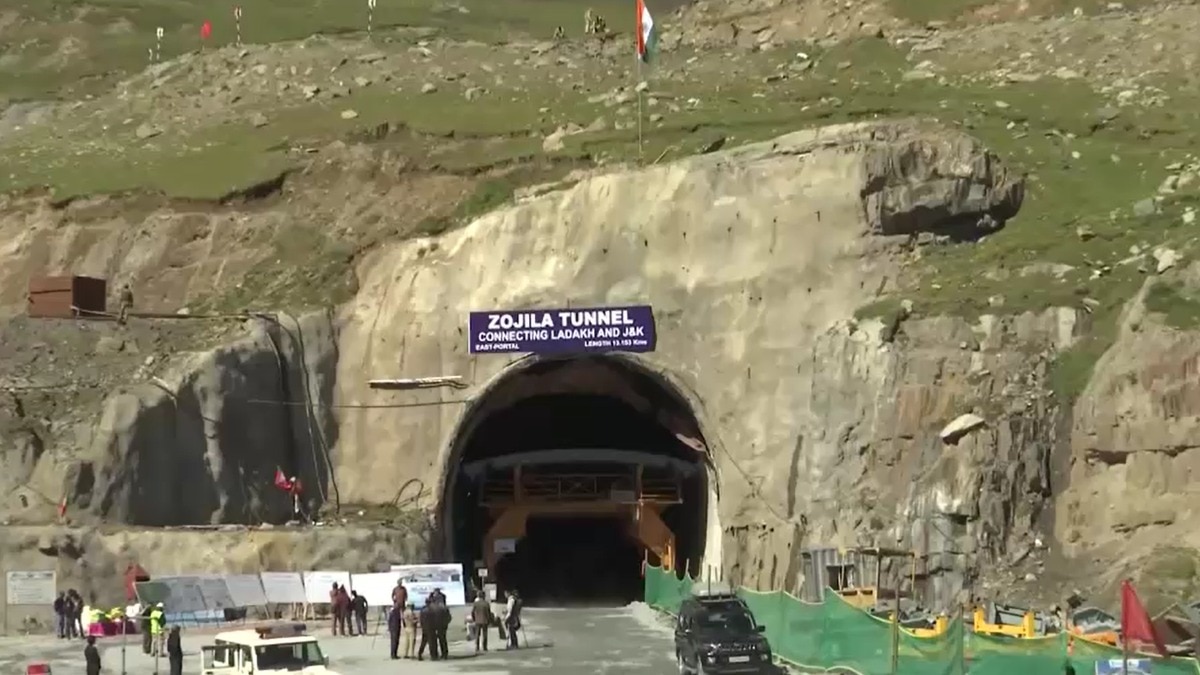
Officials during the inspection and breakthrough of Zojila tunnel, at Minimarg, in Ladakh, Tuesday, June 9, 2026.
| Photo Credit:
Imran Nissar
Workers and technicians, mostly from India, but also from abroad, put in 10 million safe working hours. They grappled with the geological uncertainties of young mountains, rock classification changing every couple of hundred metres, and water pouring out of crevices. Built at a cost of ₹6,800 crore, the excavation was carried out between the altitudes of 2,900 metres on the Kashmir side to 3,310 metres on the Ladakh side. It is expected to be operational by 2028, and is designed to stay open through the year.
Danger zone
Sagar tells a story about his colleagues, from 33 years ago. In 1993, the Pandrass High School, located 13 km away from the Zojila Pass, closed for its usual five-month-long winter vacation in December. Two teachers, Shabir Ahmad and Bashir Ahmad, decided to return home to the Kashmir valley. The Union Territory of Ladakh was part of the Kashmir division of the erstwhile State of Jammu and Kashmir till 2019.
“Winter had already set in. The two teachers left for home. The sub-zero temperatures near the Zojila Pass killed them. One body was recovered after a week and another body has not been traced to date. Locals feel wild animals may have taken it,” says Sagar.
For Sagar, the tunnel has provided a new lease of life to people who live here. “When a local would fall sick and need specialised treatment, the nearest hospital was 279 km away, in Leh. Then the patient would be flown out to Delhi or Srinagar. With the tunnel, it’ll be just a 141-km drive to Srinagar,” says Sagar. The worries about vegetables, gas, and grocery stocks will be stories from the past.
This year on March 27, despite better road management and early warnings compared to the past, an avalanche killed seven persons and injured five others at the Zojila Pass. It was a sudden bright sun that triggered the rockfall around 12.30 p.m. One of the victims of the dread-inducing Zojila Pass was Akbar Ali Shadab, a 36-year-old resident of Tharumsa Pashkum village in Kargil. Shadab had just had a baby, six months before. He worked as a wildlife guard and was respected for his volunteerism.
“News flashed on social media about four vehicles being hit by an avalanche. We reached the spot in the evening. The rescue teams halted operations for the night. My uncle’s body was found around 6 the next morning,” says Wazir, the victim’s nephew.
Now, the conversation around Zojila is changing. Sajjad Kargili, in-charge of political affairs of the Jamiat Ul Ulama Isna Asharia, Kargil, an influential seminary, sees the tunnel as the “realisation of a decades-long dream of locals”. He refers to the many leaders who through the years have asked at both the State and Central levels for the tunnel.
Kargili was joined by senior members of the seminary on June 9 to pay tribute “to all those who dedicated their lives to this cause but could not live to witness this historic moment”. He remembers those who disappeared or died.
“This is not just an engineering milestone, but also a testament to sacrifices. The historic breakthrough stands as a landmark achievement in a long journey of struggle, hope, and determination. It opens a new chapter of connectivity, progress, and prosperity for the region,” says Kargili.
A tourist vechile inside the tunnel during the inspection and breakthrough.
| Photo Credit:
Imran Nissar
Upto 80% of those working on the site are locals. With the tunnel aiming to be open through winter, the possibility of tourism through the year has opened up.
Scaling heights
Ladakh’s Zojila Pass has historically been daunting for India. During the India-Pakistan war of 1947, the it was choked by Pakistan and it took two months in 1948 to drive tanks in, between September and October, to defeat and evict the Pakistan Army. The war spurred construction work on the Zojila Pass to make it motorable. “After the 1962 India-China war, the focus again shifted to the Zojila Pass and its importance. The road saw further widening and attention,” say Sagar.
From 2005 to 2019, attempts to award the project failed four times. The project was shelved in 2019 due to financial losses of the company tendered to do the work. The work on the Zojila Tunnel saw a flip in its speed after India and China engaged in a face-off in Galwan on June 15-16 in 2020, and saw casualties on both sides for the first time since the wars of the 1960s.
On October 15, 2020, the construction of the Zojila Tunnel was started by the National Highways and Infrastructure Development Corporation Limited (NHIDCL) and Megha Engineering & Infrastructures Ltd (MEIL). The first blasting at Nilgrar Tunnel was held on October 14, 2020. Approach roads, bridges, the Nilgrar twin tunnels, cut-and-cover works, and snow gallery (to protect the tunnel from heavy snowfall) were constructed to set the stage for the tunnel work.
Six years down the line, the Zojila Tunnel is tipped to be the world’s longest single-tube bidirectional road tunnel at an altitude 11,578 feet. The main tunnel is U-shaped and is 9.5 metres wide and 7.57 metres in height.
Harsh weather conditions coupled with the mountain’s rock composition posed a major challenge for engineers and workers. The rock classification changed 67 times across the 13.14 km stretch and shifted constantly between good and poor formations. The highly volatile geology was managed with the expertise of skilled crew.
“The Himalayas are considered young mountains. They are just 700 million years old,” says Yousef Es’haghpour Rahimabadi, an Iranian engineer who works for the NHIDCL. “The rocks have not solidified or condensed fully yet. We had to work on eight to 10 fault zones, which needed special measures. Water seepage has been a major concern,” he adds.
He has 29 years of experience in building tunnels. “I mostly worked in the Middle East,” says Rahimabadi, who provided consultation on design as well as at-site solutions.
Rahimabadi says the age of the tunnel is set to be 100 years. During the construction of the project, workers braved temperatures of -20 degree Celsius for nearly 100 days a year. A base camp was established for over 1,100 people, which provided food climate- appropriate food, medical facilities, transportation, and amenities to sustain round-the-clock operations.
A Spanish company also joined the project to provide expert solutions to problems posed by the geology of the mountains.
Over the last five years, the project site faced five major avalanches, two in 2023, two in 2024, and one in 2025. On January 12, 2023, a severe avalanche hit the Sarbal area close to the Nilgrar Tunnels. On January 15, 2023, up to 172 workers were stranded in an avalanche.
To combat heavy snow accumulation in winter, a fleet of small and large snow blowers was deployed. This ensured uninterrupted construction work while simultaneously keeping the highway open for regular vehicular movement. “Procurement was also a major challenge. It took three months to bring gantries to Minamarg, because the bypass in Sonamarg was closed for winter,” says Rahimabadi.
The tunnel in numbers
30.894 km Total project length, including tunnel roads and bridges
13.153 km Zojila main tunnel length
460 metres Length of three bridges across xx
474.30 metres India’s longest shaft
2.35 km of seven cut-and-cover structures as protection from landslides
Gantries are a huge adaptable moulds designed for shaping concrete within a tunnel excavation. Rahimabadi credits the New Austrian Tunnelling Method (NATM), which applies the sequential excavation method. “The NATM method uses the blast-and-go-ahead technique. We worked in two shifts in 24 hours to ensure that the deadline was met,” says Rahimabadi.
The tunnel has vertical structures to provide fresh air ventilation and emergency safety since there is no separate escape route. It offers automatic and emergency lighting, emergency phone and radio connectivity, and message signalling to ensure the safety of travellers. Vehicles will be able to travel at a speed of 80 km per hour through it. From two hours to cross the Zojila Pass, it will take travellers 30 to 40 minutes to cross the mighty and arduous Himalayan range.
Change at the press of a button
Harpal Singh, chief operating officer of Megha Engineering, recalls spotting batches of bears hibernating close to tunnel mouths in winter. “We would ignore each other. We did not try to disturb their habitat.” He also talks about the desolate landscape, when people from Sonamarg would leave in winter. “We’d see only the police and the Army patrolling,” says Singh.
Zojila Tunnel has an immense strategic value for India. India shares a 3,488-km-long border with China, of which 1,597 km runs through Ladakh. Besides the threats posed by China to the east, Pakistan is to the west of Ladakh, beyond the Line of Control.
“Earlier, the Zojila Pass would face closure for five to six months due to snowfall. This tunnel will provide an all-weather link with Ladakh and help the Army,” says Singh.
The completion of the Zojila Tunnel project has come at a time when massive military activities are being noted on the borders of Ladakh by China and in Gilgit and Baltistan by Pakistan.
When Union Minister of Road Transport and Highways Nitin Gadkari on June 9 pressed the button for the final blast inside the tunnel, he underlined the strategic value of the tunnel. “From the perspective of national security, this project will prove to be a gamechanger. With round-the-year connectivity, the movement of the Indian Army, as well as the supply of Army materials, equipment, and logistics, will become faster, safer, and more effective, thereby strengthening the country’s strategic preparedness,” he said.
Above the booming government voice is that of a school teacher. “The tunnel may dilute local culture. Modernity will pose a challenge to old ways of life in Drass. Tourism will introduce new ways of construction,” says a worried Sagar.