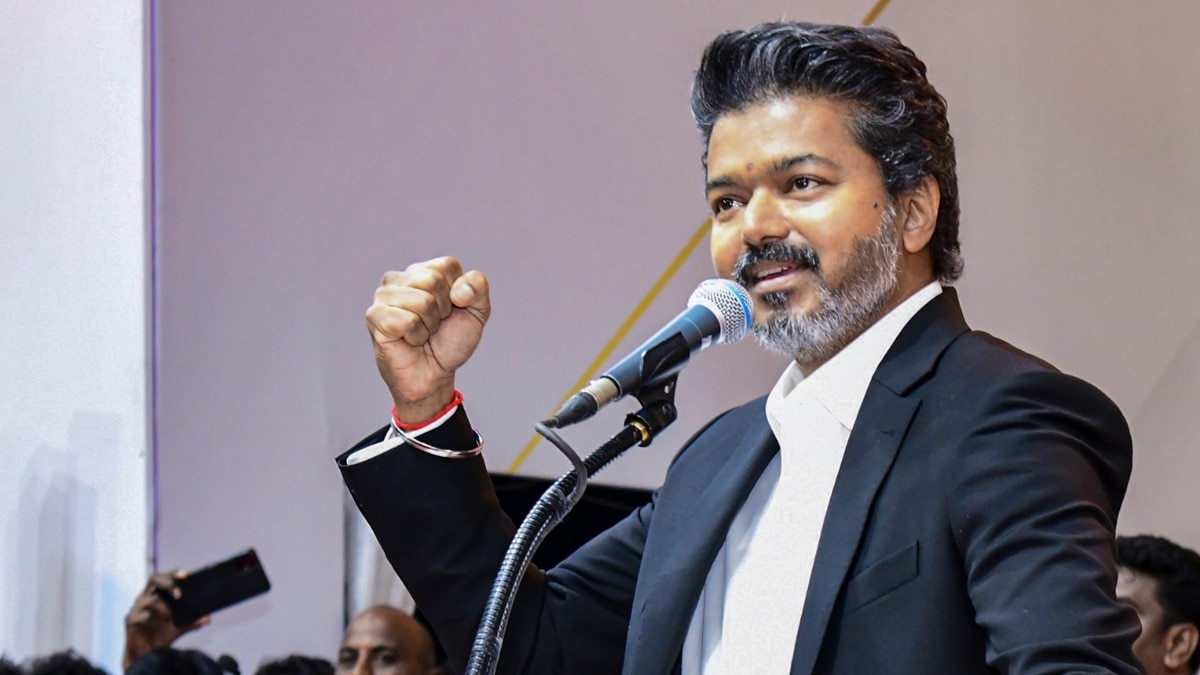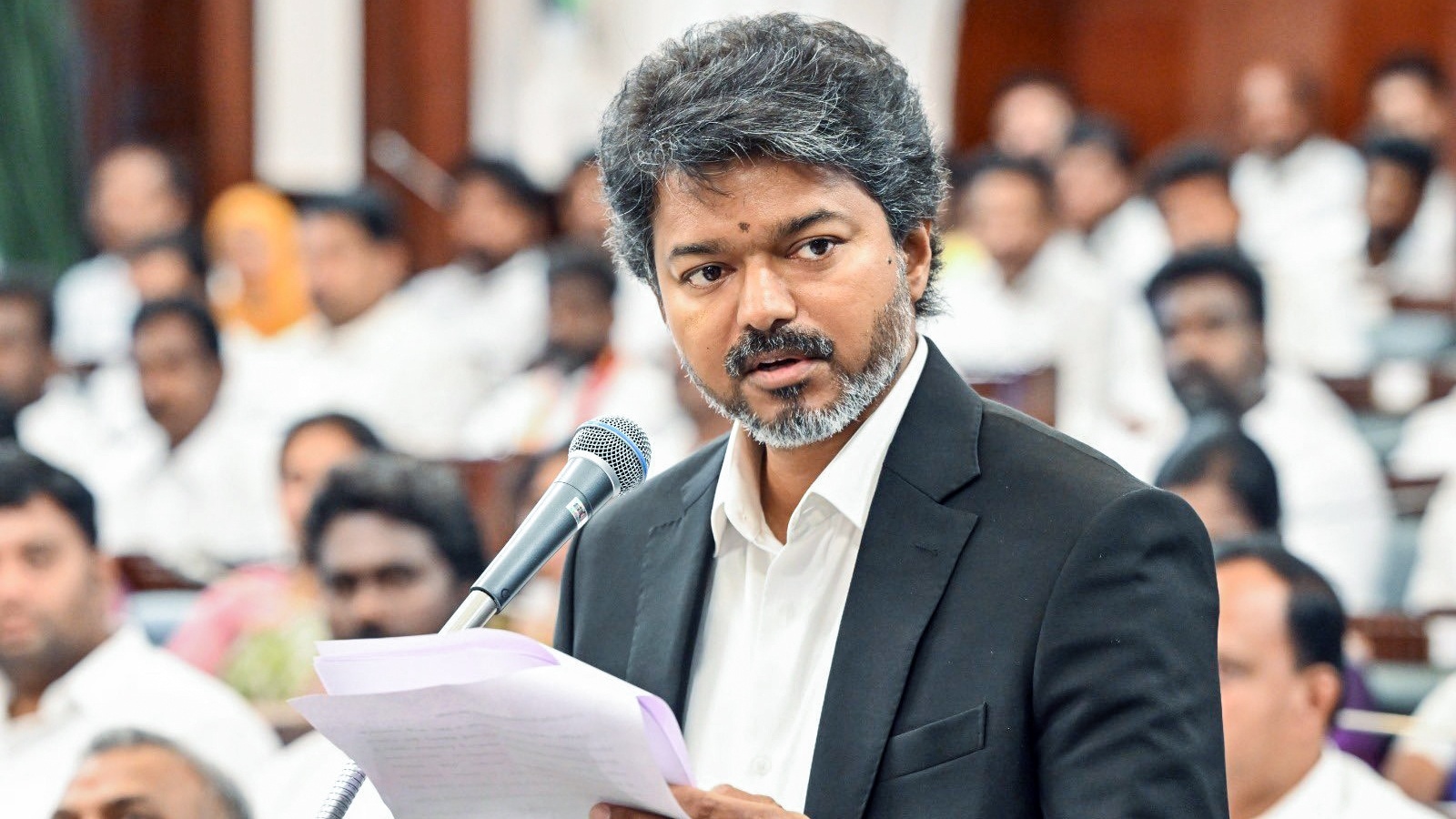
The transition was not as seamless as C Joseph Vijay may have wished. But if the film star-turned-Tamil Nadu Chief Minister wanted to send the message that a new boss was in town, he couldn’t have tailored it better – literally.
In a state where a loose white shirt and tied veshti is the de facto political uniform, Vijay took oath in a black suit, and has been making his political calls since dressed the same.
If the shirt-and-veshti look signalled a leader who was one of the people – sweating in the same heat, standing in the same dust – the suit signified Vijay’s image as an “outsider” cut from another cloth. His was the dress of the change he promised – corporate, global, professional.
Given his meteoric rise into politics and his origins rooted in cinema, Vijay’s look also signalled that he meant business.
However, there are sceptics, including some who fear it puts Vijay at a “distance” from the public. Even a groom who may wear a suit for his wedding reception goes back to veshti eventually, is the knowing advice they give. Others say that a suit is ludicrous for Tamil Nadu’s humid heat, and that even the cooler North prefers the middle path in the sleeveless Nehru jacket.
While the state has a history of people emulating their leaders – Jayalalithaa’s followers even rushed to get car registration numbers ending in ‘9’ because of her known attachment to the figure – Vijay may not find many eager to copy him.
However, there is a precedent as far as suits go in Tamil Nadu. AIADMK founder M G Ramachandran too was fond of them in his cinema avatar. “He wore flamboyant colour combinations, even when playing poor characters, pink with yellow, red with gold, colours that older political aesthetics considered mismatched. In films like Ulagam Suttrum Valiban, especially after his split with M Karunanidhi (the DMK stalwart), MGR’s colour schemes themselves became a declaration of rebellion… He resembled not any other sober politician but global entertainers like the Beatles, who used colour as spectacle,” says Gopalan Ravindran, a media and film scholar, who taught Communications at the University of Madras.
It suited MGR just fine, Ravindran adds. “Tamil fans did not see MGR as entirely human anyway. They saw him as Superhuman. Many genuinely believed his skin itself carried a golden glow, or pink colour.”
Over time, MGR also took to wearing a fur cap.
Of course, how one dresses in politics is never about the clothes alone, but as much about one’s political fabric. So the father of the self-respect movement, Thanthai Periyar, and DMK founder and former CM C N Annadurai, who radically transformed Tamil public life, treated appearance with disdain. There are many accounts of Periyar’s friends talking about his indifference towards not only clothing but even bathing every day, with the body secondary to the mind.
One story goes that once Periyar returned home exhausted after a statewide tour, and his wife repeatedly urged him to bathe. Irritated, he refused, until the domestic argument escalated into comic absurdity, involving a bucket of cow-dung water and furious exchanges.
A former aide of Annadurai recounts how before attending a wedding, he struggled to find even one reasonably unworn veshti among the total of six he owned. Another story talks of actor-politician S S Rajendran scolding Anna after discovering that the future CM was trying to borrow a suit instead of stitching a new one for a US visit.
In contrast, Rajendran, a staunch critic of Karunanidhi, criticised the DMK leader for “dressing like a king”. This was a jab at the drama around his sartorial choices, including his yellow shawl which he started sporting around almost the same time as his famous interactions with Sathya Sai Baba, apart from his trademark dark glasses. Hints that the shawl flowed from a superstitious belief was furiously denied by the DMK leader, whose party swore by staunch atheism.
Before shawls, stoles were a Dravidian accessory, popularised by Annadurai. In the 1960s, he encouraged party workers to honour one another with simple handloom stoles, partly to support struggling weavers and partly to break caste taboos. For many lower-caste communities, wearing clothes around the shoulders was restricted, while Annadurai told all to wear one.
The other big influence on Tamil Nadu politics, AIADMK leader J Jayalalithaa, also understood the politics of appearance. Her carefully draped capes, oversized cloaks and deep attachment to the colour green became part of her visual grammar – green echoing both prosperity and the AIADMK’s ‘Two Leaves’ symbol. After corruption charges levelled at her, the former matinee star vowed to shun jewellery in all forms – and stuck to it till her death.
Her confidante Sasikala often dressed the same as her, the clothes signifying their proximity while defying the criticism and controversy it often attracted.
So, will Vijay, who campaigned in a white shirt and beige trousers for the duration of the polls, be adding touches that make him stand out but blend in?
For now, somewhere in Chennai this week, a tailor would surely be readying an unexpected order for a blazer from a young man who has felt governance change texture.