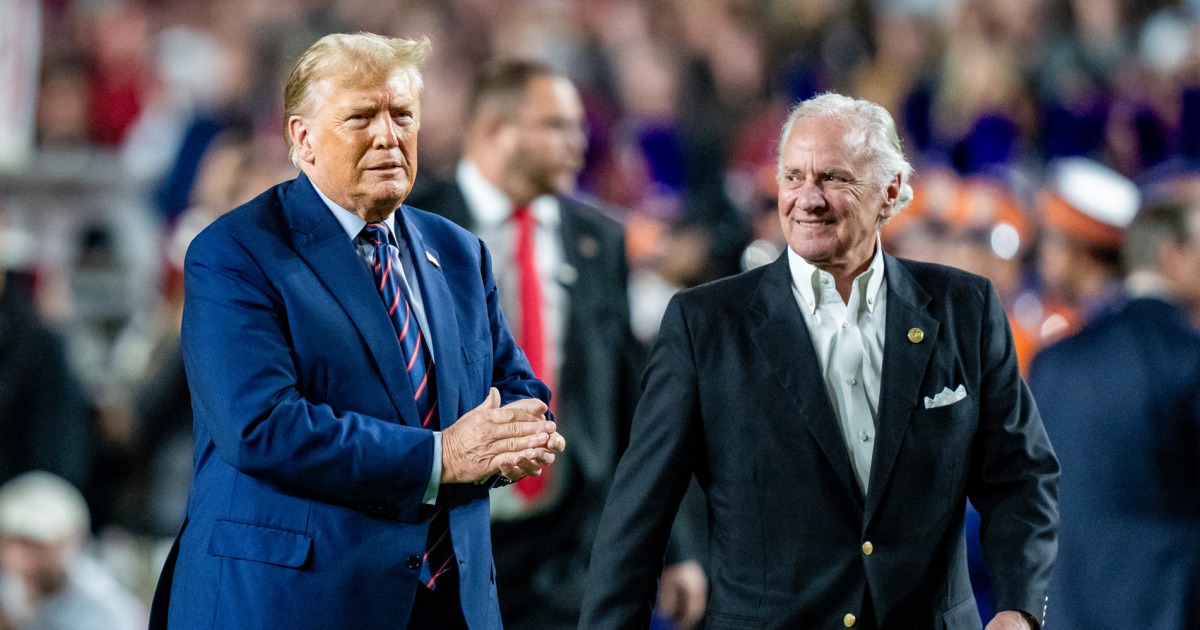
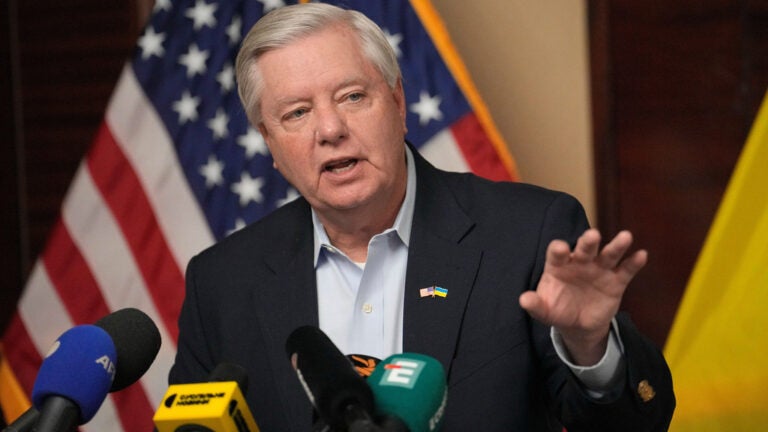
Sen. Lindsey Graham, R-S.C., left, gestures as President Donald Trump speaks with reporters while in flight on Air Force One, Jan. 4, 2026, as they were returning to Joint Base Andrews, Maryland.Alex Brandon/AP
Get your news from a source that’s not owned and controlled by oligarchs. Sign up for the free Mother Jones Daily.
Within moments of the early Sunday morning announcement that Sen. Lindsey Graham (R-S.C.) had died, there was much obvious commentary about his journey from Trump foe to Trump suck-up. During the 2016 GOP presidential primary, when Graham was competing with the onetime reality TV celebrity, he blasted Donald Trump as a “demagogue” and a “race-baiting, xenophobic, religious bigot.” He urged voters to tell Trump to “go to hell.” He predicted his party would be “destroyed,” if it nominated Trump.
Yet after Trump won, Graham became a full-fledged Trump lackey. He played golf with his new buddy and relished the access to power he now possessed. After the 2020 election, he joined Trump’s effort to pressure Republican Georgia Secretary of State Brad Raffensperger to rework the state’s vote count so Trump would prevail. And when Graham won a hard-fought Senate primary last month, he lavished praise on Trump, exclaiming, “Mr. President, you’re not far behind God.”
Graham lavished praise on Trump, exclaiming, “Mr. President, you’re not far behind God.”
One sign of Graham’s descent into the abyss of Trump toadyism is not likely to receive much attention: his acrobatic flip-flop on the Trump-Russia scandal.
After the 2016 election, during which Russia mounted a covert hack-and-leak attack and an extensive clandestine social media operation to cause chaos, hinder the Hillary Clinton campaign, and boost Trump, Graham was one of the Republican legislators who was boiling mad. He proclaimed, “I think they did interfere with our elections, and I want Putin personally to pay the price.” Graham even lobbied Republican Sen. Mitch McConnell, then the majority leader, to lead the Senate’s investigation of the Russian assault. (McConnell opted to hand the probe to the Senate intelligence committee, where it would be less visible to the public.)
In this regard, Graham was at odds with Trump, who had falsely denied Putin had interfered in the 2016 election and who derided the scandal as a “hoax” and not worthy of an investigation, which he repeatedly called a “witch hunt.” Graham also joined with Sen. Marco Rubio to press the Trump administration to impose tough sanctions on Russia—which Trump was not keen on doing.
But eventually Graham got on board with Trump’s Russia denialism. He mounted a side investigation that focused not on Putin’s operation but on the FBI’s investigation of the Russian operation and the Steele dossier, the series of memos produced by a former British intelligence official that contained uncorroborated allegations of Trump-Russia collusion. Attacking the FBI probe and the Steele dossier—which was paid for by an opposition research firm retained by a lawyer working for the Clinton campaign—became the Republican’s main tactic to divert attention from Putin’s assault on the 2016 campaign and from Trump’s complicity (that is, his false insistence that there had been no Russian intervention).
Shortly before the 2020 election, Graham urged John Ratcliffe, a Trump devotee who was then director of national intelligence, to declassify intelligence that suggested that the Clinton campaign in 2016 had concocted a scheme to “stir up a scandal against US Presidential candidate Donald Trump by tying him to Putin and the Russians’ hacking of the Democratic National Committee,” with the goal to “distract the public from her use of a private mail server.”
Graham, who once decried Putin’s covert attack on the United States, now was an obsequious Trump foot soldier.
What neither Graham nor Ratcliffe told the public was that this intel was based on Russian intelligence reports that had been pilfered by the Dutch intelligence service and that CIA analysts believed were not credible and perhaps even disinformation. Graham was deploying unverified Russian intelligence to back up Trump’s phony claim that there had been no Russian assault on the 2016 election and that the whole thing was a Democratic hoax. He had pulled a complete 180.
Graham, who once decried Putin’s covert attack on the United States, now was an obsequious Trump foot soldier. He recklessly and irresponsibly called the suspicious Russian intelligence that Ratcliffe made public “the smoking gun.”
And he stuck to this line. Last year, when Kash Patel, Trump’s nominee for FBI director, appeared before the Judiciary Committee for his confirmation hearing, Graham railed against the Trump-Russia investigation and called it “one of the most disgusting episodes in FBI history…led by corrupt people.” He falsely stated that a Justice Department inspector general’s investigation had declared the inquiry “fraudulent.” (The IG report concluded it was legitimately opened but identified several problems with the probe.) Graham had become a pit bull for Russia denialism.
What’s odd is that while Graham was helping Trump cover up Putin’s attack on American democracy, he was also a fierce advocate for Ukraine. “Lindsey was a true defender of freedom and the values that make our world safer,” Ukraine’s President Volodymyr Zelenskyy wrote after learning of Graham’s death, saying he was “deeply saddened.”
So when the issue was Ukraine versus Russia, Graham was fervently opposed to Putin’s barbarous war and tried to nudge Trump into maintaining US support for Kyiv. But on the matter of Putin’s attack on the United States, Graham fully caved in order to protect Trump—and became a useful idiot for Putin. No matter which principles Graham held and which policies he cared about, ultimately what mattered most was the influence he gained by serving a demagogue.