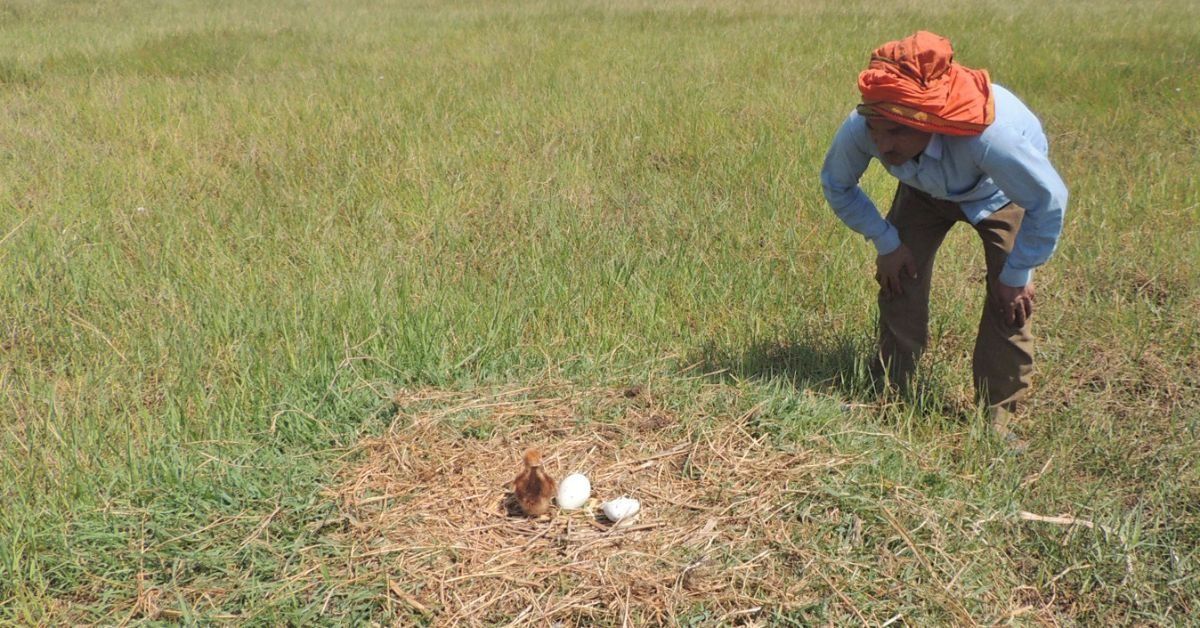
It wouldn’t be a stretch to say that the sarus cranes breeding in the wetlands of Pragpur village in Maharajganj district of Eastern Uttar Pradesh recognise farmer Rampreet’s melodies. For years, he’s protected the birds by keeping a close check on them, their nests, eggs, and chicks.
This mindset shift is commendable for Rampreet, who hails from a farming community that once viewed the sarus cranes as “pests” that caused a nuisance to their wheat and paddy.
But it’s not the bird’s fault. As wetlands have been widely drained or ‘reclaimed’ for agriculture and infrastructure, the birds have been pushed onto flooded croplands that mimic their natural habitat.
Over 95 percent of wetlands in Uttar Pradesh fall outside protected areas, and except for a handful, none of them have even been notified as wetlands under the Wetland (Conservation and Management) Rules, 2017. But the sarus cranes are adept at seeking out home.
And how does Rampreet identify them?
The birds are unmistakable with their grey plumage, long pink legs, and red head and upper neck, a stark contrast against the bright green of the wetlands. They are said to be the world’s tallest birds, reaching up to 152-156 cm in height.
The sarus crane is the state bird of Uttar Pradesh
Declared the state bird of Uttar Pradesh, and India’s only resident breeding crane, the bird’s declining population — the current population size is estimated at 15,000–20,000 mature individuals — set alarm bells ringing, compelling the Wildlife Trust of India to formulate a plan for the bird’s protection.
As Professor B C Choudhury, senior advisor at Wildlife Trust of India and principal investigator of the ‘Sarus Habitat Securement Project’, underscores in a documentary, Where the Sarus Sings, “If you declare a bird as a state bird, you need to do something for it. The fact that the sarus crane only lives outside protected areas, in the agricultural landscape, makes it mandatory for us to think of a novel plan by which we can take care of it.”
The most plausible explanation for the decline in numbers and shrinkage in their distribution seemed to be the destruction of the bird’s wetland habitat for infrastructure development and agricultural purposes, so much so that the bird was classified as ‘vulnerable’ by the IUCN (International Union for Conservation of Nature).
The sarus mitras measuring the nest diameters at nesting sites
As professor Choudhury explains, the sarus cranes are also caught in the crosshairs of changing cropping patterns. “The best population of sarus crane was in the Terai belt (stretching from Nepal’s Bagmati River in the East to India’s Yamuna River in the West). But, Terai, from a multi-species grass-dominated landscape, has become a single grass species landscape with sugarcane.” This, he reasons, has wedged out sarus crane habitats.
Where the sarus sings
Currently, approximately 100 water bodies in the 10 project districts in Eastern Uttar Pradesh have been identified as sarus-occupied wetlands. This is a breath of hope for the eastern part of the state, where spotting the bird was once tough.
This is a testament to the success of the Sarus Habitat Securement Project — an endeavour by Wildlife Trust of India in partnership with the Uttar Pradesh Forest Department and supported by Tata Trusts and World Land Trust.
The project spans 10 districts, mobilising the farmers towards wetland conservation by way of creating management committees that promote locals to stewards for the birds’ protection.
A sarus crane with its chick
Having led the project since 2013, Arshad Hussain from Wildlife Trust of India, says the goal was to show people how special the bird is. For the initial two years, Arshad focused on getting the lay of the land and understanding the birds’ patterns and habits. Only once he was familiar with this, he proceeded to heal the relationship between the birds and the farmers.
“The first thing we did was to sit down with the farmers in the region and understand their views of the bird. They asked us, ‘But why should we protect the sarus crane, when it destroys my paddy?’ Then we made them understand that protecting the bird wouldn’t just benefit it, but also them. We pointed out how the bird, while foraging through the soil, loosens the mud and how this increases the aerability of the soil. We explained how the sarus crane eats insects that would otherwise harm their crops and flowers, and prevent pollination.”
As Arshad would often reason with the farmers, “Think of it this way: When you are choosing a location to build your home, you would always pick the area that had all available resources, right? So when the sarus crane is choosing your field to nest, it’s an indicator that the field is a good ecosystem.”
According to ‘sarus census’ — a biannual estimation by the Wildlife Trust of India of the birds’ population across the 10 districts of Eastern Uttar Pradesh, currently there are 2,878 sarus cranes. Meanwhile, Wildlife Trust of India, under its Sarus Habitat Securement Project, has protected 237 sarus crane nests in the current breeding season.
Enabling a village to recognise its finest bird
Mukesh Chauhan from Bidauli village returns home and gives his mother the day’s debrief. “The ‘sarus’ bhaiyya(brother) had come to school today. They were telling us how we shouldn’t hurt the sarus or harm its eggs,” he tells her. She, in turn, tells her friends the same. The message keeps passing around.
This is exactly how the Sarus Protection Committees — currently there are 12 of these in Uttar Pradesh — ensure ripples of awareness. Each member of the committee heads into the wetland with a pair of binoculars, a digital camera, and a book on recognising Indian birds by ornithologist Salim Ali.
One of the members of the sarus protection committees measuring the nesting sites in the water
As Ravindra Tripathi, secretary of the Sarus Protection Committee, shares, “The awareness programmes in schools, the sit-downs with the elderly people of the village have caused people’s mindsets to shift. People have begun to recognise the sarus crane.”
Identified as sarus mitras(friends of the sarus crane), people like Ravindra and farmer Rampreet have pledged their allegiance to the bird.
As the Wildlife Trust of India explains, before 2019, the project focused primarily on conserving the sarus crane living in agricultural fields and wetlands outside protected areas. After 2019, however, its vision inclined towards securing the wetlands of Eastern Uttar Pradesh, which have a dual vantage; while serving as vital habitats for the species, they also form essential ecosystems that sustain biodiversity.
The protection of the wetlands is being done in collaboration with Uttar Pradesh State Wetland Authority (UPSWA).
In addition to this, the sarus mitrasconduct nest monitoring across the project districts to protect nests, chicks, and ensure an uptick in the population of the bird by keeping a check on poaching. This was supplemented with awareness sessions in schools, dialogues with farmer groups, and NGOs.
Today, any sighting of the bird evokes enthusiasm. “Now the farmers are so happy to see the birds in their field. They give us routine updates on bird sightings and hatching of the eggs,” Arshad says.
Gradually, through awareness models, the people of Eastern Uttar Pradesh have stopped viewing the sarus crane as a pest to be tackled, but instead as a novelty to be celebrated.
This story is part of a content series by The Better India and Wildlife Trust of India.
All pictures courtesy Wildlife Trust of India