World Cup
Despite some recognizable problems — local organizers initially struggled to raise money, hotel bookings lagged, and certain ticket costs soared — the tournament won over some of its sharpest critics, including Boston Globe columnist Bob Ryan.
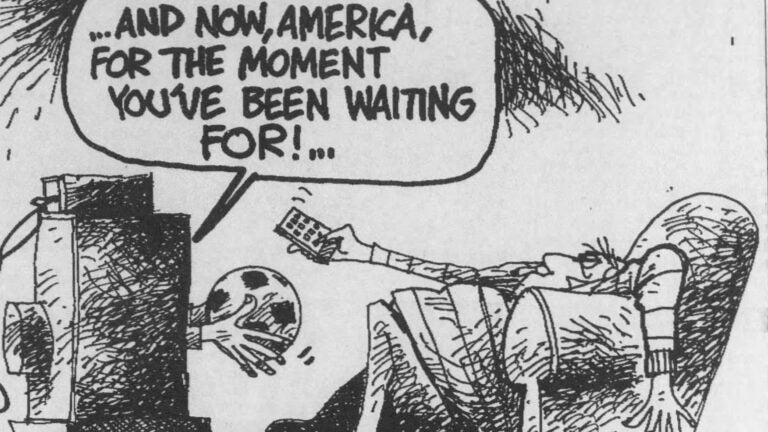
A Boston Globe illustration from the 1994 World Cup draw in Dec. 1993. Larry Johnson Illustration
May 20, 2026 | 9:25 AM
8 minutes to read
Surveying the rest of the world’s obsession with soccer following the World Cup draw in Dec. 1993, Boston Globe sportswriter Bob Ryan was unimpressed.
“If their sports menus are so bereft that soccer represents the main course, that’s their problem,” he wrote with characteristic certainty. “Here in America, we’ve got the greatest smorgasbord of sports entertainment to be found anywhere in the world, and we have relegated soccer to its rightful place.”
Ryan’s analysis of soccer, and the prevailing view of it in the United States at that time, may have felt like a warning sign flashing on the FIFA dashboard.
Yet the tournament ended up smashing attendance records, and produced indelible images that live on in international lore. On a more local level, the six World Cup games (four of which were in the first round, two in the knockout stage) offered many New Englanders their first chance to experience the global game at a truly elite level.
But beyond the broad strokes of memories and montages, what exactly was the local Boston-Foxborough setup like in 1994, and how does it compare with 2026?
What were the prices?
Unlike the 2026 edition, tickets for the 1994 World Cup were first rolled out more than a year in advance. And in another clear departure from the “dynamic pricing” model that has subsequently enveloped the American sports scene, tickets weren’t that expensive (at least initially).
When a smaller group of “priority list” fans got early access to tickets in January of 1993, prices were set at “about $25 apiece for each of the four first-round games and one second-round match,” per Frank Dell’Apa of The Boston Globe.
By February a more complete ticket price list had emerged. Just like the 2026 tournament, tickets were broken into “Categories,” with Category 1 being the most expensive, and Category 3 being the cheapest.
Prices varied by the stage of the tournament, but an individual ticket for a non-box seat to a first round game cost, at most, $65 (opening games cost $10 more).
The cheapest ticket was the Category 3 route, which cost just $25 (Category 2 was in between at $45). Even when calculated for inflation, these prices fall far short of the 2026 figures. The average ticket price was $58.
For example, the maximum $65 ticket purchases in Feb. 1993 equates to approximately $151 in 2026 terms. That’s similar to the pricing for FIFA’s Category 3 tickets when they were first put on sale in Oct. 2025. There is no comparison to the modern Category 2 and Category 1 prices (a majority of the seats), which initially cost $310 and $410, respectively.
The predictable result of affordable World Cup tickets was that they sold out “within five hours” when put on sale in June of 1993, according to Dell’Apa.
Granted, the cheaper prices were not a result of some earlier altruistic notion emanating from the hearts of World Cup planners. As Marla Messing, Executive Vice President on host committee for USA ’94 quipped in a recently released Vice TV documentary, “Soccer’s American Dream,” organizers were pleased with the sellouts but felt money had been left on the table.
“Alan was bummed that we didn’t charge higher prices,” Messing joked of U.S. Soccer president Alan Rothenberg.
Still, there was one familiar trait for those viewing it through the prism of 2026: Overly expensive VIP packages. After most of the regular seats sold out, they were all that was left on the market directly from FIFA. It drew skepticism from local reporters.
“All the US World Cup tickets have been sold, except for some premier seats,” wrote Globe columnist Will McDonough in July, 1993. “The Platinum Package, for a mere $10,000, includes a ticket to 10 games through the country, including Foxboro Stadium.”
“Such a deal,” McDonough sarcastically concluded after giving a full rundown on the various outrageously-priced packages.
What were the problems?
While Boston Soccer 2026 (the local organizing committee) has experienced a well-documented array of issues, their 1994 forerunners also went through a series of financial struggles.
“Boston Soccer ’94, the nonprofit organization credited with securing the bid, has not yet established a host committee and has failed to sell any regional sponsorships at $240,000 each,” Dell’Apa reported in March of 1993.
“Certainly I wish that we could raise more money faster,” Bob Caporale, Boston Soccer ’94’s chairman at that point, candidly admitted. A month later, it had secured $900,000 in financing from the Massachusetts Industrial Finance Agency (now MassDevelopment) to help with Foxboro Stadium renovations.
“Carporale says it isn’t true that MIFA made the loan because Boston Soccer couldn’t find a bank willing to do so,” wrote Globe reporter Joan Vennochi on April 28, 1993.
And just like their modern equivalents, the local organizers were accused of lagging behind other U.S. cities. In ’94, the lack of international friendlies at Foxboro Stadium in the buildup to the tournament drew negative reviews.
“Doubtless, there have been missed opportunities and many entities could be held accountable,” Dell’Apa observed in Sept. 1993. “The Boston Host Committee appears to lack imagination to initiate matches. But the final responsibility lies with the [United States Soccer Federation].”
While Boston Soccer ’94 eventually ran up a bill of more than $1.3 million, there was one major silver lining. Organizers in 1994 had greater access to a revenue pie that was less understood and less carved-up than it has become in the ensuing decades.
Rothenberg explained this in an April interview with The Guardian’s Matt Hughes, pointing out that the host nation was allowed to keep revenue from ticket sales and domestic commercial revenue (a concept which is no longer true in 2026).
“In 1994 FIFA retained the international marketing and TV rights, and then turned everything over to us,” he told Hughes. “We had all the responsibility, but we also had revenue opportunities from ticketing and selling sponsorships and licensing.”
The end result was that the tournament generated a surplus of almost $100 million, per a FIFA annual report following the ’94 tournament, with a portion of that getting shared with the hosts.
This contrasts with 2026, as Boston organizers have come to vividly understand.
“In this tournament the host committees have the responsibility to put on the matches, but have been given very, very limited revenue opportunities,” Rothenberg added. “So it’s been a real challenge for a lot of these host committees to get it all together and do it in a way that it won’t be a financial disaster.”
“It’s very difficult to fund-raise for major events like this and especially with FIFA’s restraints on intellectual property and branding,” said Boston Soccer 2026 chief Mike Loynd earlier this year, acknowledging Rothenberg’s point.
How did the games play out?
While “Boston Stadium” (as Gillette Stadium will be known in FIFA terms) is set to host seven games in the 2026 tournament, Foxboro Stadium held six games in 1994.
There were four group stage games:
- June 21: Argentina 4, Greece 0
- June 23: South Korea 0, Bolivia 0
- June 25: Argentina 2, Nigeria 1
- June 30: Nigeria 2, Greece 0
And two in the knockout round:
- July 5: Italy 2, Nigeria 1
- July 9: Italy 2, Spain 1
Of note was legendary Argentine superstar Diego Maradona, who scored his final international goal at Foxboro Stadium in the win over Greece. Maradona, having led his country to two straight World Cup Finals (including a win in 1986 that followed one of the greatest individual performances in tournament history) appeared to be finding his form at the perfect time.
His celebration after scoring against Greece — running up to the camera and shouting like a man possessed — was a lasting image.
Diego Maradona vs Greece, 1994. pic.twitter.com/ZJabBN4606
— 90s Football (@90sfootball) September 19, 2022
Maradona helped Argentina past Nigeria at Foxboro in their second game, 2-1, but was suspended afterward for a failed drug test. The exact nature of the failed test remains controversial, but the 33-year-old played no further part in the tournament. One of the most famous players in World Cup history exited its grand stage for the last time in Foxborough.
In the knockout round, Italy took center stage. Though the Italians lost their opener 1-0 to Ireland at Giants Stadium in one of the great upsets of the tournament, an experienced and decorated Italian roster calmly navigated their way around the initial defeat.
Roberto Baggio, the Italian playmaker nicknamed “Il Divin Codino” (The Divine Ponytail) due to his hairstyle, scored two late goals to push his team past Nigeria in the Round of 16.
Baggio again came through for the Italians in the quarterfinals, the last game of the tournament played in Foxborough. And despite a contentious game — Italian defender Mauro Tassotti was eventually suspended eight games for elbowing future PSG manager Luis Enrique in the face, breaking his nose — Italy held on to defeat Spain 2-1.
Roberto Baggio vs Spain, USA 94. pic.twitter.com/b3YqvKgAt3
— 90s Football (@90sfootball) December 21, 2024
Was it a success?
Gauging the local outcome of 1994 World Cup is a slightly mixed bag.
In purely financial terms, it again sounded a familiar note to the buildup in 2026.
As Globe reporter Jerry Ackerman explained in July of 1994, hotels hoped for greater returns in the knockout stage because “earlier matches delivered mixed returns.”
The following day, Ackerman noted that revenue projections for the Boston area as a result of direct tourist spending from hosting the tournament had been revised down by almost a third.
Subsequent economic impact studies of the 1994 World Cup have questioned how much the tournament brought to the region, and even if hosting it ultimately cost Boston money.
However the World Cup coming to New England had an impact on a budding soccer scene that is undeniable in 2026, and went beyond tangible financial measurements. Where there were no professional teams of any kind in the region prior to 1994, dozens have sprung up (with varying success) since then.
The cascading legacy of ’94 is all around New England’s soccer scene. Brian Bilello, president of the region’s MLS team (the Revolution, which along with the league was born out of the success of ’94), was an usher at Foxboro. He can be seen in the background of an iconic photo of Maradona celebrating his Argentina goal. His story is representative of a generation who saw professional soccer in some cases for the first time, and were hooked.
Arguably the most prominent win for the local scene in the 1994 World Cup was the unexpected conversion of one of its most ardent critics.
“By the time the Patriots play their first exhibition game, the World Cup trappings will be gone and it will seem a little dull around here. Foxborough will no longer be an international dateline,” wrote the Globe’s Bob Ryan after the end of Italy-Spain on July 9. He then delivered an admission that, by his own high sports standards, was incredible.
“OK, are you ready? I was wrong,” Ryan acknowledged. “I thought it would be sacrilegious to bring the World Cup to the United States, but I was in error.”
Taking a last look at USA ’94, he left the door open for the tournament’s inevitable return.
“The day may never come when we Americans will acquire a comparable passion for the game,” Ryan concluded, “but that doesn’t mean we can’t, or shouldn’t, once again offer our halls for hire.”
Hayden Bird is a sports staff writer for Boston.com, where he has worked since 2016. He covers all things sports in New England.
Sign up for the Today newsletter
Get everything you need to know to start your day, delivered right to your inbox every morning.