On the night of 14 January 2017, Makar Sankranti had drawn to a close in the villages near Pakhi Pahar, a forested hill range in West Bengal’s Purulia district. The sky was clear, the moon almost full, and the winter air carried a sharp edge. Joydeep Chakraborty sat beneath a kusum tree (Schleichera oleosa), waiting for a friend who had gone to buy snacks from a nearby shop. When the cold began to settle into his bones around 9.45 pm, he lit a small bonfire beside their camp and held his hands out to the warmth.
The forest had fallen into that familiar night-time rhythm of rustling leaves and distant insects when a sudden sound cut through it. A sharp, cackling howl rose from somewhere in the dark. Joydeep froze. The sound came again, shifting in pitch, neither a dog nor a jackal. He stood up, switched on his torch, and followed the direction of the call towards a dense patch of bushes.
For a brief moment, he sensed movement beyond the light’s reach. The animal called twice more and then slipped away. When he searched the ground, he found no footprints.
“That was the first time I heard a striped hyena in the wild,” Joydeep recalls. “I was scared. But that sound stayed with me.”
At the time, he returned to his camp with more questions than answers. He had been visiting Pakhi Pahar for years as a mountaineer. The hills were familiar terrain. Yet that night marked the beginning of a different relationship with the forest, one that would unfold slowly over the next decade.
A question that would not leave
In the days that followed, curiosity pushed him to look for information on striped hyenas in India. He expected to find detailed studies and field reports. Instead, he found very little, particularly from eastern India. What he did discover concerned their legal status. “Earlier in India, hyenas were listed under Schedule III,” he explains. “After the Wildlife (Protection) Act was amended in 2024, they were moved to Schedule I, alongside species like tigers, elephants, pangolins and vultures.”
Striped hyenas are protected under Schedule I of the Wildlife Act.
The shift reflected concern. Globally, the striped hyena population is estimated at fewer than 10,000 mature individuals. Despite their wide range across parts of Asia and Africa, they face habitat loss, fragmentation, and human conflict. “This animal plays a very important role,” Joydeep says. “It clears carcasses from dumping sites and helps reduce the spread of disease.”
The more he read, the more he realised how little attention the species received in his own region. That gap stayed with him. Soon after that winter night, work took him to South India. Yet even there, far from Purulia’s hills, he found himself thinking about the call he had heard. “I knew that when I returned, I wanted to do something,” he says.
Returning to the hills
He came back in 2018 with a clearer intention. From March that year, he began exploring the forests around Pakhi Pahar in earnest. He did not start with a research grant or institutional backing. Instead, he walked. Alongside a few tribal villagers who shared his curiosity, he covered long stretches of dry hills and forest paths, searching for signs of hyena presence. “For the next two years, I travelled mostly on foot, averaging about 25 kilometres a day,” he says. “I gathered information, but very little success was achieved.”
Field surveys began in 2018 with support from local villagers.
Those early years were defined more by effort than by results. Days passed without sightings. Tracks were faint or uncertain. Yet something else was taking shape during that time. The villages around Pakhi Pahar began to know him not as a visitor, but as someone who kept returning. People offered him water, meals, and a place to charge his equipment. Conversations that began casually deepened over time. “By that time, the tribal villages had accepted me very well,” he says. “I gradually became a part of them.”
Learning the forest from within
His connection to the region, in fact, went back further. In 2012, during one of his mountaineering trips, he had met Paresh Mahato, a Santhal tribal who lived with his family in a lone hut facing the hills. Paresh knew the forest in ways that maps could not capture. He showed Joydeep hidden paths and pointed out animal trails. Eventually, he led him to a hyena den tucked deep within the hills. “He invited me to their annual hunting festival, Sikari Utsav,” Joydeep recalls.
Local residents assist in tracking hyena movement across Purulia.
In May 2015, he camped with the community during the festival. Armed with spears, hunters used traditional traps. Any animal caught was killed, including hyenas. For Joydeep, it was a close look at a system shaped by generations of survival and tradition.
In August 2016, Paresh fell ill with recurring fever and stomach pain. Within a month, he passed away. “I lost everything with his sudden demise,” Joydeep says. “He was my only companion in the hills. I learnt so much from him.”
Trust-building in villages became central to conservation efforts.
After Paresh’s death, Joydeep continued visiting the forest. The terrain remained unchanged, but his understanding of it had deepened. He began to see how closely the lives of people and animals were tied together. Most families in the region depend on agriculture and livestock. Goats, in particular, serve as a primary source of income. When a hyena kills livestock, the loss is immediate and personal.
“When a hyena kills a goat, people chase it and kill it in retaliation,” Joydeep says. The response, he understood, came from fear and necessity. Yet he also saw its impact on a species already struggling to survive.
When livelihood and wildlife collide
One incident in particular stayed with him. “There was a pregnant female hyena,” he recalls. “She entered a house with her male companion and tried to lift a baby sleeping on a cot. Villagers attacked them with bamboo sticks. The female escaped. The male was killed.” He pauses before adding, “That pregnant hyena became my only hope.”
Between 2017 and 2021, he estimates that five to six hyenas were killed in his project area. Retaliation was one threat. Roads were another. Hyenas often feed on dogs killed in traffic collisions. While feeding at night, they are struck by speeding vehicles. “There is no specific research paper available for hyenas on this,” Joydeep clarifies. “But for wildlife in general, restricted movement increases the risk of inbreeding. The impact is similar.”
Mudit Kumar, Divisional Forest Officer of Kangsabati North, acknowledges the broader challenge. “Warning signs exist on highways, but more are required,” he says. “A formal population survey of striped hyenas in Purulia is still pending.”
The first sign of presence
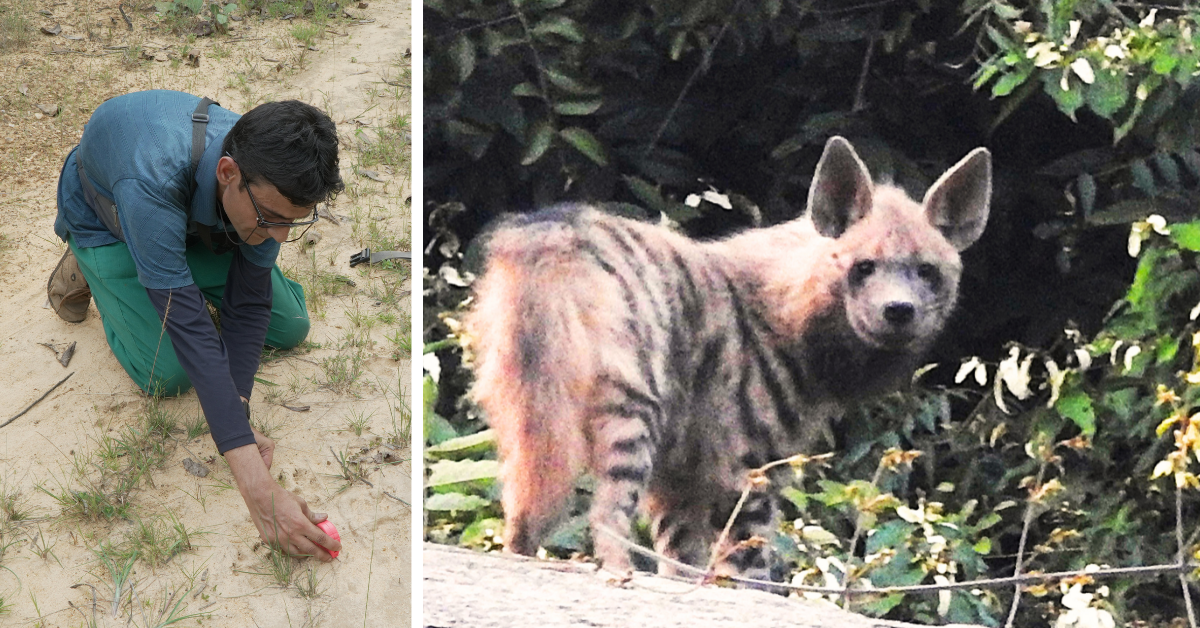
Amid these realities, 8 March 2020 brought a small but significant breakthrough. After nearly two years of walking and searching, Joydeep found the first footprint. “I got its footprint for the first time,” he says. It was proof that the animal he had been chasing through stories and faint trails was still there.
Confirmed hyena sightings followed years of forest tracking.
Two weeks later, on March 24, the nationwide lockdown began. Fieldwork stopped abruptly. Forest visits paused. The pause, however, did not undo what had already begun within the villages. By the time he resumed work, relationships had strengthened.
In February 2022, he captured the first hand-camera photograph of a striped hyena in the region. The image confirmed what the footprint had suggested. Around that time, he noticed another shift. Conversations with villagers had begun to change tone. Instead of focusing only on livestock loss, people were listening when he spoke about the hyena’s role in clearing carcasses and reducing disease. He explained how hyenas recycle calcium by consuming bones and how feral dogs often cause greater livestock damage.
Bhakto Ranjan Sardar is among villagers who now safeguard hyenas.
Bhakto Ranjan Sardar from Baghmundi block remembers that transition. “We used to think large footprints belonged to tigers,” he says. “We would kill hyenas if we saw them near our huts. Joydeep-da explained their importance. Now we protect them.”
Mukesh Mahato echoes that change. “Joydeep-da kept visiting homes and talking to people. It took years for us to understand.”
Joydeep considers 2022 a milestone year. The shift did not happen overnight, but retaliatory killings reduced significantly around that time. The forest department, too, noticed improvements in protection and surveillance.
A new generation in the hills
In November 2021, before that broader shift became visible, the pregnant female hyena he had been tracking gave birth to three cubs. “Seeing them emerge from the den after four to five months was very special for me,” he says. The sight confirmed that the species was not only surviving, but breeding.
In May 2022, camera traps provided by Idea Wild were installed near the lair. A forest fire destroyed the first set. He returned and reinstalled them. He clarifies that the traps were not placed inside protected forest areas. “Installation of camera traps needs permission,” he says. “My permission is still in its final stage. So I use camera traps only on private land and properties inside and surrounding villages and near village water bodies.”
Camera evidence established regular hyena activity in the area.
When the footage was reviewed, it showed the mother and cubs joined by eight to ten more hyenas. Over the following years, additional sightings strengthened the picture. Two adult hyenas were spotted at different locations in February and March 2025.
Today, after nearly nine years of fieldwork, excluding the pandemic pause, Joydeep estimates that 18 to 19 hyenas inhabit his study area. There is still no official population data for the region. “ZSI conducted a survey on large carnivores, but the final report is still not available,” he says.
Joydeep works as an independent researcher. Dr Anindita Bhadra from IISER Kolkata serves as his research mentor. His scientific papers are under evaluation and will be published by Kalyani University. “I am seeking grants,” he says, “for the women who helped collect data.”
Breeding evidence in 2021 marked a key milestone in the study.
When he looks back at that winter night in 2017, he sees it as the beginning of a long conversation between himself, the forest, and the villages that live within it. The striped hyena, once heard as a distant and unsettling call, has become a shared responsibility. The change did not arrive dramatically. It grew through repeated visits, patient dialogue, and a willingness to stay.
The hills of Purulia still carry the same winter air and moonlit silence. Somewhere within them, a striped hyena may call again. This time, more people are listening.