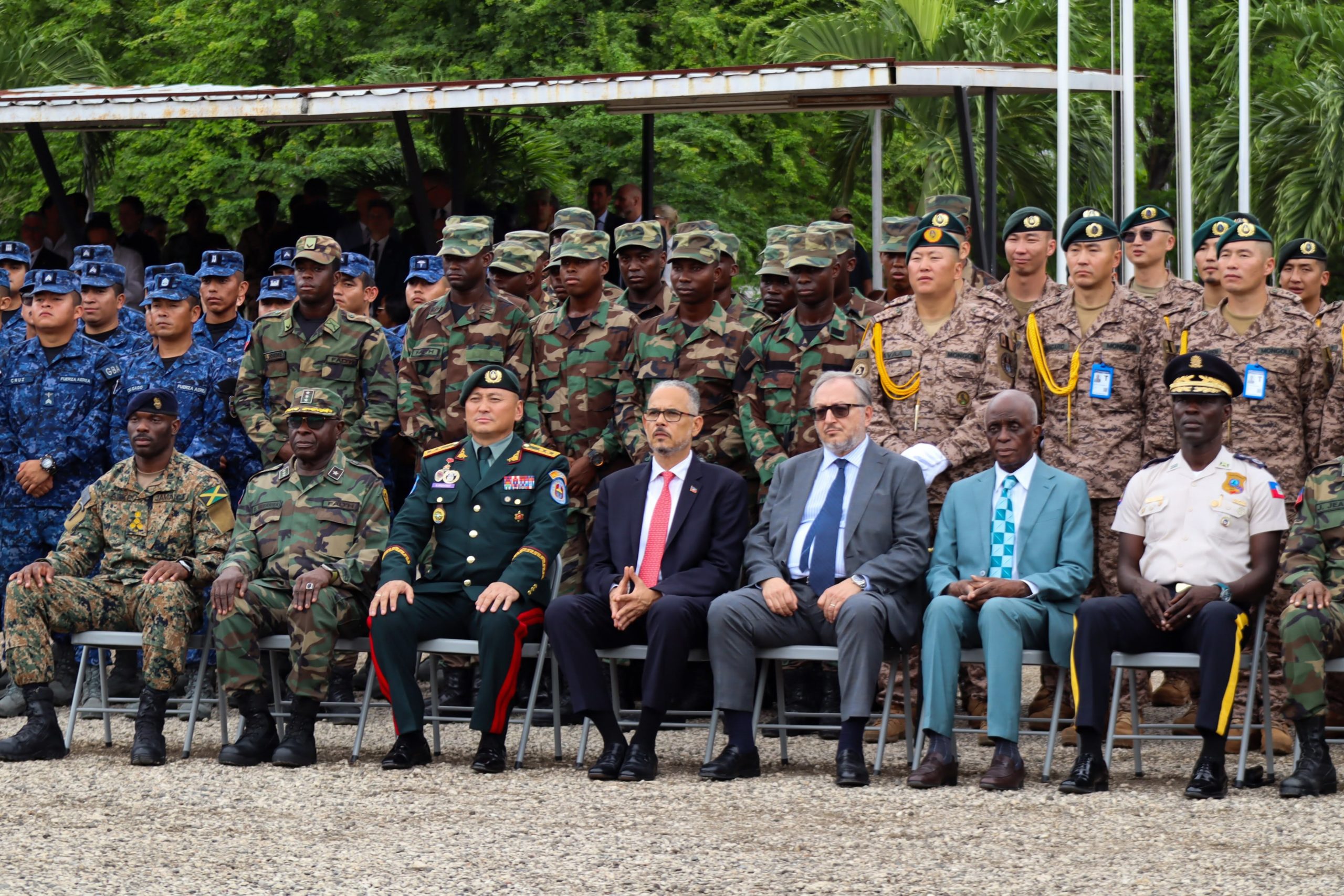
Haiti has officially launched a new phase of its fight against armed gangs, with Prime Minister Alix Didier Fils-Aimé leading a ceremony on October 8, 2026, at the Vertières military base in Tabarre.
The ceremony marked the operational launch of the Gang Repression Force (FRG), an international security mission established to support Haitian authorities in confronting armed groups, protecting civilians and restoring government control in areas affected by gang violence.
The launch comes as Haiti continues to face a serious security crisis, with armed groups controlling parts of the country and forcing families to leave their homes.
Prime Minister Calls for the State to Regain Control
During the flag-raising ceremony, Fils-Aimé said restoring security and government authority must remain a national priority.
“The state must regain control of its territory,” the prime minister declared.
He explained that the FRG’s mission includes helping Haitian security forces regain control of gang-held neighborhoods, protect residents and restore public order.
However, the prime minister also acknowledged that military and police operations alone would not resolve Haiti’s crisis.
He emphasized the need to reopen public institutions, restore access to justice and bring essential government services back to communities affected by violence.
According to Fils-Aimé, these steps are also necessary to create conditions for free, transparent and credible elections.
Six Countries Contributing to the Mission
The ceremony brought together Haitian government officials, members of the diplomatic community, United Nations representatives and representatives of six countries contributing personnel to the force.
The participating countries identified in the government’s announcement are Guatemala, El Salvador, Chad, Mongolia, Jamaica and Sri Lanka.
Members of Haiti’s Armed Forces (FAd’H) also attended the event.
Military demonstrations were held during the ceremony to highlight the capabilities of the international contingents.
The FRG is intended to operate alongside Haiti’s existing security institutions, including the Haitian National Police (PNH) and the Armed Forces of Haiti.
What Is the Gang Repression Force?
The Gang Repression Force, known internationally as the Gang Suppression Force (GSF), is a multinational security mission authorized by the United Nations Security Council.
It replaces the previous Multinational Security Support (MSS) mission, which began deploying to Haiti in June 2024 but faced shortages of personnel, equipment and funding.
The new force was authorized under UN Security Council Resolution 2793 in September 2025, with a broader mandate to conduct operations against armed gangs alongside Haitian security forces.
On September 29, 2026, the Security Council adopted Resolution 2829, extending the mission’s authorization until March 31, 2027.
The force is authorized to grow to approximately 5,500 personnel, although that number has not yet been reached.
As of late September, approximately 1,500 personnel were deployed, according to Reuters. Additional contingents are expected to arrive as the mission expands.
The mission’s military commander is Mongolian Major General Erdenebat Batsuuri, while Jack Christofides serves as the Special Representative overseeing the force.
What Happens Next?
The official launch is an important development in Haiti’s security response, but it does not mean that gang-controlled neighborhoods have already been recovered or that the country’s security crisis has been resolved.
The mission’s progress will depend on several factors, including the arrival of additional personnel, access to equipment and funding, cooperation with Haitian authorities and the ability to protect civilians during operations.
The force had already begun conducting security operations before the October 8 ceremony. According to its official website, GSF personnel carried out operations in Tabarre and Cité Soleil on October 5 and 6, reporting the seizure of weapons, the removal of barricades and the apprehension of suspected gang members. Those are the force’s reported operational results, not independently established measures of lasting security improvements.
For many Haitians, the most important question is what this new mission will change in their daily lives.
Families displaced by violence are waiting to return home. Communities need safe roads, functioning schools, access to hospitals and the ability to work without fear of armed attacks.
The government’s announcement marks the beginning of another stage in the international security effort. Whether that effort produces lasting improvements will depend on what happens after the ceremony.