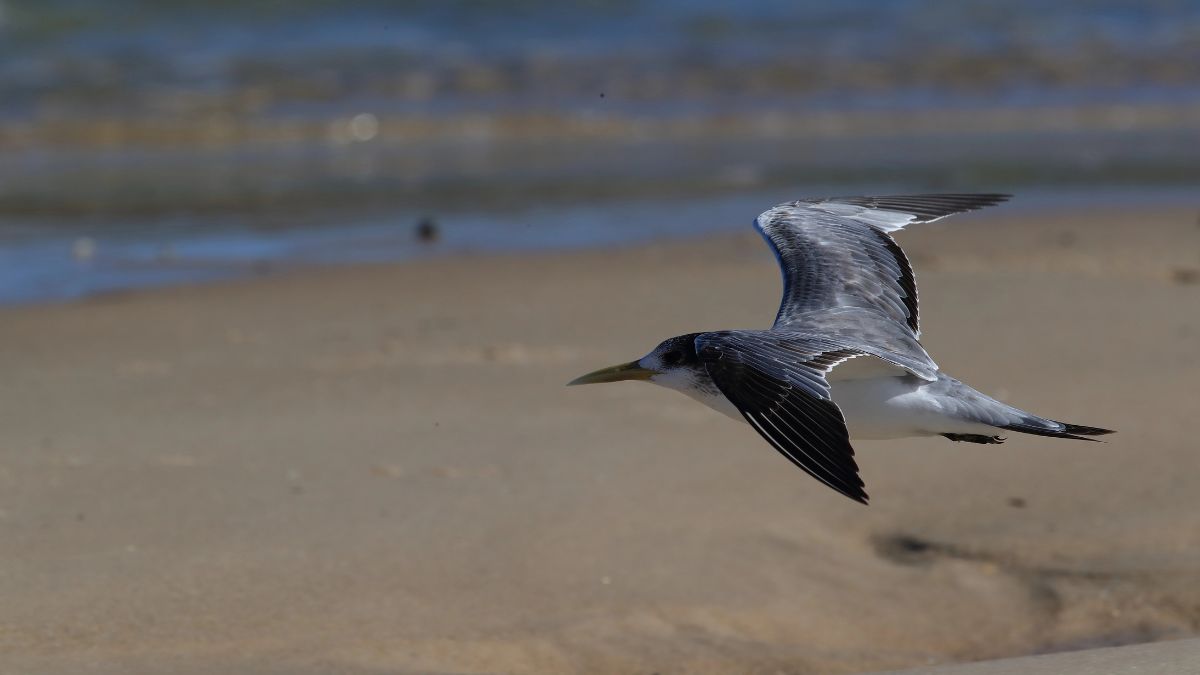
Image: Greater crested tern via Deposit Images.
H5 bird flu has been detected in a native Australian seabird for the first time, after a greater crested tern was found dead at Robe Marina in South Australia’s South East.
The bird was reported to the Emergency Animal Disease Hotline on Tuesday, July 7, and collected that same day.
Testing was undertaken at Gribbles at PIRSA’s Glenside facility and the CSIRO’s Australian Centre for Disease Preparedness, with results confirming H5 bird flu on Friday morning.
Authorities are treating the detection as an isolated incident, with no cases identified in poultry and no signs of mass wildlife deaths anywhere in Australia.
“This detection of H5 bird flu in an Australian seabird is unfortunate though not unexpected given we cannot control how birds mingle in the wild,” Minister for Primary Industries and Regional Development Clare Scriven said.
“The fact that we have located this single bird is a testament to the public, who have become our eyes across the state and are reporting to the EAD hotline at around 100 calls per day.”
Two giant petrels found at Emu Bay on Kangaroo Island and Port Vincent on Yorke Peninsula have also been confirmed as carrying H5 bird flu.
The results bring South Australia’s total to five confirmed cases, all involving wild seabirds.
The first four cases were recorded in giant petrels, which are migratory seabirds that occasionally visit Australia. The greater crested tern is the first native Australian seabird to return a positive result.
South Australian Chief Veterinary Officer Dr Skye Fruean said it was not possible to control the movement of wild birds entering and leaving the state.
“While it is assumed this bird mingled with migratory seabirds that had H5 bird flu on the coast or offshore islands, we can never know for sure,” Dr Fruean said.
“What is important is how we respond. The reporting of any sick or dead birds or other wildlife to our hotline is critical for us to understand how and where bird flu is entering South Australia.”
Surveillance is continuing across the state through helicopters, planes, drones and field crews.
The largest aerial survey of South Australia’s coastline in more than four decades was completed last week, covering almost 5,000 kilometres of coastline, islands and reefs. It found no evidence of widespread impacts from the virus.
A series of community information sessions will also be held across the state, beginning at Kingscote Town Hall on Thursday, July 16.
Further sessions will be held at Yorketown Town Hall on Wednesday, July 22, a metropolitan Adelaide venue yet to be confirmed on Monday, July 27, and the Port Parham Sports and Social Club at Dublin on Thursday, August 6.
People are being urged not to touch sick or dead birds or other wildlife.
Signs to watch for include multiple sick or dead birds in one location, weakness, an inability to stand or fly, unusual behaviour, swelling, discolouration or respiratory distress.
Anyone who finds sick or dead wildlife should avoid contact, record what they see and report it to the Emergency Animal Disease Hotline on 1800 675 888.
For more go to, https://pir.sa.gov.au/animal-management/animal-health/species/poultry/avian-influenza