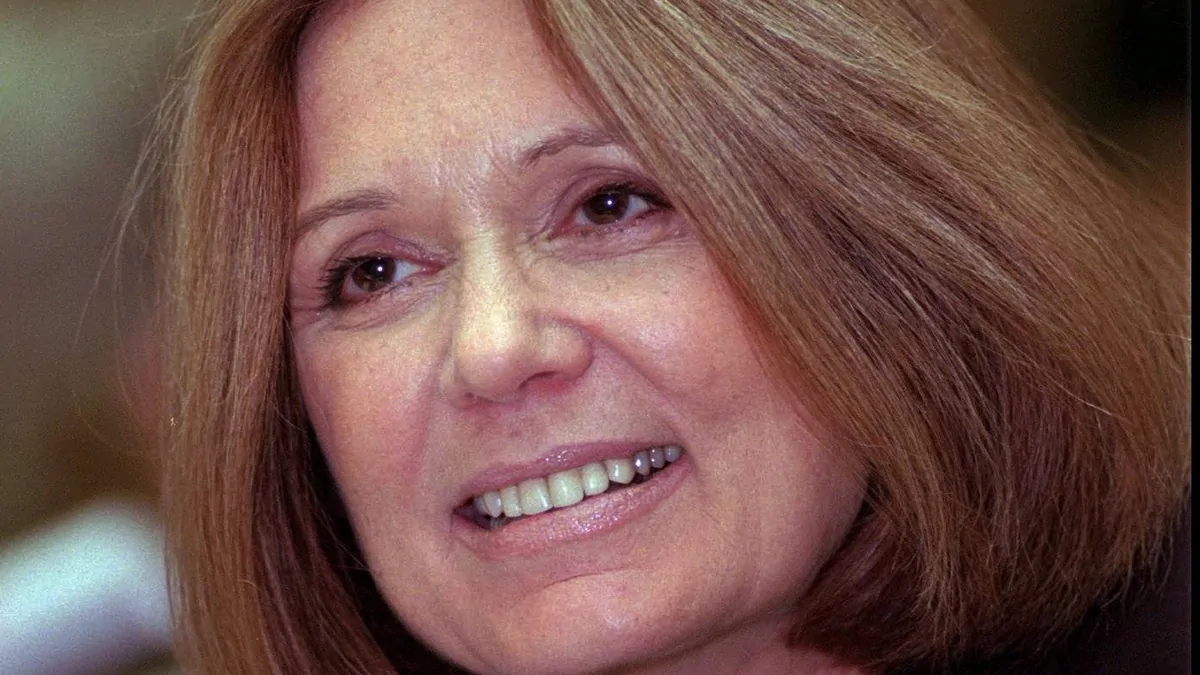
Gloria Steinem, the indefatigable feminist and journalist whose activism revolutionised the personal and professional lives of women, has died. She was 92.
Steinem “passed away peacefully at her home in New York City, surrounded by some of the many who loved her,” a post on her official Instagram page said Thursday. It added that she died on Wednesday, although it did not give a cause of death.
“Gloria’s near-century on earth were years well-lived, and she continued working for equality until the very end,” the post said.
Know the news with the 7NEWS app: Download today Arrow
She “lived true to her independent spirit, always with curiosity and a great sense of humour,” the statement added. It hailed her ability to welcome hundreds of guests into her living room for so-called “Talking Circles,” and was committed to using her home as a “centre for social justice movements.”
Her representatives asked her fans to light a candle in her honor and for donations to be made to her Gloria’s Foundation charity.
Steinem dedicated her life to causes ranging from reproductive freedom and domestic violence prevention to workplace gender inequalities.
Gloria Steinem of the National Organisation for Women attends an Equal Rights Amendment rally outside the White House on July 4, 1981, in Washington. Credit: PEC/APWomen’s liberation leader Gloria Steinem poses in New York City on May 3, 1974. Credit: XNBG AD/AP
She was the face of a movement that radically changed rights for women so they could eventually apply for credit cards without a man’s signature, be admitted to Ivy League schools that previously barred them and legally get an abortion in the United States.
A pioneer of the 1960s’ era of second-wave feminism, Steinem advocated for social issues as well as wrote about them.
Her first brush with national fame came in 1963, when she went undercover as a Playboy bunny and wrote an exposé about the poor working conditions that the servers in Hugh Hefner’s famed Playboy clubs endured.
Steinem earned some of the highest recognitions possible, including the Presidential Medal of Freedom, the nation’s top civilian honor.
But she came from humble beginnings — and had an unusual childhood.
‘Nobody would choose one if they didn’t have to.’
Born on March 25, 1934, in Toledo, Ohio, Steinem and her older sister, Susanne, spent much of their early years crisscrossing the country with their mother, Ruth, and their father, Leo, who brought the family with him for his job as a traveling antiques salesman.
Steinem did not attend school regularly until she was 11, after her parents divorced and she had moved back to Ohio with her mother.
Ruth Steinem had mental health problems, something Steinem has said deeply influenced her. Seeing doctors dismiss her mother’s needs contributed to her desire to get women more of a voice in society. And being forced to care for her mother deterred her from wanting children of her own.
“I’d already been the very small parent of a very big child — my mother,” she told People magazine in 1992. “I didn’t want to end up taking care of someone else.”
Members of the National Women’s Political Caucus. Credit: XMEH/APFeminist Gloria Steinem pets her cat in her New York apartment on March 18, 1970. Credit: XCJ AD/AP
In 1956, Steinem graduated from Smith College, the all-women’s liberal arts school in Massachusetts, with a degree in government — an uncommon major for women then. While overseas in London at age 22 after graduation, she discovered she was carrying an unwanted pregnancy.
“I had all the usual fantasies — maybe if I go horseback riding, maybe if I throw myself down the stairs,” she recalled to NPR in 2021.
Abortions were illegal at the time, but by “sheer luck,” she said, she found a physician who directed her to a doctor who was secretly doing abortions. She dedicated her 2015 memoir, “My Life on the Road,” to the doctor who referred her to the woman who performed her abortion.
Steinem’s abortion spurred her lifelong interest in reproductive rights, but she did not publicly reveal that she had had it until 1969.
In 2019, she told Al Jazeera it bothered her that the debate was framed as “pro-choice” versus “pro-life” and said no one is “pro” abortion.
“Nobody would choose one if they didn’t have to,” she said.
Steinem spent two years in India on a fellowship after she graduated college and later went to New York to pursue journalism, a field in which she struggled to be taken seriously as a woman.
Gloria Steinem attends A+E Network’s “HISTORYTalks: Leadership and Legacy” at Carnegie Hall on Saturday, Feb. 29, 2020, in New York. Credit: EA/APHonoree Gloria Steinem poses at Equality Now’s “Make Equality Reality” event at the Montage Hotel on Monday, Nov. 3, 2014, in Beverly Hills, Calif. Credit: CP SAH**NY**/AP
It wasn’t until her blockbuster piece on Playboy bunnies was published in 1963 in Show magazine that she gained recognition.
For the two-part exposé, written in diary form, Steinem assumed a fake identity and accepted a job for several weeks as a bunny. The women, she wrote, were expected to always “think about something happy” so they could put on a cheerful persona for their male clientele, even as their clubs demanded exorbitant portions of their tips and forced them to dress in skimpy outfits and heels so high, Steinem’s feet swelled and permanently expanded a half size.
In the following years, while growing her profile as a feminist activist, she helped launch two key magazines.
In 1968, she became a founding editor and political columnist for New York magazine. Her 1969 article “After Black Power, Women’s Liberation” cemented her place as a feminist icon.
‘Too pretty’ and other criticisms
In 1971, she co-founded Ms. magazine, which started as an insert in New York magazine before becoming its own standalone magazine the following year. In 1976, it became the first national publication to spotlight domestic violence on its cover.
As Steinem established herself as a leader in the fight for legalising abortion, for gender equality in the workplace, against child abuse and in other areas, she was not without controversy.
Some, including those in her own movement, felt she was “too pretty” for the feminist message she was trying to convey and that the 1970s miniskirts she would sometimes wear for her television interviews were working against her.
Gloria Steinem, Journalist and Activist talks during the Forbes 30/50 Summit at the Louvre Museum in Abu Dhabi, United Arab Emirates, Wednesday, March 8, 2023. Credit: Kamran Jebreili/AP Photo/Kamran JebreiliWriter and political activist, Gloria Steinem speaks to the crowd during the Women’s March on Washington, Saturday, Jan. 21, 2017 in Washington. Credit: JLM/AP
In 1992, she released a book entitled “Revolution From Within: A Book of Self-Esteem” that focused on personal development. The idea behind it, she explained, was that to effect change on a societal level, individuals need inner strength. But it was panned by some reviewers as a pivot away from activism instead.
In September 2020, while Donald Trump was president, Steinem spoke about how she handled criticism.
“The most painful criticism or attacks come from people who share your values, not people who don’t share your values,” she told The New York Times. “If Trump spoke well of me, I would shoot myself.”
Steinem cared deeply about politics, co-founding the National Women’s Political Caucus in 1971 to increase the number of female legislators.
‘Even if I live to 100, which I have every intention of doing, it’s not that long left.’
Little slowed her down, including a diagnosis of breast cancer at age 52. She was diagnosed early and able to treat it. She was 79 when former President Barack Obama awarded her the Presidential Medal of Freedom. Her life was depicted on-screen multiple times, including in “Mrs. America,” an FX miniseries that streamed on Hulu in 2020. She received numerous accolades in journalism, including the Lifetime Achievement in Journalism Award from the Society of Professional Journalists.
Steinem got married at age 66 to lawyer and entrepreneur David Bale, father of actor Christian Bale, in 2000. Many of her followers were surprised: Steinem had long dismissed marriage as an institution that ruined relationships.
Bale died of lymphoma three years after they wed. When later asked why she changed her mind about marriage, she told a reporter, “I didn’t change. Marriage changed.”
Feminist icon Gloria Steinem speaks, Thursday, Dec. 7, 2017, during the 13th annual Massachusetts Conference for Women, in Boston. Credit: SRS/APGloria Steinem, right, and her husband David Bale, left, arrive at the premiere of “Laurel Canyon” in Los Angeles, in this March 4, 2003. Credit: BMC JSZ DS/AP
“If I had married when I was supposed to get married, I would have lost my name, my legal residence, my credit rating, many of my civil rights,” she added. “That’s not true anymore. It’s possible to make an equal marriage.”
She told The New York Times that Bale helped her learn the importance of living in the moment and accomplishing what you set out to do.
“Even if I live to 100, which I have every intention of doing, it’s not that long left,” she told the paper in 2020. “I just hope that I don’t die saying, ‘But! Wait!’”
Major gaffe as Australia celebrates 125 years since flag first flown
2 min read
Premiership hero among three star Cats dropped for elimination final
1 min read