Local News
The town argues Kraft Sports is attempting to avoid contractual obligations by characterizing public safety reimbursements as unlawful licensing fees.
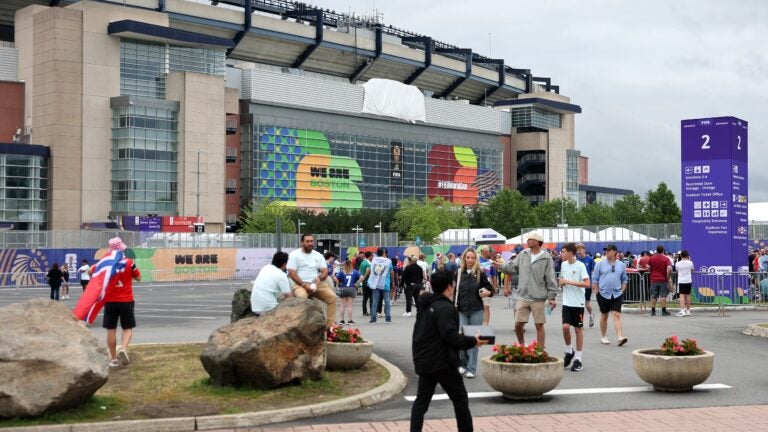
Outside Gillette Stadium before the World Cup Group I match between Norway and France on June 26. Mattia Ozbot/Getty Images
The town of Foxborough fired back after Kraft Sports & Entertainment and the New England Patriots filed a lawsuit against the town over new financial obligations tied to Gillette Stadium’s annual entertainment license.
On Tuesday, Foxborough announced it filed a 61-page answer and counterclaim asking a judge to dismiss the lawsuit, arguing the companies are “contractually bound” to pay the public safety costs associated with stadium events — expenses the town says should not fall on local taxpayers.
“These public safety services are uniquely required because of the scale and nature of the events held at the stadium and should not be borne by Foxborough taxpayers … Under its longstanding contract with the Town, the Plaintiffs are required to bear these expenses, a fact that the Plaintiffs failed to include within their underlying appeal,” the town said in a statement.
The counterclaim comes after Kraft Sports — along with co-plaintiffs New England Patriots LLC, Kraft Soccer LLC, and NPS LLC — sued the town June 15 in Norfolk Superior Court, accusing Foxborough of “repeatedly misusing its state-granted licensing authority unlawfully to extract funds” from the organizations that operate Gillette Stadium and its events.
According to the complaint, Foxborough used the stadium’s 2026 entertainment license renewal to impose roughly $1 million in new annual financial obligations, despite state law limiting entertainment license fees to $100.
-
Patriots, Kraft Group sue Foxborough over annual stadium licensing fees
Foxborough, however, argued the plaintiffs have “purposefully mischaracterized” the dispute. In its counterclaim, the town contends the payments are not unlawful licensing fees but reimbursements required under the parties’ longstanding lease agreement to cover the public safety services needed for large-scale events.
The town said it is “disappointed” to see the claims brought by the companies, as they “fail to recognize the extensive work” by Foxborough’s public safety teams, noting that more than 70 events are held at the stadium each year.
In the filing, Foxborough rejected most of the claims made by the Kraft Group and its co-plaintiffs. The town asserted that the corporations “willfully” confused state licensing regulations with their contractual requirements under the stadium lease.
“While the plaintiffs, a collection of multibillion-dollar corporations, would prefer to have Foxborough taxpayers bear these expenses, they are contractually bound to pay for the public safety services that are necessary to ensure safe and efficient events at their private venue,” the document states.
The town maintains that it “acted lawfully and appropriately in issuing the license and imposing conditions necessary to protect public health and safety.”
In the filing, Foxborough further denied the plaintiffs’ allegation that the town had presented the company “with an invoice for $953,640.” Foxborough stated it instead had issued its first invoice, a one-twelfth installment, under the terms of the entertainment license.
Foxborough’s counterclaim additionally argued that the lawsuit violated “implied covenant of good faith and fair dealing” by denying conditions agreed to their lease.
“As a result of such breach, the Town, the patrons of the stadium events and the tax-payers of Foxborough have suffered or will suffer harm which can only be remedied through specific performance of the obligations under the Lease and License,” the court filing states.
Along with asking the court to dismiss the complaint, Foxborough has requested that the court award the town “its costs, fees, and expenses in the defense of this matter due to the frivolity of the complaint and the plaintiffs’ lack of candor to this tribunal.”
“The Town remains committed to protecting both public safety and the interests of its residents while ensuring that events at Gillette Stadium can continue to be conducted safely and successfully,” Foxborough officials said. “The Town is also committed to ensuring that the owners of Gillette Stadium adhere to their obligations.”
A spokesperson for Kraft Sports did not respond Tuesday evening to a request for comment.
The legal battle marks the latest development in ongoing negotiations over entertainment licenses for Gillette Stadium.
Earlier this year, a disagreement over security expenses briefly raised questions about preparations for the 2026 FIFA World Cup, which is scheduled to bring one more match to Foxborough.
In March, members of Foxborough’s Select Board said they would not approve the entertainment license required for the matches unless the Kraft Group agreed to cover an estimated $7.8 million in public safety costs. The dispute was ultimately resolved after the Kraft Group agreed to cover the security costs, clearing the way for the World Cup matches to move forward.
Sign up for the Today newsletter
Get everything you need to know to start your day, delivered right to your inbox every morning.