

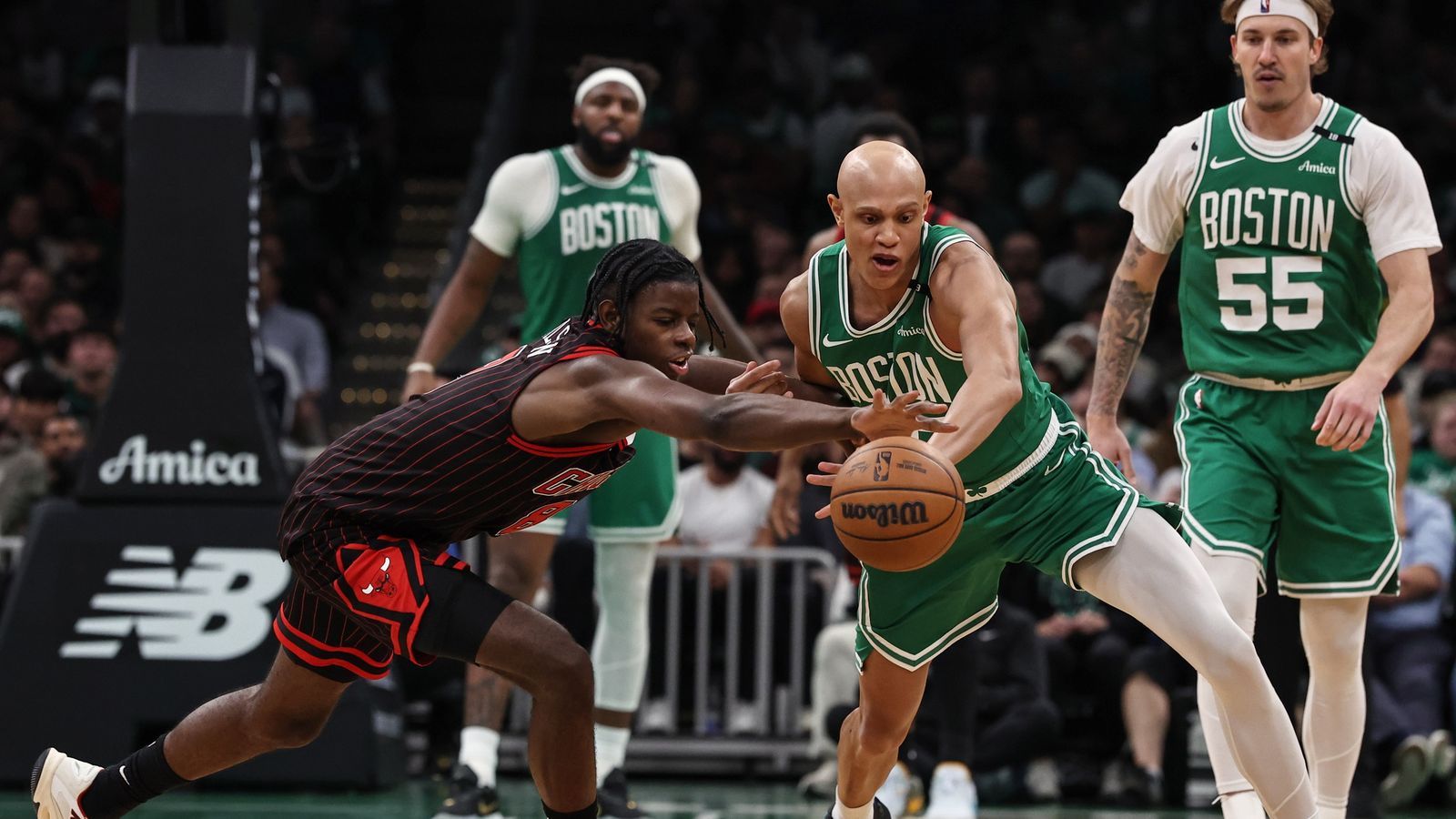
BOSTON — There has been plenty to talk about through the first few games of the Boston Celtics’ season. A disappointing loss to the Detroit Pistons on Opening Day. A big-time bounce-back win over the New York Knicks. And on Monday, a blowout win over the Chicago Bulls.
Jayson Tatum struggled in Detroit, then completely turned the tide against New York. On Monday, it was Payton Pritchard‘s show. His 19-point third quarter fueled a huge Boston victory.
Hugo Gonzalez played well against Chicago, Sam Hauser‘s 3-point shot has been unstoppable, and Paul George looks like if you threw the prime version of himself into a role-player Frankenstein machine.
The Celtics’ defense has been impressive. Outside of a rough second half in transition against the Pistons, it’s been as advertised. Boston is second in the league in deflections per game (20.7), second in opponent field goal percentage in the restricted area (56.6%), and third in opponent turnovers per game (20.0).
But flying under the radar is the Celtics’ offensive foul drawing. It pairs perfectly with their new, more aggressive style of defense.
Heading into the season, the NBA changed the way push-offs are called. Referees have been instructed to call more offensive fouls when a ball-handler pushes off a defensive player with his off-arm. But it seems like the refs are cracking down on illegal screens, too.
Through the first three games of the season, the Celtics have drawn 12 offensive fouls. Three teams have drawn 13 (Oklahoma City Thunder, Charlotte Hornets, and Memphis Grizzlies), and the Celtics are one of two to have drawn 12 so far (Utah Jazz).
So, how are the Celtics doing it? And at the same time, how can they avoid getting called for offensive fouls themselves?
“Just following the rules. Set good screens,” Joe Mazzulla said of avoiding offensive fouls. “Very important that we arrive there early. It’s a relationship between the ball handler and the screener, making sure we’re set, making sure we’re just following the rules that they’re having. And defensively, I think just being physical at the point of attack to where you can mess up their ball-handler-screener relationship.”
Avoiding offensive fouls is part of the challenge. Boston got called for five on Monday night alone. But so did Chicago. Boston is sprinting through screens, and it’s working.
The Celtics’ new defensive style involves a lot of ball pressure. Guys helping over to gun for steals is part of it, but the on-ball player also has to make sure to fight hard. And the quicker they chase after the ball-handler, the more likely they are to catch the screener off-guard.
“We’re trying to play pressure, and sometimes that occurs on the screener moving a bit of it, but we’re not trying to force nothing,” Gonzalez said. “Just trying to apply pressure to the ball and make them feel uncomfortable.”
Look at the way Baylor Scheierman defends this hand-off. His job is to stay glued to Norman Powell. He doesn’t want to give him any space. Scheierman also knows Wilson is coming to set a screen.
So, rather than trying to go around the screen, Scheierman beats Wilson to the spot. He gets to the spot of the screen before Wilson can get his feet set, so by the time the two collide, Scheierman is thrown off-kilter by an offensive player still in motion. That’s an offensive foul.
The same thing happens here. This time, it’s Payton Pritchard guarding Josh Giddey above the break. Watch what happens when Noa Essengue comes to set a screen.
Giddey goes too early, and once again, the defender beats the screener to the spot. Pritchard is with Giddey step for step. So, by the time Essengue gets there to set the screen, Pritchard is ready to run into him while he’s still moving.
Part of this is the Bulls. They don’t have good enough timing. It’s exactly what Mazzulla mentioned: The relationship between the ball-handler and the screen-setter.
Giddey went too early, so Essengue didn’t have time to set up a legal screen. Same with Powell and Wilson. But Boston’s hustle also factors in.
Watch Pritchard closely on this play. Ron Holland runs a handoff with Daniss Jenkins, and Pritchard has to get around the screen. Except the screen never happens.
I was in the building for this play. I watched the Pistons’ in-arena team show the replay to the Little Caesars Arena fans: Holland never actually made contact with Pritchard.
He went into the handoff intending to set a screen. But when he saw Pritchard beating him to the spot, he pulled out of it. It was too late.
Pritchard ran into the action as if he was going to get screened. And when he got near Holland, who was definitely not yet in a legal screening position, he sold it. He hustled to the spot to it looked like Holland clipped him. He didn’t.
Boston needs this type of hustle, too. It’s not always about beating a player to a spot. Sometimes, it’s about fighting through contact.
Here, Jordan Walsh is guarding Jalen Brunson, and Mikal Bridges goes to set a screen near half-court. Walsh sticks with Brunson stride for stride.
He doesn’t beat Bridges to the spot. But he fights over the screen so hard that Bridges throws a bit of extra shoulder into it. That causes Walsh to tumble, earning the offensive foul call.
Walsh could have slithered over the screen. He could have tried to get around it. Instead, he went through it. That hustle forced a Knicks turnover.
The Celtics are emphasizing these hustle plays on defense. Every offensive foul they draw — every illegal screen they force — is a huge win. Just look at the way the coaches react.
Here’s that Wilson offensive foul again. The one Scheierman drew. This time, instead of watching Scheierman, watch the Celtics’ bench. More specifically, watch the bench after Scheierman draws the foul.
A standing ovation. It starts with Matt Reynolds on the back left of the bench. Then DJ MacLeay stands up. Then, just as the camera cuts to Scheierman, you can see the entire back row of coaches begin to stand.
That happened all night. The coaches stood up. The players got amped. Whenever Boston drew an offensive foul, it was a party on the bench.
This hustle is a core piece of who the Celtics want to be as a team. It helps their possession-oriented goals, their defense, and their energy levels.
Drawing offensive fouls isn’t exactly the type of thing that would show up in a box score. But the Celtics are clearly tracking it. And the early returns have been impressive.
