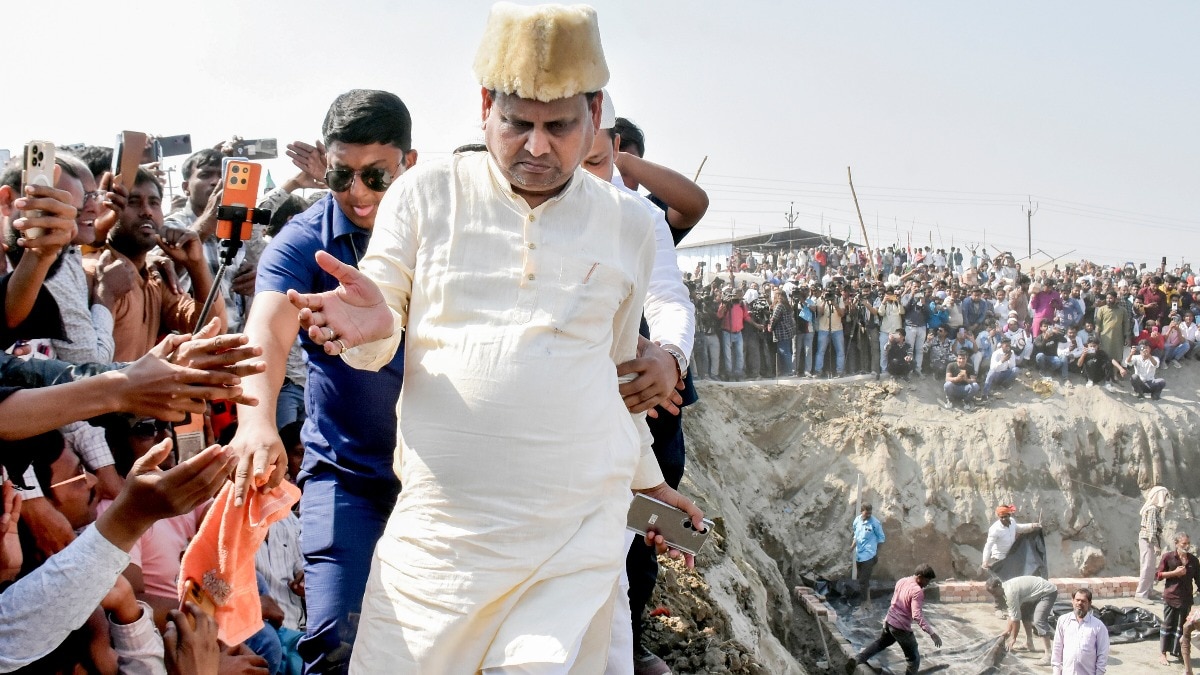
The new Suvendu Adhikari-led government in West Bengal is dealing with its first direct challenge, as Aam Janata Unnayan Party (AJUP) supremo and MLA Humayun Kabir has openly challenged the state government over qurbani, the ritual sacrifice during Eid al-Adha. Not just Kabir, Trinamool Congress MLA from Raghunathganj, Akhruzzaman, has also taken the matter to the Calcutta High Court.
As the state rolled out fresh guidelines restricting cow slaughter unless certain conditions are met, Kabir insisted that qurbani would continue regardless of objections or curbs.
However, Dilip Ghosh, BJP leader and West Bengal Animal Resources Development Minister, said that the government’s cattle slaughter rules shouldn’t be linked to Eid qurbani practices.
“There is no basis of linking cattle slaughter rules with Eid or religious practices like qurbani. If there is a custom… that has to be performed in adherence to the existing laws of the land,” Ghosh was quoted by The Times of India as saying.
Even as Kabir and Akhruzzaman took on the BJP over its restrictions on cow slaughter ahead of Eid, other senior Muslim leaders appealed to the community to refrain from purchasing and sacrificing cows this year.
Eid al-Adha will be celebrated on May 28 in India.
HUMAYAN KABIR SAYS QURBANI 1,400 YEARS OLD TRADITION, WILL CONTINUE
Speaking to news agency ANI, on Wednesday, Kabir said that the act of qurbani, which he described as dating back to 1,400 years, would keep on going regardless of any objections or regulatory directives.
“It’s a tradition that has been going on for 1,400 years and will continue as long as the world exists,” ANI quoted Kabir as saying about qurbani on Wednesday.
Kabir further asserted that while the government had the authority to regulate the consumption of beef as it saw fit, but it must not interfere in a long-standing religious practice dating back millennia. “The government can make a rule asking Muslims not to eat beef, but ritual sacrifice [qurbani] will continue. We won’t listen to any objections”.
A former Trinamool Congress MLA who previously served as a minister during the first Mamata Banerjee ministry, Kabir formed the AJUP after he was expelled from the Trinamool Congress in December 2025 after he proposed the construction of a Babri Masjid in Bengal.
In the 2026 Assembly polls in West Bengal, Kabir won both the seats he was contesting, those being Rejinagar and Naoda. He had previously stated he would be open to supporting the BJP in order to keep the TMC out of power in the event of a hung Assembly.
“If they [BJP] give me support to stop the TMC, I will support them from outside. If they support me from outside, I will not join them. I will not join TMC. I will join BJP,” Kabir had stated in February.
TMC MLA AKHRUZZAMAN APPROACHED CALCUTTA HIGH COURT
Kabir is not the only person opposed to this notice. TMC MLA Akhruzzaman moved a petition to the Calcutta High Court contending that the restrictions interfere with the religious practices associated with Eid-ul-Azha.
“Qurbani is a religious custom of Islam. During this time, the very cattle, whether cows or buffaloes, that one has reared are offered as a sacrifice to Allah,” he said.
While appearing before the court on Wednesday, TMC MP from Krishnanagar, Mahua Moitra, had argued that the notification restricting cow slaughter would inflict financial losses on economically weaker sections dependent on cattle rearing for livelihood.
“The notification issued by the State Government will result in financial loss for the poor people of the state. Poor people rear cattle with the expectation that selling them will provide some financial savings. However, the measures taken by the state administration will cause harm to the common people,” she submitted before the Bench.
On Thursday, the Calcutta High Court reserved its order on petitions challenging the Bengal government’s cattle slaughter restrictions ahead of Eid al-Adha.
Similarly, The Communist Party of India (Marxist–Leninist) also moved the Calcutta High Court seeking urgent judicial intervention against the state BJP government’s move to invoke the West Bengal Animal Slaughter Control Act, 1950, arguing that the proposed restrictions would infringe upon the religious freedoms of the Muslim community and adversely impact the livelihoods of farmers and cattle traders, many of whom belong to the Hindu community.
MUSLIM LEADERS URGE COMMUNITY TO REFRAIN FROM COW SACRIFICE
Even as Humayun Kabir locks horns with the Suvendu Adhikari-led West Bengal government over qurbani restrictions, several Muslim clerics and community leaders have appealed to Muslims to refrain from cow sacrifice during Eid al-Adha this year.
The imam of Kolkata’s iconic Nakhoda Mosque, Maulana Mohammad Shafiq Qasmi, urged Muslims to avoid cow sacrifice out of respect for Hindu sentiments and argued that the West Bengal government’s latest notification has made the process extremely difficult in the absence of adequate infrastructure.
“If the government cannot provide the required infrastructure, then it should declare the cow the national animal while imposing a complete ban on its slaughter and beef exports,” Qasmi told PTI.
He said the government must first ensure proper slaughterhouses and veterinary facilities before enforcing such rules. “The government should build slaughterhouses in every area and ensure veterinary surgeons are available in every market,” he said.
Qasmi also stressed the need for communal harmony in a diverse society. “We appeal to our fellow Muslims, please do not perform cow sacrifice as it hurts the sentiments of our Hindu brothers,” he said, suggesting goats could be sacrificed instead.
A similar appeal was made by Pirzada Toha Siddiqui of Furfura Sharif, who urged Muslims not to buy cows for qurbani this year.
“No cow sacrifice this year; I appeal to everyone not to buy cows,” Siddiqui said, citing the BJP government’s strict guidelines on animal slaughter. He warned that following the new rules had made cow sacrifice a cumbersome process and said avoiding it would help prevent controversy or unrest during Eid al-Adha celebrations.
Siddiqui instead suggested offering goats or other permissible animals for qurbani. At the same time, he questioned why no action was taken against India’s large-scale beef export industry, noting that “India is the world’s second-largest exporter of beef”.
Former plaintiff in the Babri Masjid-Ram Janmabhoomi dispute case, Iqbal Ansari, also weighed in on the issue, saying Muslims should respect the cow because it is revered in Hinduism.
“We are Indian Muslims and the cow is called ‘Gaumata’. Muslims should respect cows. The government should declare it the national animal,” he said, adding that cow sacrifice should not be allowed as it hurts religious sentiments and creates social tensions.
Congress leader Husain Dalwai also appealed for sensitivity towards Hindu sentiments.
“If the sentiments of our Hindu brothers are hurt by cow slaughter, then I believe that we should not sacrifice cows. Because we live in this country together and respect each other’s religion,” Dalwai said, adding that goats could instead be sacrificed.
WHAT IS THE WEST BENGAL GOVERNMENT NOTICE BEING OPPOSED BY KABIR AND TMC
The BJP-led West Bengal government last week issued a notice reiterating that no cattle or buffalo can be slaughtered without a mandatory fitness certificate, citing provisions of the West Bengal Animal Slaughter Control Act, 1950, and a 2018 Calcutta High Court order.
Under the rules, the certificate can only be jointly issued by the Chairperson of a Municipality or the President of a Panchayat Samiti along with a government veterinary officer. Both must certify in writing that the animal is over 14 years old and no longer fit for work or breeding, or has become permanently incapacitated due to old age, injury, deformity, or any incurable disease.
The notice also bars slaughter in public places, allowing it only at municipal or government-designated slaughterhouses. Violations of the law can attract up to six months in jail, a fine of up to Rs 1,000, or both. Those denied a fitness certificate can appeal to the state government within 15 days.
– Ends
Published By:
Shounak Sanyal
Published On:
May 21, 2026 17:20 IST