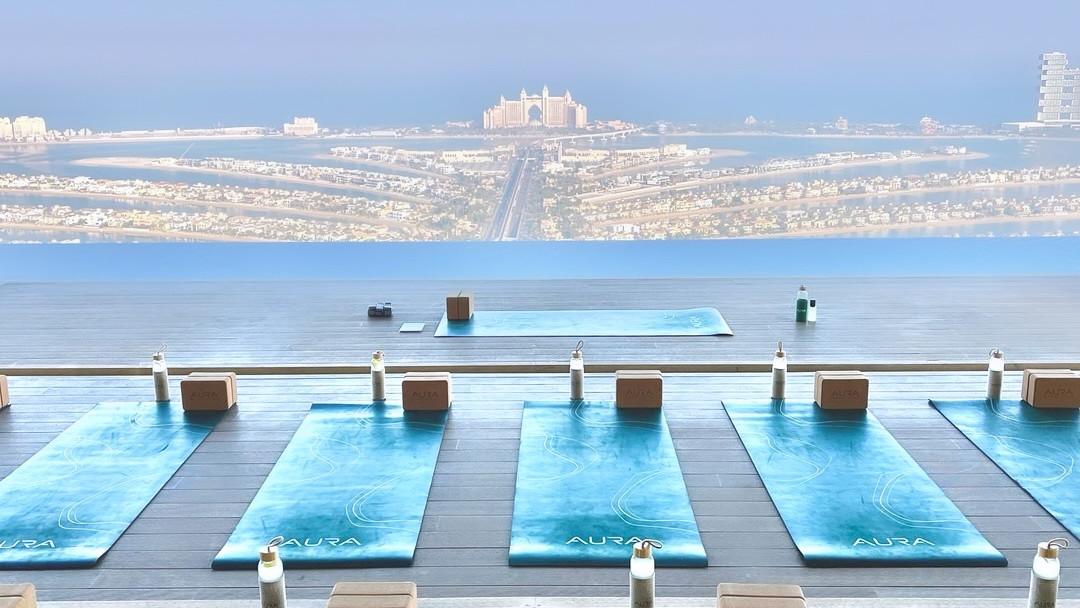
By 6.15am, the yoga mats on Aura Skypool’s terrace start to fill with lithe, lycra-clad bodies — just as the first sunlight peeps through Dubai’s skyscraper forest. Up on the 50th floor of The Palm Tower, the world’s highest 360 degree infinity pool is usually the kind of place with pumping dance music and thong-bikini’d hotties posing in cabanas beside that view. On Friday and Saturday mornings, however, the vinyasa brigade arrives.
But Aura is far from the city’s only glitzy hang-out with a virtuous second side. W Dubai – The Palm, a sleek five-star hotel shaped like a superyacht, regularly swaps pool parties for floating breathwork classes on padded li-los.
On Bluewaters Island, the glamorous La Cantine beach club hosts candlelit reiki meditation and Lagree Pilates classes overlooking the sea — the workout’s muscle-burning moves timed to coincide with the waves’ rhythm. Early on Sunday mornings, city-dwellers sweat it out on Al Qudra Cycle Track, an 50-mile road-biking route through the desert dunes, before gathering at Ripe Market to fill their tote bags with farm-fresh organic fruit and veg.
By 6.15am, the yoga mats on Aura Skypool’s terrace start to fill with lithe, lycra-clad bodies — just as the first sunlight peeps through Dubai’s skyscraper forest. Credit: Longjetivity.wellness.hub/Instagram
ROAM. Landing in your inbox weekly.
A digital-first travel magazine. Premium itineraries and adventures, practical information and exclusive offers for the discerning traveller.
By continuing you agree to our Terms and Privacy Policy.
“(Wellness) is what the younger generation is seeking, but also Gen X like me have turned our backs on hedonism and are seeking a healthier life,” the former Londoner explains.
Aura Skypool Credit: Longjevity.wellness.hub/Instagram
“With a young, affluent, international population, trends are always actively pursued here. Padel was super popular recently; prior to that, it was stand-up paddleboarding.”
Community-focused clubs are one of the city’s newest fascinations, with collectives such as Phame Club offering wellness-focused experiences with like-minded strangers — whether Pilates sessions, art classes or lifestyle talks.
W Dubai – The Palm, a sleek five-star hotel shaped like a superyacht, regularly swaps pool parties for floating breathwork classes on padded li-los. Credit: breasydxb/Instagram
“After years of chasing success, many of us are realising that true luxury is emotional stability and self-awareness,” says Russian-born co-founder, Odnorob Alena. “People — especially women — are becoming more international about how they spend their time.” I’ve also witnessed Dubai’s transformation up-close. When I moved to the city 23 years ago, weekends were all about hotel brunches: raucous all-dayers and ludicrously lavish buffets, usually costing around £100 per head.
They’d always — always — descend into chaos and a gruelling hangover. These days? Yes, you can still find the boozy ones, but brunch with friends is just as likely to involve matcha lattes and eggs royale in a trendy bistro; bonus points if you’re still sporting that post-yoga glow.
Cafe culture is booming in Dubai, with a healthy crop of independent and UAE-grown brands all over the city — such as East West Atelier, a serene, light-flooded hangout in Al Quoz, a former industrial district that’s now home to art galleries and design studios. And nearby Lila Molino, which serves Mexican tamales and tostadas beside Alserkal Avenue’s art exhibitions and indie cinema: another warehouse area turned cool design hub.
Venues like this lend themselves perfectly to phone-free meet-ups, another of Dubai’s wellness trends, says Nathalie Delande, who set up (Dis)connect Dubai, a “back to basics” community that gathers to “slow down and connect without screens” — choosing to crochet, read, paint or simply chat together instead.
“We (all) crave real experiences,” says Delande, who moved to the UAE from Belgium 13 years ago. “We disconnect from our phones to connect again with ourselves and with people around us, through creativity and presence.” On Saturday mornings in the cooler months, Alserkal’s cafes spill onto the pedestrianised streets. The scene is so laid-back, so wholesome, you could almost be in Scandinavia — were it not for the abundant winter sunshine.
Traffic-free zones used to be a rarity in Dubai, but not anymore: many of its newest residential projects have carless areas, while established neighbourhoods such as Al Karama and Al Fahidi will banish vehicles in coming years in a bid to reduce air pollution.
Coffee has, in fact, long been part of Emirati life. Cafe culture didn’t hit Europe until the 16th century, by which time the Gulf region had been swigging the good stuff for around 100 years.
In the UAE’s humble pre-oil days, locals would roast Arabica beans over open flames in their desert camps, serving small cups of slightly bitter, cardamom-infused gahwa. It’s still intrinsic to Emirati culture; you can try a cup at the Sheikh Mohammed Centre for Cultural Understanding and the Dubai Coffee Museum near Dubai Creek.
These days, coffee comes with an extra kick — whether a lion’s mane latte from Black Sheep Coffee in the Dubai Mall, which is infused with a supposedly brain-boosting mushroom powder, or a No Filter “coffee rave” with live DJs and surprisingly packed dancefloors. They’re entirely booze-free. “I thought people would just be connecting and talking (but) the energy (is) actually higher than what you see in a club,” organiser Shivam Grover told local nightlife magazine, What’s On. The music is thumping, the crowds are jumping – but the only shots are espressos.