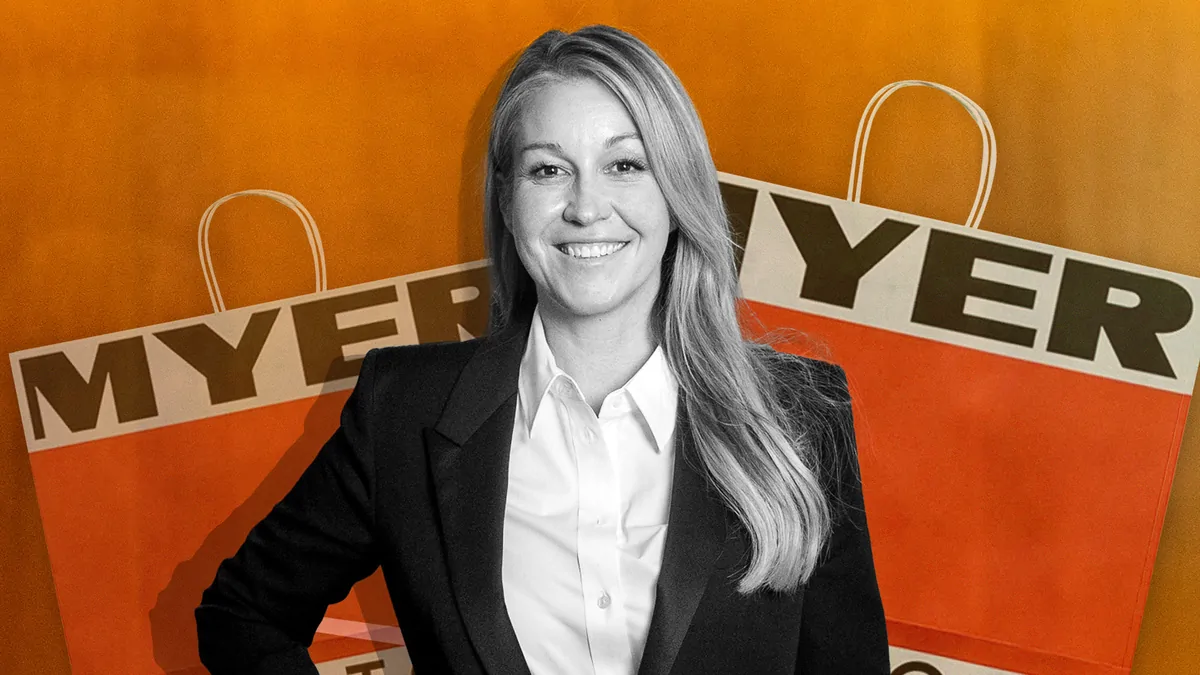
Myer boss Olivia Wirth says she has seen a sharp slowdown in trading as the perfect storm of higher fuel prices, rising interest rates and a cooling housing market force shoppers to keep their wallets shut.
The department store giant expects total sales for the 2026 financial year to be flat at about $4 billion.
Myer on Monday said trading over the past six months had been volatile, with sustained cost-of-living pressures driving consumer sentiment to its lowest levels in recent times.
Sign up to The Nightly’s newsletters.
Get the first look at the digital newspaper, curated daily stories and breaking headlines delivered to your inbox.
By continuing you agree to our Terms and Privacy Policy.
While sales surged in May, they slumped in June and July as the inflationary effects of higher fuel prices triggered by the Iran war, three interest rate hikes, slower household income growth, and a weaker housing market made consumers nervous.
It was also further compounded by a warmer-than-average start to winter.
Not even steep discounting and promotions were enough to lure in more shoppers.
Monday’s trading update showed showed a 5.5 per cent sales dive in June, followed by a 4 per cent slide in July.
Ms Wirth told investors the second half had been characterised by a volatile and significantly more challenging macroeconomic and retail environment than the first half, as well as the previous financial year.
She said while the retailer’s performance in the second half was “mixed”, it “observed a material downturn in consumer sentiment”.
“This was particularly evident in June and July, resulting in a subdued consumer and weak discretionary spending,” Ms Wirth said.
“While we remain cautious on the near-term consumer outlook, we are confident that the strategic actions we are taking today are strengthening the group’s competitive position, resilience and supporting the creation of long-term shareholder value.”
Ms Wirth has been overhauling Myer’s offerings, particularly in clothing and beauty, after conceding it needed to broaden its appeal to young shoppers.
Last year, it bought Just Jeans, Portmans, Dotti, Jay Jays and Jacqui E — collectively known as Apparel Brands — from billionaire Solomon Lew’s Premier Investments in a near-$1 billion deal.
Myer expects total sales for the year to July 25 to grow just 0.3 per cent to $4.09b. Adjusted for the Apparel Brands acquisition, total sales were up 11.3 per cent on an actual basis.
The department store said stronger sales in home, womenswear and children’s categories, as well as Just Jeans were offset by lower sales in beauty and the Portmans fashion brand.
Sales at Apparel Brands are expected to be down 1.3 per cent over the 2026 financial year, with comparable sales down 0.3 per cent.
Sales at Myer retail, the department stores division, rose 0.7 per cent, or one per cent on a comparable basis.
Myer said heavier promotional activities have “not been sufficient to offset weak underlying consumer spending”. Instead, it had hurt profits.
The retailer expects operating gross profit to fall by between 2.1 per cent and 2.5 per cent to around $1.6b, which it said reflected higher-than-planned promotional activity to stimulate demand.
Morgan Stanley analyst Melinda Baxter called out Myer among the retailers most exposed to a sharper slowdown.
It comes as department stores become increasingly challenged, both in Australia and abroad. Myer’s major rival David Jones slumped to a worsening pre-tax loss of $95.5m in 2025, compared with a loss of $74.1m in 2024.
Meanwhile, big US brands Saks Fifth Avenue and Neiman Marcus have also collapsed amid pressure from online giants.
Myer will release full-year results in September.