

Boston Bruins
“As long as I’m here, they will see the way. I’ll continue what guys before me built.”
COMMENTARY
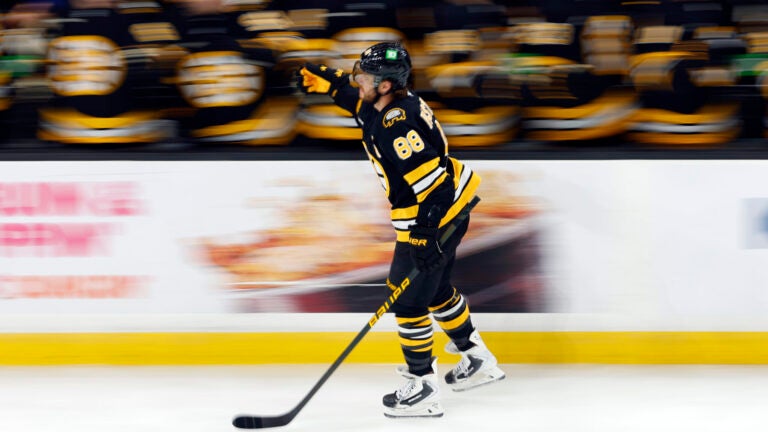
For all of the pomp rooted in the Bruins’ big announcement on Sunday, David Pastrnak made one thing abundantly clear at Warrior Ice Arena.
He might now have the “C” stitched on his sweater. But the Bruins’ star forward isn’t changing his approach — both on the ice as Boston’s top offensive conduit, and in the dressing room as the affable, light-hearted presence that draws in veterans and newcomers alike.
“Nothing is changing,” Pastrnak said. “We’ve been a group of leaders, always, when I’ve been here. Guys before me, they always had it as a group leadership and that’s not going to change, even if I’m captain. The reason [I’m] here is because of all those guys.
“We’re going to work as a team and make sure everyone feels comfortable and welcomed. Young guys, it doesn’t matter if you’re a rookie or a 10-year veteran, you’re always welcome here in this room whether you have a letter on or not.”
Pastrnak’s message on his first day as Bruins captain followed a similar script echoed by the likes of Zdeno Chara, Patrice Bergeron, and Brad Marchand.
But even Marco Sturm acknowledged on Sunday that Boston’s new captain isn’t exactly cut from the same cloth as some of the former franchise pillars who anchored the Bruins’ dressing room.
“He’s definitely not a Chara and not a Bergeron as a leader,” Boston’s bench boss said. “But that’s okay. I said that in the past. He’s a different kind of leader — very positive, always with a smile, always has an ear open for everyone.”
In some respects, Pastrnak doesn’t exactly fit the profile of the resolute, exacting monolith like a Chara, or the lead-by-example, unassuming stalwart like Bergeron — two captains whose demeanor and approach were interwoven with a Bruins franchise rooted in stingy, punishing play.
Pastrnak’s game doesn’t revolve around landing welts against opponents, nor will he be in the running for any Selkes.
In some respects, Pastrnak’s highlight-reel skillset, panache on the ice, and stylish suits away from the rink stand as a stark contrast to some of the hallmarks of the Bruins — although Derek Sanderson might have something to say over the latter when it comes to demerits for a deep wardrobe.
Pastrnak may not be Bergeron or Chara.
But for a Bruins team in the midst of a new era — and set to add several younger players into their lineup in the coming years — Pastrnak is the right choice for a Boston franchise that needs a fresh perspective, and a lot of new blood.
As an understudy of Chara, Bergeron, Marchand, and other veteran stalwarts like David Krejci, David Backes, and Nick Foligno, Pastrnak has had plenty of time to pick up pointers from those who came before him over his last 12 years in Boston.
Over that decade-plus of time spent with the Bruins, Pastrnak has had a front-row seat to “superheroes,” as he deemed it, who commanded Boston’s room.
With Chara, he learned firsthand the work ethic required to entrench yourself in the NHL ranks — and the dedicated need to assert oneself as one of the top players at hockey’s highest level.
In Bergeron, Pastrnak saw the merits of communication and empathy — praising his former centerman for his knack for reading the room and checking in on his teammates over the peaks and valleys of a long season.
And with Marchand, Pastrnak witnessed the importance of will — both to maintain one’s own high standard at this level, and to drag his teammates into the fight when needed.
The unifying theme between all three is an emphasis on the collective, rather than the individual.
It’s a sentiment that Pastrnak intends to carry over with a reworked leadership hierarchy — including Charlie McAvoy, Hampus Lindholm, and Nikita Zadorov.
“We play a team sport,” Pastrnak said. “Number one thing is you need a group, a good group of guys you are excited to come to work with and go to battle with every single day.
“The biggest thing for me is to make sure we are tight as a group and be pulling everybody on the same rope. In a team sport, you can’t win as an individual. You can’t even win with half the team. You need everybody to be on the same page.”
But the landscape across the NHL has changed in recent years — with speed and skill the most coveted commodity, younger skaters raising the collective ceilings of rosters, and players being more empowered than ever across the league.
It’s a shifting dynamic, one that a player like Pastrnak — who has married those lessons learned from franchise stalwarts with the same infectious enthusiasm he’s carried for over a decade — is apt to embrace.
“What I learned is everybody’s different, and everybody has to find their own way of leading, and you can’t try to be someone else. It doesn’t work in life,” Pastrnak said. “I’ve been grateful my whole career to be learning from some unbelievable hockey players and human beings. I couldn’t be more prepared for this and I’m really excited for the responsibility and challenge.”
As the Bruins welcome an influx of younger talent like James Hagens and others into the lineup, a player with Pastrnak’s gravitational pull — be it his playmaking wizardry on the ice or his energetic and engaging approach in the room — is a welcome sight.
The 30-year-old winger arguably played his best hockey last year on a “kid line” next to Fraser Minten and Marat Khusnutdinov — and it shouldn’t come as much of a surprise that he brought up Hagens ahead of practice last week to hone their craft together.
“It’s been awesome. It’s been so welcoming. To be in the locker room and have him pull me aside and say, ‘Hey, you want to go out and shoot some pucks,’ it’s something I’m grateful for,” Hagens said of Pastrnak’s gesture. “It’s great to be able to pick a guy’s brain. Everything he does, I can learn from.”
The Bruins know what they have in franchise fixtures like Pastrnak, McAvoy, and Jeremy Swayman.
It’s the development of Hagens, Minten, Dean Letourneau, and the rest of Boston’s next wave of talent that will determine whether or not this retool delivers — and a captain like Pastrnak seems ready to pull those youngsters along through the ups and downs.
But even if Pastrnak may not be as stone-faced as Chara, that doesn’t mean that Boston’s room will be far more lax — as evidenced by Boston’s new captain shredding into his teammates after a no-show performance in the playoffs last year against Buffalo.
“I have to tell you, it happens more than you think,” Sturm said of Pastrnak’s outburst. “I think for the fans, it was the first time actually seeing David like this…but I can tell you, Charlie McAvoy did the same thing and probably Zadorov.
“Everyone had their turn, for sure. But for me, this is leadership. Sometimes it means a lot to guys when it comes from a David or a Charlie instead of listening to me all the time yelling.”
The Bruins have plenty of work to do if they want to get back to the level of contention Pastrnak basked in for most of his first decade with this club.
Back then, Pastrnak was just the fresh-faced youngster tasked with peppering the net and pulling on the rope alongside a veteran core that propped open an extended contention window.
Pastrnak’s tasks on the ice remain the same as Boston’s top offensive conduit in 2026. And off the ice, the Bruins’ new captain is undeterred by the endeavor of cultivating Boston’s next core of talent.
He’s seen this story play out before, after all. Now, Pastrnak is ready to pen his own chapter.
“You have these types of human beings and hockey players to learn from, and that’s why I don’t worry about the young guys — because I know they are in great hands and we will continue to help them grow,” Pastrnak said. “Because we’ve been helped when we were young guys. … It’s important to make them feel comfortable and show them the way.
“As long as I’m here, they will see the way. I’ll continue what guys before me built.”

Sign up for the Today newsletter
Get everything you need to know to start your day, delivered right to your inbox every morning.
