Local News
“The last couple of weeks, we’ve been surprised,” one farmer said. “People are definitely coming out more to the farmers markets.”
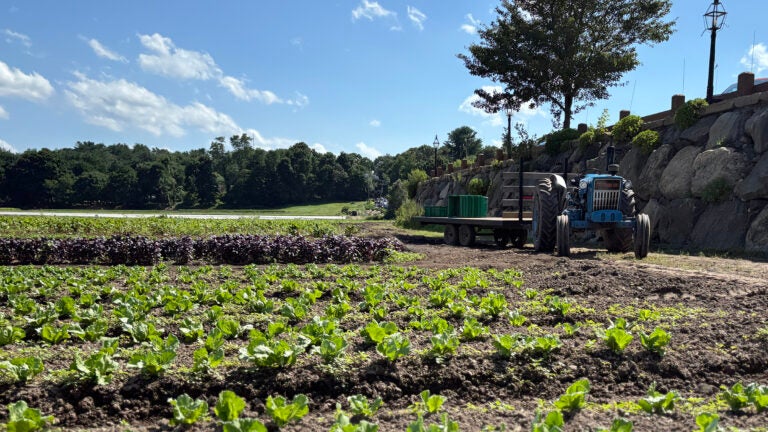
Lettuce fields at Wilson Farm in Lexington. (Photo courtesy of Wilson Farm)
July 31, 2026 | 8:55 AM
4 minutes to read
At Hutchins Farm in Concord, the lettuce is flying off the farm stand.
“Normally for the farm stand on an average day we’re picking 200 heads of lettuce to feed the farm stand, and now I’m like, oh, that’s not enough,” said Liza Bemis, a fifth-generation co-owner of the organic farm, which has been growing fruits and vegetables since 1973. “We have to be picking almost close to 300 heads of lettuce a day to feed the farm stand.”
A few miles away in Lexington, Lauren Wilson is fielding a different but related demand. Her phone is ringing more than usual, although her lettuce sales haven’t increased. The concern on her customers’ minds? Cyclospora.
“We have seen an incredible number of people calling about it and an incredible number of people coming in just to make sure that it is still our own lettuce,” Wilson, also a fifth-generation farmer, at Wilson Farm, said. “I would say people are nervous about both California and Mexico right now,” she added.
As a national cyclospora outbreak rattles shoppers, Massachusetts farms are seeing mixed effects: Some are selling more lettuce, others are fielding anxious questions, and some haven’t noticed much change at all.
The Centers for Disease Control and Prevention has logged more than 1,947 confirmed domestic cyclosporiasis cases since May 1, with a multistate cluster tied to iceberg lettuce from Taylor Farms de Mexico hitting Midwestern states hardest.
Massachusetts, however, has not been part of that outbreak. State health officials say the 18 cases reported here so far this year fall within the normal seasonal range.
For some Massachusetts farms, the gap between the national narrative and the local case count is translating directly into foot traffic.
At Kimballs Fruit Farm in Pepperell, which sells at eight farmers markets around the Boston area, co-owner David Wadleigh said the farm has seen “an increase in sales across the board” over the past few weeks, not just in lettuce, but in corn, zucchini, cucumbers and green beans. Markets that once sold out by the end of the day are now selling out early, he said, and the farm has had to add staff at its busier stops.
“The numbers are almost double what they were last month,” Wadleigh said, though he cautioned that June-to-July sales typically climb in New England regardless of outside factors. What stood out to him isn’t customers name-checking the outbreak — in fact, he said almost no one at the markets has mentioned it directly — but rather how much more product the farm has had to load onto its trucks to stock farmers markets.
“The last couple of weeks, we’ve been surprised,” he said. “People are definitely coming out more to the farmers markets.”
At Allandale Farm in Brookline, the surplus of harvest this time of year makes the cause of any bump hard to pin down. A spokesperson for Allandale Farm said in a statement to Boston.com that it’s difficult to know whether stronger demand is coming from cyclospora anxiety or simply from the arrival of corn, tomatoes, and other peak-summer crops.
Some especially worried customers have started buying only Allandale-grown produce, the farm said, and while questions about the outbreak came in heavily early on, it has tapered off as more coverage frames the outbreak as a large-scale agriculture problem rather than a risk tied to small local farms.
“We’re hoping that more folks use this as an opportunity to think about where their food comes from. We are all connected to each other, in a myriad of ways, especially in our food system. Shopping with local farms and politically supporting federal public health regulations are two very important ways we all can take care of each other,” the farm said in a statement.
Bemis has noticed something similar: an uptick in new faces and more frequent visits from regulars, on top of the lettuce surge. What’s struck her most, she said, is how differently customers are reacting compared with the E. coli-tainted spinach scare nearly two decades ago, when she said shoppers avoided an entire category of greens out of fear of the contamination.
“I’ve been happily surprised at their understanding that our lettuce is not the problem,” Bemis said. “That universally lettuce is not an issue. It has to do with supply chain stuff.”
She said customers have been asking more pointed questions about food safety and where, exactly, their produce travels before reaching the stand — something she said she’s glad to walk them through.
Not every farm is seeing a shift at all, though. At the Urban Farming Institute, a nonprofit that runs farm stands across Mattapan, Dorchester, and Roxbury, CEO Amber Valbrun said cyclospora rarely comes up with customers. The organization has welcomed dozens of first-time visitors in recent weeks — 30 one Friday, more than 40 the next — but Valbrun attributed the increase to word of mouth rather than cyclospora concerns.
“We actually don’t hear much about it at our farm, which is a good sign,” Valbrun said. “From what we have heard, it’s positive for us — that folks feel comfortable and excited to be able to come to our farm stand and feel that sense of security with what they’re purchasing.”
Back in Concord, Bemis said she’s glad the scare has pointed people toward a shorter, more visible supply chain. But she’s careful not to frame the outbreak as good news.
“This is a terrible thing that is happening, but I’m happy that people are finding us — that’s a silver lining for us,” she said. “But overall, it’s pretty awful. The whole problem is from consolidation in the food system, and that’s an awful thing.”
Annie Jonas is a Community writer at Boston.com. She was previously a local editor at Patch and a freelancer at the Financial Times.
Sign up for the Today newsletter
Get everything you need to know to start your day, delivered right to your inbox every morning.