Be thankful for the fight.
New Zealand’s Pureora Forest Park stands as a cathedral of green — vast, ancient, stirring, its wonder held not only in what stands before us, but in the knowledge that this vast wilderness once stood face-to-face with its own disappearance.
Ever since Europeans first settled in and around this volcanic hotspot around 150 years ago, loggers have been hard at work stripping away the timber riches clinging to the slopes of the Hauhungaroa Ranges, close to the core of New Zealand’s North Island.
By the 1970s, barely any of the virgin podocarp forest remained — galvanising three brothers into leading an environmentally charged campaign that would last for three years and enlist the support of world-renowned botanist, David Bellamy.
ROAM. Landing in your inbox weekly.
A digital-first travel magazine. Premium itineraries and adventures, practical information and exclusive offers for the discerning traveller.
By continuing you agree to our Terms and Privacy Policy.
We’re grateful that they did.
Our group of three mountain bikers, plus guide Lynley Twyman, has come to Pureora to ride among the same forests that those activists fought to protect. Had they not, we certainly wouldn’t be riding a route called the Timber Trail.
The 84km-long stretch — one of 23 Nga Haerenga Great Rides of New Zealand, with a 24th to open outside Queenstown later this year — follows machine-built single tracks and repurposed logging tramways as far as Ongarue.
Like all but a handful of the 15,000 mountain bikers who complete it annually, we plan on splitting the ride across two days.
Most do so using electric-powered mountain bikes. But at the trailhead on day one, we’re the only outliers — our decision to ride traditional bikes one that draws on the philosophy of greater efforts leading to greater rewards. Whether that’s true or not remains to be seen.
Our first test comes soon after setting off. After listening to chattering kaka parrots while weaving between epiphyte-laden matai and totara trees, we grind through the gears on the arduous climb up the northern slopes of Mt Pureora.
Will Shirer Credit: Will Shirer
By the time we reach the trail’s high point, just beneath the mountain’s 1135m summit, it’s comforting to know that the worst of the backbreaking work is behind us.
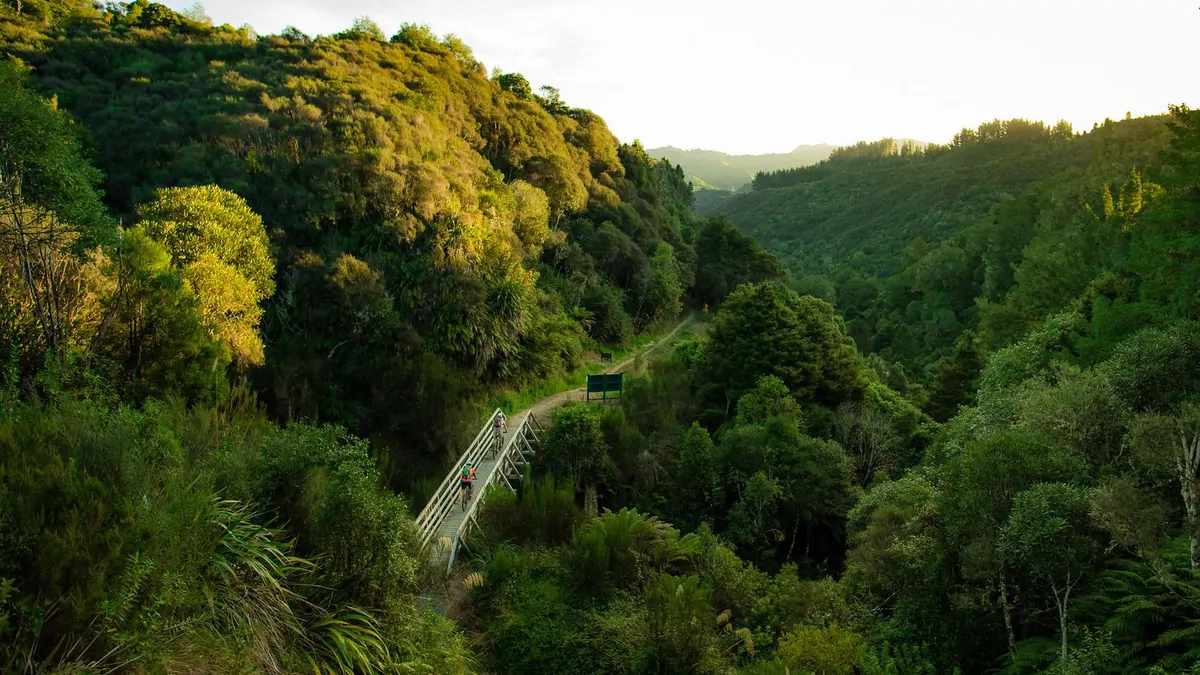
After pausing to catch our breath, glimpses of Lake Taupo appear through the foliage as we descend towards the first of eight suspension bridges along the trail.
Three of those bridges measure more than 100m long — all of them spanning stream-fed ravines that appear impenetrable.
Crossing each bridge becomes a test of nerves. The pull to look out and over the untouched wilderness is overwhelming, to the point of being distracting. Nevertheless, every sense of self-preservation tells us to keep our front wheel straight and to focus on the path ahead.
Many of the riders we’d seen at the trailhead have already settled in by the time we park our bikes outside the Timber Trail Lodge in Piropiro at the end of the day.
Owned by a consortium of 26 local investors who also operate the shuttle and bike hire service from Ongarue, the solar-powered lodge sleeps up to 45 who routinely gather together to swap tales over craft beers while a fireplace crackles in the background.
Communal dinners become opportunities to socialise with like-minded strangers — rooms configured across doubles and triples, some with shared bathrooms (separated male and female) and others ensuites. Importantly, all rooms are double glazed, carpeted and warmed via impressive heating.
One of the eight suspension bridges along the trail. Credit: Mark Daffey
Remnants of the trail’s origins materialise on our second day as we pedal through tramway cuttings and the world’s only rideable spiral tunnel — both designed to ease gradients for the bush tramways that transported logs to timber mills.
Our tyres rumble over half-buried timber sleepers and pass by a jigger turntable and abandoned worker’s huts. Fun, flowy descents thankfully outnumber uphill sectors that, while gentle, still leave pulses racing.
As we emerge from the forests into rolling dairy fields on the final approach to Ongarue, the thought of ending our ride is saddening.
Maybe that feeling is our reward, though. If so, it’s one we’ll happily accept.
Two-day ride including overnight accommodation and bike hire about $690 per person; timbertrail.nz; visitruapehu.com
The entrance to the tunnel on Ongarue Spiral. Credit: Will Shirer