Local News
ShotSpotter deploys a network of acoustic sensors that pick up the sounds of gunshots, but critics say it is unreliable and leads to the over-policing of communities of color.
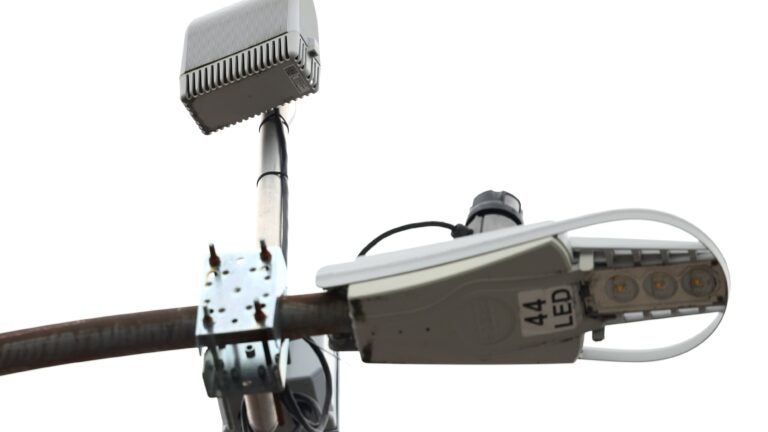
A view of what was thought to be a ShotSpotter device on a light pole in Somerville. Jessica Rinaldi/Globe Staff
The Cambridge City Council voted Monday to end the use of ShotSpotter devices throughout the city. The vote comes after years of debate over the benefits and potential risks associated with the technology, which listens for gunshots and quickly alerts the police if any are detected.
Five councilors voted to stop using ShotSpotter, while two opposed them and two others voted present during the council’s meeting this week.
With the vote, the council ordered the city manager and police officials to stop using ShotSpotter within 90 days. The contracts involving ShotSpotter will be terminated, and the devices themselves will be physically removed from locations around Cambridge.
ShotSpotter is a product offered by the company SoundThinking, which says its technology helps save lives, gets police to crime scenes quicker, and allows investigators to recover more evidence. It works by deploying a network of acoustic sensors high above streets that are designed to only pick up loud sounds that resemble gunshots. If three separate sensors detect a sound that could be gunshots, the system alerts authorities and determines where to send police.
The company did not immediately return a request for comment, but provided a statement to The Boston Globe saying that it was reviewing the implications of the council’s vote.
“SoundThinking is proud to have successfully served the Cambridge Police Department and the citizens of Cambridge with gunshot detection services since 2014,” the company said. “ShotSpotter is proven, unbiased technology that detects and alerts police to gunfire, enabling faster response, evidence collection, and lifesaving medical aid, all the while preserving privacy. We remain committed to working with communities, like Cambridge, that share our belief that every resident deserves those protections against gun violence.”
ShotSpotter’s Cambridge network is funded by grants from the Department of Homeland Security.
Those who wanted to get rid of ShotSpotter in Cambridge wrote in their resolution that the technology “has never been independently scientifically validated to be an accurate and reliable source of information.” They say that there is no evidence that ShotSpotter prevents crime, point to reports showing that it has a high rate of false positives, and say that it can be triggered by any loud noise, like a backfiring car.
They are also concerned that data collected by ShotSpotter devices could be used by the federal government to perpetuate an immigration enforcement agenda that is deeply unpopular in Cambridge. Critics highlight that SoundThinking runs a law enforcement information database known as CrimeTracer, which they say has historically been accessed by ICE and other federal agencies.
“It does pose a privacy and safety risk for residents, especially when the federal government has a relationship with the company and it’s not reliable. There was once a time, over a decade ago, where there was an interest in this technology, but now we know more about its effectiveness and its consequences,” Councilor Ayah Al-Zubi, a cosponsor of the resolution, said before the vote.
Councilor Jivan Sobrinho-Wheeler, another cosponsor of the resolution, said that ShotSpotter makes Cambridge less safe and voiced concerns about how it may contribute to over-policing in communities of color.
“We know that it misses many of the actual gunshots and it’s dangerously inaccurate, and sends police into communities of color when there are no gunshots, when there are firecrackers or other loud noises,” he said.
ShotSpotter became a political flashpoint in 2024, when lawmakers such as Sens. Ed Markey and Elizabeth Warren pushed for an investigation into the technology due to concerns about over-policing and potential civil rights violations.
At the meeting, both City Manager Yi-An Huang and acting Police Commissioner Pauline Wells advocated for keeping ShotSpotter. There have been at least 11 incidents where ShotSpotter detected gunshots in Cambridge but police did not receive a 911 call, Wells said.
“That means 11 moments when no one reached for the phone, 11 moments when officers would have no direction, 11 moments when seconds were slipping away and ShotSpotter was the only reason help was there at all,” Wells said.
The vote came just a week after a man opened fire on Memorial Drive in Cambridge, seriously injuring two people before he was subdued by a State Police trooper and a civilian. City officials said that the shooting occurred outside ShotSpotter’s range, and that the network did not notify police of the attack.
Although ShotSpotter did not catch the Memorial Drive shooting, proponents of the technology said that the violence highlights the fact that gun violence is an ongoing problem in Cambridge and authorities need every tool available to decrease it.
“Last Monday’s incident was a reminder that gun violence is something that can be extraordinarily random, that there are very dangerous weapons on our streets that are very easily accessible,” Huang said.
Ross Cristantiello
Ross Cristantiello, a general assignment news reporter for Boston.com since 2022, covers local politics, crime, the environment, and more.
Sign up for the Today newsletter
Get everything you need to know to start your day, delivered right to your inbox every morning.