

Transportation
The new curbside design is now scheduled to break ground in 2027.
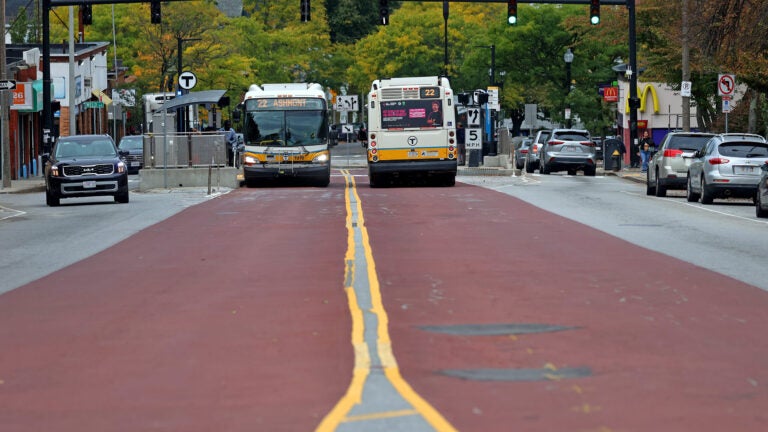
The City of Boston’s plans for an extension to the center-running bus lane along Columbus Avenue — the first of its kind in New England — are shifting to a more traditional curbside design, an MBTA spokesperson confirmed to Boston.com.
A key feature of center-running lanes is that they avoid conflict with stopped and double-parked vehicles blocking bus lanes. The city believes the curbside design can be successful along the mile-long stretch of road from Jackson Square to Ruggles because there’s “no reason to stop along the roadway,” the spokesperson wrote.
Southwest Corridor Park borders the west side of that stretch of road, the spokesperson wrote.
“Blocked bus stops are not a primary challenge. With very few curb cuts (driveways), a side-running bus lane can be very successful here,” the spokesperson wrote in an email to Boston.com.
But the change in long-standing plans is a concern for transportation advocates. This shift follows a series of abandoned plans for transit infrastructure from the city, including the removal of bus lanes in Seaport in 2024, from Boylston Street in February 2025, and from North Washington Street in July 2025.
Chris Friend, interim executive director of local public transportation advocacy group TransitMatters, said the group wants to see “fast, frequent, and reliable” buses.
“The infrastructure that they install to achieve that service is one tool,” Friend said to Boston.com. “We think that the center-running bus lanes are the most effective way to increase speeds and reliability.”
Phases I and II of Columbus Avenue
The curbside design is now a part of the second phase of the city’s Columbus Ave Transit Priority project. The first phase placed the region’s first center-running bus lane along a stretch of the road from Walnut Avenue to Jackson Square in 2021.
Phase I, a stretch that hugs the border of Roxbury and Jamaica Plain, has been a source of pride for the city, boasting improved reliability, frequency, and travel times.
The most recent analysis by the city, in spring 2025, found that riders traveling northbound during peak hours saved more than three minutes on average compared to before the installment, the spokesperson wrote. Riders traveling southbound during peak hours saw a marginal 38-second improvement during the average trip, according to the spokesperson.
Another analysis found a 10 percent reduction in speeding vehicles along the stretch, and 78 percent of riders said they were “satisfied” with the new bus lane.
Friend added that the buses that now use the center-running bus lane — the 22, 29, and 44 — did not appear on TransitMatters’ recent list of the slowest buses in the city.
Phase II of the project involves the part of Columbus Avenue that runs from Jackson Square to Ruggles Street.
The city was set to break ground in 2026, but the MBTA spokesperson wrote that work will now begin in 2027. Before then, however, the city will conduct community engagement and proceed to a “bidding process” for the project, the spokesperson wrote.
Blue Hill Avenue pushback
The change to Phase II of the Columbus Avenue project comes as pressure mounts against a similar project elsewhere in the city. Some residents in Roxbury, Mattapan, and Dorchester have vocally opposed a planned center-running bus lane along Blue Hill Avenue.
The $162 million plan to revamp Blue Hill Avenue has prompted pushback from some community, members, who say the project would worsen traffic and eliminate parking for local businesses.
The city, however, said the area is one of the most dangerous in the city, with a crash requiring EMS every three days on average, according to the city’s transportation action plan for the area. The buses along the corridor service 40,000 people daily, and riders could see improvements up to 15 minutes, according to the plan.
Some residents have started petitions and packed community feedback sessions to advocate against the Blue Hill Avenue project.
In July, Boston City Councilors Brian Worrell and Miniard Culpepper proposed extending the Orange Line as an alternative to the center-running bus lane — a long-shot project that could take 15 to 20 years to complete.
When asked whether the shift away from a center-running bus lane on Phase II of Columbus Avenue has any implications for Blue Hill Avenue, the MBTA spokesperson told Boston.com: “Public feedback is being considered at the moment.”

Sign up for the Today newsletter
Get everything you need to know to start your day, delivered right to your inbox every morning.
