


In the old Greek myth, Daedalus is the finest craftsman in Athens. Celebrated far and wide, he takes on his nephew, Talos, as an apprentice. The kid is a genius. Talos studies the spine of a fish and comes away with the idea for the saw, and it’s obvious to everyone, including his uncle, that he will eclipse his master. So Daedalus takes him up to the roof of the Acropolis and throws him off. Athens banishes him for it. He dies far from home.
The story is 3,000 years old, but something like it is playing out across Boston right now.
This past summer, on a patio just off Harrison Avenue, an electric violinist in a white sundress is playing Sisqó’s “Thong Song” over a Euro-disco beat. In the corner, a portrait artist paints anyone willing to sit still. Servers move through with crab claws dressed in shaved horseradish and yuzu petimezi, and Aegean wines have been flowing since the bar opened. Squint hard enough and the parking lot across the street goes away, and you could be on Paros.
But you’re not. This is XO—a play on exo, Greek for “outdoors”—the patio annex to South End hot spot Kaia, and the occasion is a midsummer influencer party, which is going more or less the way these things go: young people photographing their food, then the scene, then themselves inside the scene with the food. Working the room is Demetri Tsolakis, 43, shaved head, close beard, built like a guy who goes to the gym. He moves like a skilled politician—an audience for everyone, a specific recommendation about a specific mezze, a thank-you delivered like he means it.
Which he might. Tsolakis is riding high these days. Kaia is the newest restaurant in a portfolio that took seven years to build, and his Xenia Greek Hospitality is now among the most decorated Greek restaurant groups in the country. There’s the cocktail lounge Hecate; Greco, a fast-casual chain now at seven locations; Brookline’s Bar Vlaha, built on the mountain cuisine of northern Greece; and Krasi, a Back Bay mezze and wine bar. This magazine named Kaia Boston’s Best New Restaurant in 2025. The New York Times, Condé Nast Traveler, Time Out, and the Boston Globe have listed his spots among the best Greek restaurants in the city, the country, and in Kaia’s case, the world. Later this year, Tsolakis will open his 12th restaurant.
What’s not on the invitation, though, is that Tsolakis is being sued by the company of the man who helped bring him up in
the business.
That man is George Aboujaoude, owner of Committee, the Seaport restaurant where Tsolakis worked for the better part of a decade. The two were close once. Aboujaoude hired him young, promoted him, and lavished him with opportunity. When Aboujaoude got married, Tsolakis was there. “He was a very dear friend of mine,” Aboujaoude says now. “I considered him family.”
In March, though, the parent company of Committee, Pier 50, filed a lawsuit in Suffolk Superior Court alleging that Tsolakis spent nearly a decade draining Committee’s accounts to furnish the restaurants he was building on the side. Tsolakis denies all of it.
So it comes down to this: Either the former apprentice stole to build his empire, or the former master is suing to take a piece of it. Neither version is flattering. Only one is true.
Kaia. / Photo by Birch
Three weeks before the party, on the hottest day of the summer so far, Tsolakis sits down with me at a table next to Kaia’s large front window. The sun shines through the glass at an angle that cuts a perfect silhouette of the restaurant’s logo onto the white wall behind his head, and he swears he didn’t plan it. We settle in, and he proceeds to talk. And talk.
After all, talking is the business, he explains. He built the whole thing on philoxenia—the ancient Greek hospitality concept of treating strangers as friends—and it all starts with conversation. “I talk to strangers walking on the street,” he says, “strangers next to me on a plane, at a bar. I want to go everywhere and come back and tell stories.” He wants his managers doing it, too. “I love my managers to talk to guests, to tell them how something is prepared and where the dish is inspired from,” he says. And the subject is always Greece. “We’re telling the story of Greece in many different ways.”
But one story gets less airtime.
In the early 1990s, the Tsolakis family was living in Marlborough, Connecticut: Demetri; his father, George; his mother, Vasiliki; his older brother, Steve; and his younger brother, Nicholas. They were a restaurant family. George Tsolakis owned four Pizza Express locations in the Hartford suburbs. But George was in trouble. In 1991, state prosecutors charged him with writing bad checks, failing to pay state sales tax, and operating his pizza parlors without a sales tax permit, according to the Hartford Courant.
Then George disappeared. He was last seen on February 23, 1992, leaving a Greek-American club in Hartford. His red Fiat turned up almost a month later, in a parking lot at Foxwoods. He has never been found.
Tsolakis has a shorter version. “My father just never came home one night.” He believes his father was murdered, but no body was ever found, no one was ever charged, and George Tsolakis remains an open missing-person case.
After the disappearance, Tsolakis’s mother moved her boys to Springfield, Massachusetts, where her family ran a small chain of Greek restaurants “creatively named Mykonos I, Mykonos II, and Mykonos III,” Tsolakis says. It was in those dining rooms, working at his mother’s hip, that he got his first real taste of the business. He started out running the soda machine, a chatty kid pouring Pepsi products for amused customers, child labor laws be damned.
His mother worked long hours to keep them afloat, and the boys worked to keep up. “I grew up there, and I fell in love with hospitality,” Tsolakis says. “But more than that, I fell in love with taking care of family. We all worked so hard, and we all chipped in.” (Steve now runs operations for Greco; Demetri and his brothers recently bought their mother a house in Canton and relocated her east from Springfield.)
Tsolakis moved to Boston in 2001 to study business at Suffolk University. While he loved restaurants, he says his plan was to go into finance and “make a lot of money.” Still, he needed to pay for school. For that, he took a job promoting Aria, a nightclub in the Theater District.
He was still a teenager. Boston nightlife in those days was a small crowd, a few hundred people who all knew each other. Somewhere in there, he met a promoter nine years his senior. His name was George Aboujaoude.
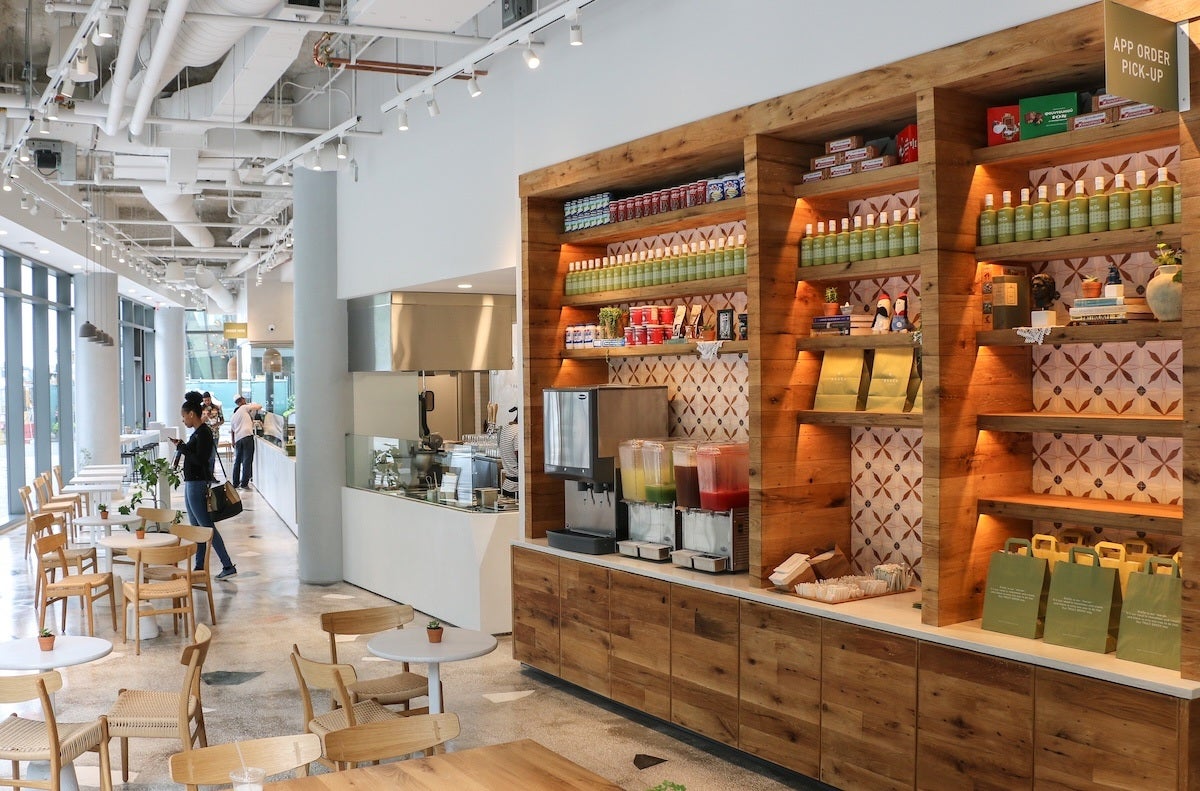
Greco. / Courtesy photo
Like Tsolakis, Aboujaoude was raised in the restaurant business. His parents and sister immigrated to Massachusetts from Lebanon in 1970, at the urging of his aunt, who was already running a Lebanese joint on Shawmut Avenue. By the time Aboujaoude was born in Boston two years later, his father had opened Cedars across the street. “My dad owned the building, so I lived there,” Aboujaoude says. “I was born there.”
Aboujaoude started off washing dishes, waiting tables, and learning the business from his father. He loved it. As he told the Globe in 2022, “There’s nothing better than getting a great compliment and seeing staff happy and seeing the kitchen happy.”
School went less well. A self-described poor student, Aboujaoude left college after his sophomore year while working across town in the Lansdowne Street clubs, then at their early-’90s peak. He started out as a promoter at Avalon, filling the room with the affluent young people he met at his day job selling suits at Armani on Newbury Street, he told the Behind the Rise podcast in 2024.
Eventually, the gig turned into a marketing job with the Lyons Group, which was running spots up and down Lansdowne Street at the time. He stayed roughly a decade, from his early twenties into his early thirties, and was popular with management. “I can’t even say enough good words about him,” says Michael Lyons, retired managing director of Lyons Group. “He’s a straight-up incredible individual: hardworking, sharp, very accommodating, one of the nicest men I know in this city.” Lyons still eats at Aboujaoude’s restaurants. In his time with the company, Aboujaoude learned how the club business worked: how to scale, and how to run several places at once without always being on-site.
In 2006, Aboujaoude was recruited as a managing director at Aria, the Theater District club where Tsolakis had promoted parties to pay his Suffolk tuition. Tsolakis was gone by then, but the two men would soon meet in the small world of Boston nightlife.
A year after that, a friend’s uncle bought a building on Newbury Street, and Aboujaoude invested 5 percent to open a restaurant there called Cafeteria. It was, Aboujaoude told the Behind the Rise podcast, perpetually in danger of closing. They had a great location and a great patio, he said, but no plan for the winter. When his initial partners tired of it, Aboujaoude assembled a new group of investors and purchased the business. He reorganized the place, and vowed to stop “leaving money on the table.”
That was the man who reached out to Tsolakis in 2008.
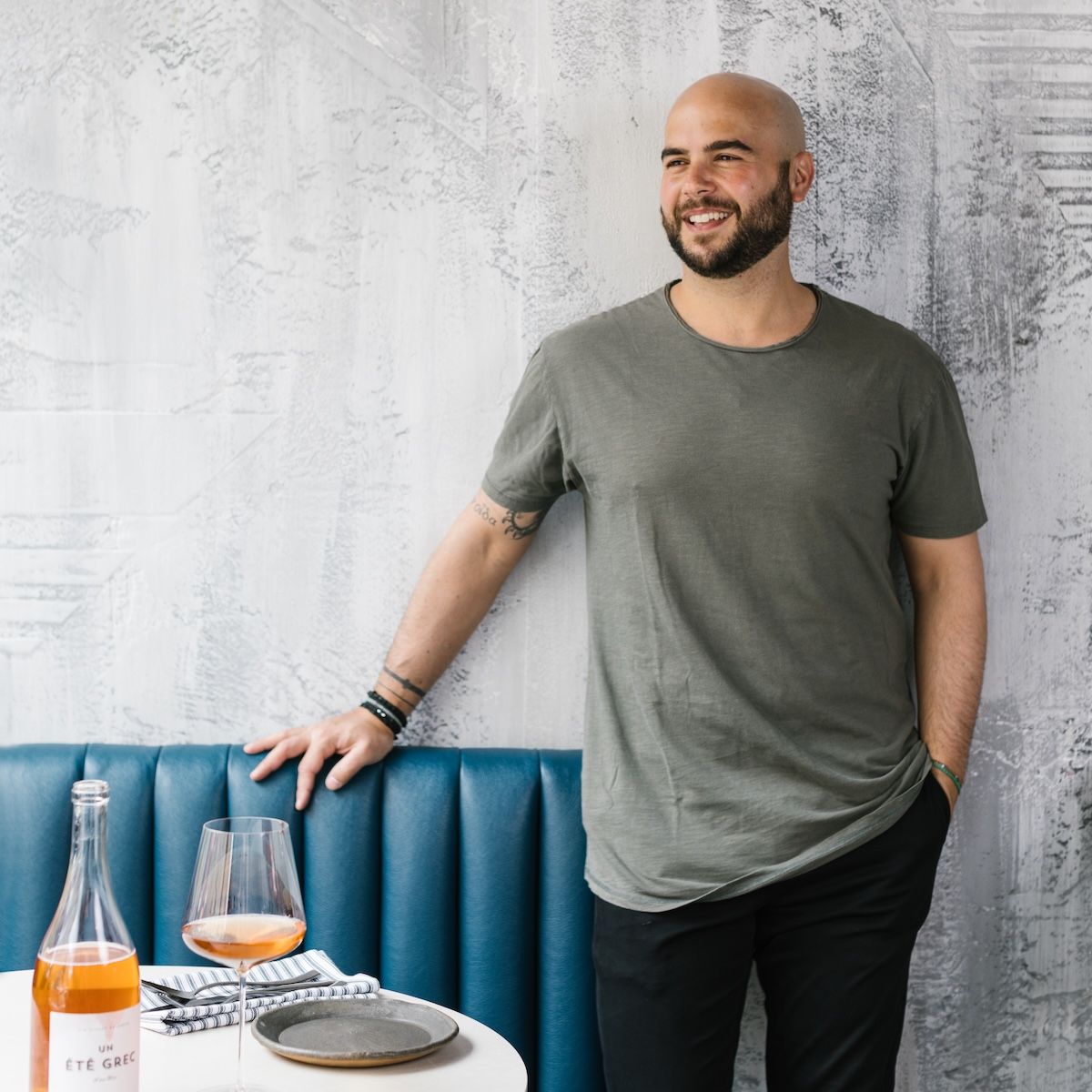
Demetri Tsolakis was once general manager of the Seaport hot spot Committee, owned by George Aboujaoude. Now, Tsolakis has a restaurant empire of his own, and is being sued by Aboujaoude’s company, which is accusing Tsolakis of misappropriating funds. / Photo by Linda Campos
After college, Tsolakis did exactly what he said he’d do—he took a client services job at Investors Bank & Trust and earned good money, which made his mother happy. Then, two years later, he heard the siren call of restaurants, succumbed, and began managing the now-defunct Downtown Crossing fusion spot Mantra. It was then that Aboujaoude got in touch.
Aboujaoude initially offered Tsolakis a job helping to open a glitzy nightclub called Bijou, Tsolakis says. The younger man signed on. But when that project suffered repeated delays, Aboujaoude moved him over to the struggling Cafeteria instead. There, Tsolakis took control. He oversaw a top-to-bottom rebrand that turned a “tablecloth” Italian pasta spot into the American brunch-lunch-and-dinner place its name implied, he says. It worked. The place was a hit.
Eventually, Tsolakis helped open Bijou as well. It debuted in 2011 with lines down the block, touring DJs, and athletes on the VIP list. The club was a smash, and it made Aboujaoude a titan of Boston nightlife. Tsolakis and Aboujaoude worked closely on both ventures. “George trusted Demetri with everything,” says Kayla Padilla, who worked with both men for more than a decade and eventually left to join Tsolakis at Xenia, where she is now chief human resources officer.
By 2014, Bijou and Cafeteria were packed, and both men were doing well. Aboujaoude married Kathryn Hamilton, a former Patriots cheerleader, and Tsolakis attended the wedding. Meanwhile, Tsolakis began looking ahead for their next venture. He knew it wouldn’t be another Bijou-style establishment. “[Nightclubs are] not my forte,” he says. “I’m not a big drinker. I’m not a big clubber.”
So when it came time to open a new concept in the Seaport, Tsolakis says he pushed for something “really Greek.” This was a long-shot bet in 2015. Greek food had not yet become what it is in Boston, and the area was still mostly parking lots. Anthony’s Pier 4 had just closed, and Empire and Strega were the only restaurants open in the neighborhood. But where others might have seen desolation and risk, Tsolakis and Aboujaoude saw opportunity. There was a lot of development in the pipeline, and they believed the neighborhood was about to take off.
Steering away from an all-Greek concept, they settled on a hybrid approach, mingling Greek and Mediterranean cuisines, and built the place around the cocktails-and-nightlife formula at which Aboujaoude excelled. Aboujaoude dubbed it Committee. It opened in June 2015. Tsolakis, who would go on to name his restaurants Krasi, Hecate, Bar Vlaha, and Kaia, says that while he pushed to bring Greek flavors to the Seaport, the name was not his idea. “Do you think I would call my Greek restaurant Committee?” he says now.
When Tsolakis set out to recruit a team, people thought the location was crazy. He asked Lou Charbonneau, a veteran of Sonsie, about coming to work at Committee. “I was like, ‘What the hell are you guys doing? The Seaport is a dirt lot,’” Charbonneau says. He passed. Later, he attended the soft opening and still didn’t think it would fly. “There’s this building, and then there’s an elevator shaft across the street, and everything else is barren,” he says. Nevertheless, Committee took off. Charbonneau laughs about it now. “I’ll definitely eat my hat,” he says. He signed on two years later. Today he’s Xenia’s beverage director.
Padilla, who had also followed Tsolakis over from Cafeteria, says Tsolakis and Aboujaoude “had a mutual trust.” They were building a brand, the staff was excellent, and the place was making money. “They were always friendly,” she says.
“Honestly, I had nothing but love for [Tsolakis],” Aboujaoude says. “My family had nothing but love for him. We always wished him the best.”
It didn’t last.
They made it a few years. Then it became clear the two men ran restaurants very differently. Tsolakis was high-energy—collaborative, restless, always building something. “There’s definitely nothing stagnant with Demetri,” Charbonneau says. “He’s got new ideas every 10 seconds and will tell you about all of them.” Brendan Pelley, who joined Tsolakis in 2022 as Xenia’s culinary director, puts it this way: “It’s always collaborative. It’s always ‘Let’s discuss.’”
Aboujaoude, according to Tsolakis, ran things another way. “If he saw good reviews and good profits, he was really hands-off,” Tsolakis says. But he also didn’t want anyone moving. The result, in Tsolakis’s telling, was a place where nobody grew.
Tsolakis says he remains grateful to his former boss—for the start, the introductions, and for one lesson in particular. “He really, really prized loyalty,” Tsolakis says. “He always instilled in me that having a loyal team will get you far. But, if you’re getting far, you also have to take them with you. You can’t just leave them behind.” When I asked Aboujaoude whether he recognizes loyalty as something he taught, he offered a one-word answer: “Yep.”
It’s a lesson Tsolakis took to heart.
In 2017, Tsolakis launched a restaurant of his own. The idea was Greek fast-casual street food. He built it on Newbury Street with a Committee bartender named Stefanos Ougrinis, and he called it Greco. Tsolakis was still working at Committee, and Aboujaoude came on as an early investor.
This is where the two men’s memories begin to diverge. Aboujaoude has described himself as a passive investor. Asked what he put in, he says he believes it was about $20,000. “I invested in Greco when he asked me,” Aboujaoude tells me, “before the first location had ever opened.” Tsolakis says he handed Aboujaoude shares as a courtesy. “I didn’t want to piss him off.… I gave him shares to appease him, and he was fine with it,” Tsolakis says, because he wanted to keep working at Committee. And he did. Greco became a success, and now has seven locations: four in Boston, one in Burlington, and two in Washington, DC.
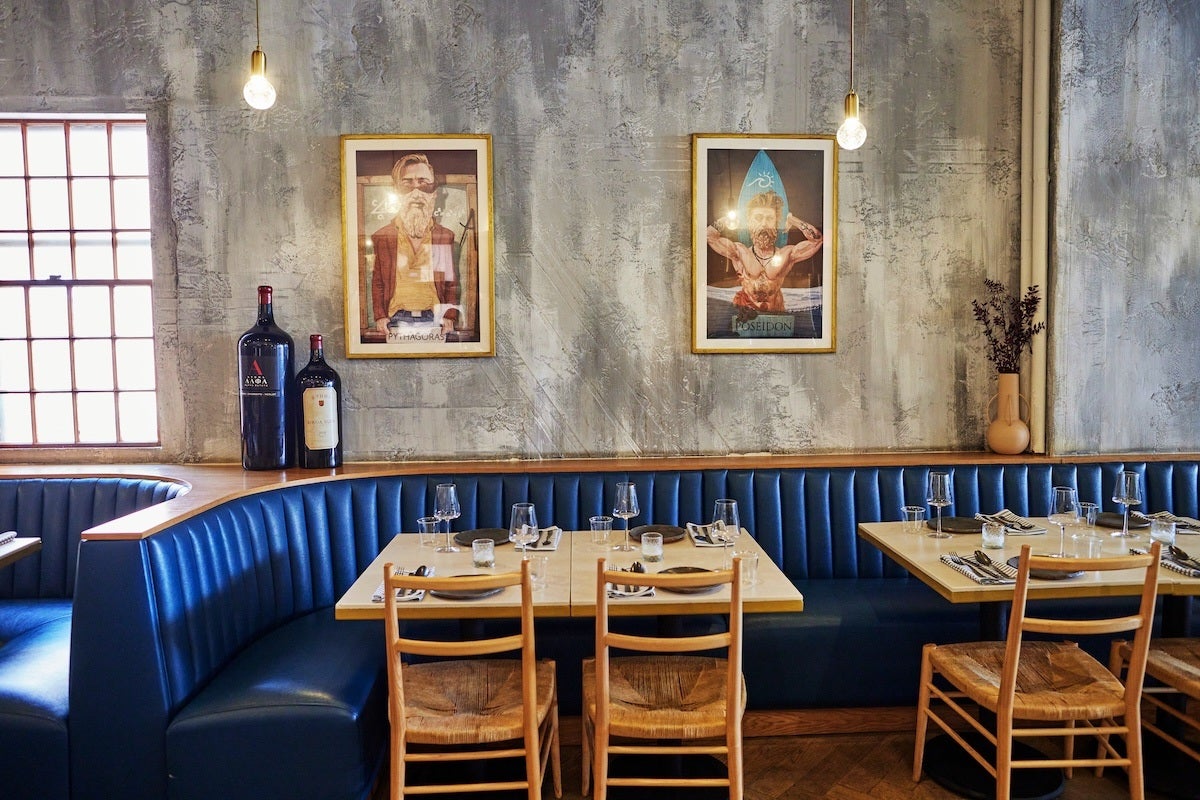
Tsolakis’s Xenia Greek Hospitality empire includes Krasi (pictured), Kaia, and Greco. / Photo by Brian Samuels
Still, the men remained on good terms. It wasn’t until Tsolakis opened Krasi in 2020, while still at Committee, that the relationship fractured, Tsolakis says. A Greek street-food counter on Newbury may not have been a threat to a Seaport restaurant, but an acclaimed Back Bay mezze and wine bar was. Aboujaoude says that he didn’t even know his employee was opening a restaurant. “The first time I heard Demitri was opening Krasi was when one of his chefs posted something on Facebook,” he says. “It was in Greek.… I Google translated the article, and that’s how I found out.”
After a dozen years in business together, nobody told him. The two of them didn’t discuss it. “Not directly or indirectly,” Aboujaoude says. “We didn’t speak about it.” What Aboujaoude’s company would come to allege, years later, is that some of what went into that restaurant was bought with Committee’s money.
Tsolakis says the timing tells a different story. Krasi opened just over a month before the lockdown, and what followed, in his telling, was a struggle to keep Committee alive. “My focus was to really get Committee out of the pandemic,” he says. “I don’t think he understood how much work that took—getting it through. I made profits for them.”
Then Committee’s best people started leaving for Xenia. Tsolakis offered them not just a title and a paycheck, but equity. The transition happened during a six-month window, Charbonneau says, and five years later, they’re all still there. “Demetri definitely provides a lot of opportunities for people who have been with him.”
Nobody had to tell Aboujaoude. “Well, I mean,” he says, “I noticed.”
Tsolakis says they left because there was nowhere to go. “He didn’t invest in the future of anyone,” he says of Aboujaoude. “We were supposed to be there and just do the work. If one of my GMs is like, ‘I’ve been a GM for four years. What’s next?’ I’d say, ‘Let me figure this out.’”
He also has a theory about why his old boss is angry. “People have their own reasons for doing what they do, and you may never know someone’s true intentions,” he says. “What George really feels betrayed by is not being involved in every single thing that I have done without him…. I think seeing growth is what bothers him.”
In the myth, Daedalus took Talos in and taught him the trade. The trouble began when the boy started getting good.
And Tsolakis was getting very good. While Committee has largely been left out of the culinary conversation surrounding Boston’s Greek restaurant boom, Tsolakis has been at the top since Krasi. He now has 11 restaurants, with Moro Mou (Greek for “my baby”), a 12-seat Greek-Japanese fusion spot in the Seaport, slated to open soon. He’s an adjunct professor at BU. At 43, he’s one of the most celebrated restaurateurs in the city.
Tsolakis finally left Committee in 2023. According to Aboujaoude, the men never spoke again.
Ask Aboujaoude what he makes of any of it now—Xenia, the man himself—and he offers nothing at all. “I don’t have an opinion,” he says. “I mean, it’s like anybody else who opens a restaurant. I don’t have an opinion of him or his restaurants.”
While Tsolakis was building all of this, Aboujaoude was having a rougher stretch.
Aboujaoude says he’s fine. “Committee is going strong,” he tells me. The restaurant recently renewed its lease and hired a new chef. Cafeteria didn’t survive the pandemic, but he replaced it in 2022 with Eva, a still-running Lebanese-Mediterranean restaurant in the former Cafeteria space on Newbury Street.
Everything else, it seems, has started to unravel.
Start with Bijou, the club that put Aboujaoude in the spotlight. He left in 2023. He says it was voluntary and overdue. “My family was growing. I didn’t want to be home at 3 in the morning anymore, waking up at 6 with my children. [The business] was never going to return to 2019.” He says he gave up management control in 2020 or 2021, but filings with the Secretary of State show that he was listed as manager of Bijou’s holding company until March 2023.
Then the litigation. Cafeteria’s landlord sued Aboujaoude and Cafeteria’s LLC in 2020 for more than $360,000 in unpaid rent and other debts. That suit was settled. In 2021, Aboujaoude sued his Cafeteria partners for more than $500,000 that he claimed was diverted from Cafeteria’s assets. The suit was dismissed, and Aboujaoude characterizes it as a simple matter of an investor wanting to get out of the restaurant business post-COVID.
The next one was messier. In July 2024, a former Bijou bartender and Eva bar manager named Cara Corey filed a discrimination charge against Aboujaoude and several of his businesses with the Massachusetts Commission Against Discrimination (MCAD). In December of the same year, Corey also filed a civil complaint against Aboujaoude and others in Middlesex Superior Court, alleging sexual harassment, assault, and retaliation from Aboujaoude, among other claims. Her complaint also asserts that Aboujaoude’s partners removed him from Bijou—contradicting his account that he left on his own. Aboujaoude has denied the allegations categorically in a filed response to Corey’s complaint, and submitted affidavits from a former coworker of Corey’s and an operations manager at Eva, both of whom describe the relationship between Corey and Aboujaoude as consensual. In his response filing, Aboujaoude acknowledges a consensual relationship, but denies Corey’s allegations of sexual assault and retaliation. Separately, in January 2024, Aboujaoude obtained an abuse prevention order against Corey in Newton District Court. It was extended twice and has since lapsed.
The case is still ongoing, and involves multiple defendants and wage-related claims. “We’re still working through discovery,” says Corey’s attorney, Rebecca Newman.
Aboujaoude’s wife, Kathryn, filed for divorce in September 2025. The marriage, her filing states, suffered “an irretrievable breakdown” on January 10, 2024—the same day Corey contacted Kathryn to tell her about her and Aboujaoude, according to court filings from Corey and Aboujaoude. Kathryn then filed a motion to compel her husband to produce financial documents the case required.
By this past winter, Aboujaoude had either lost or walked away from his club, and his marriage was in divorce court.
In March, his company sued Tsolakis.
To an outsider, it might appear at first blush that the lawsuit is simply a desperate move by a man in an increasingly tight spot. Or maybe it’s an act of naked jealousy by a former master against the apprentice who left him behind. How else to explain the timing? Why wait until now, years after Tsolakis left, to file?
But there are a few problems with that assumption. For one, Aboujaoude says the decision wasn’t his to make, claiming that it was Pier 50’s investors who decided to file the lawsuit. For another, there may be something to it.
Tsolakis found out from a reporter that he was being sued. In March, someone from Law360, a legal news website, asked for comment on the lawsuit. “And I was like, ‘What lawsuit?’” he says. He called his lawyers and discovered his old boss’s company had filed a civil complaint against him, three years after he’d left.
The complaint alleges that while working at Committee, Tsolakis misappropriated more than $1 million of Committee’s money on barstools, flatware, plates, floral arrangements, and other products, as well as interior design, cleaning, printing, and branding services—for his own restaurants. Tsolakis denies all of it. “With a lawsuit, people are going to say something, and there’s nothing you can do about it,” he says. “It sucks that it came to us, but in the end, I think it makes everyone on my team stronger and more close-knit. It didn’t harm us.”
The issue with that stance is that Pier 50’s lawsuit might not be so easily dismissed as sour grapes.
Nothing has been proven yet—the case is still in the discovery phase, and Pier 50’s attorney, David Rich, hopes for a trial in late 2027—but I recently reviewed checks, invoices, and bank records that may be difficult to explain away. In October 2018, for instance, Pier 50 LLC, the company that owns Committee, cut a check for $4,561.64 to the architecture firm Silverman Trykowski Associates. The invoice it paid is addressed to Demetri Tsolakis at Committee. The heading on the line item reads: “Krasi @ 40 Melcher”—a Fort Point address, nearly two years before Krasi opened in the Back Bay.
In August 2022, Pier 50 paid $5,075 to Dave Blakney Metalworks in Woburn. The invoice had arrived by email at “[email protected].” Its subject line reads “krasi wine rack, etc invoice.” The largest item was a custom steel wine rack, gold powder coated, for $4,700.
In June 2021, Casa Design Group billed $10,918.75 for 10 French barstools and shipping. The invoice reads, “Project: Krasi Wine Bar, South End,” billed to Tsolakis at Committee’s address on Northern Avenue, shipped to Krasi on Gloucester Street. It was paid in three pieces from Pier 50’s account: two debit-card charges of $2,729.68 on consecutive days in June, and a check for the $5,459.39 balance in September.
And in June 2019, Pier 50 wrote a check for $4,400 to Fairfield Realty, a Boston property manager. The memo line reads, “114 Marl St.” The landlord’s deposit summary shows how it was applied: $4,000 in back and forward rent on a Marlborough Street apartment, in the name of Demetri Tsolakis.
Aboujaoude’s signature was stamped on all of them by Committee’s outside bookkeeping vendor. Rich says this firm was authorized to issue checks approved by Tsolakis.
That is either the strongest evidence for the case or the strongest evidence against it, depending on whom you ask.
No one initially set out to find evidence of misdeeds. In fact, Committee’s investigation was triggered by the individual hired to replace Tsolakis, Rich says. The new manager reviewed the company’s previous expenses because they were high and discovered what Rich calls “the magnitude of money being spent by Committee on non-Committee-related expenses.” Committee then hired a forensic accounting firm to search for more of what it claims are misappropriated funds. Less dramatically, Aboujaoude says the lease was coming up for renewal, and investors wanted to know what the next 10 years looked like. “That’s when someone caught it,” he says.
Rich says Tsolakis’s position at Committee is what made the alleged theft possible. “Mr. Tsolakis maintained Committee’s bank records, directed the outside bookkeeping service to issue payments to vendors, and approved Committee’s accounts payables on a weekly basis,” he says. The complaint puts it more sharply: “Due to his position of trust as General Manager, Mr. Tsolakis was able to conceal and mask his wrongdoing for many years.”
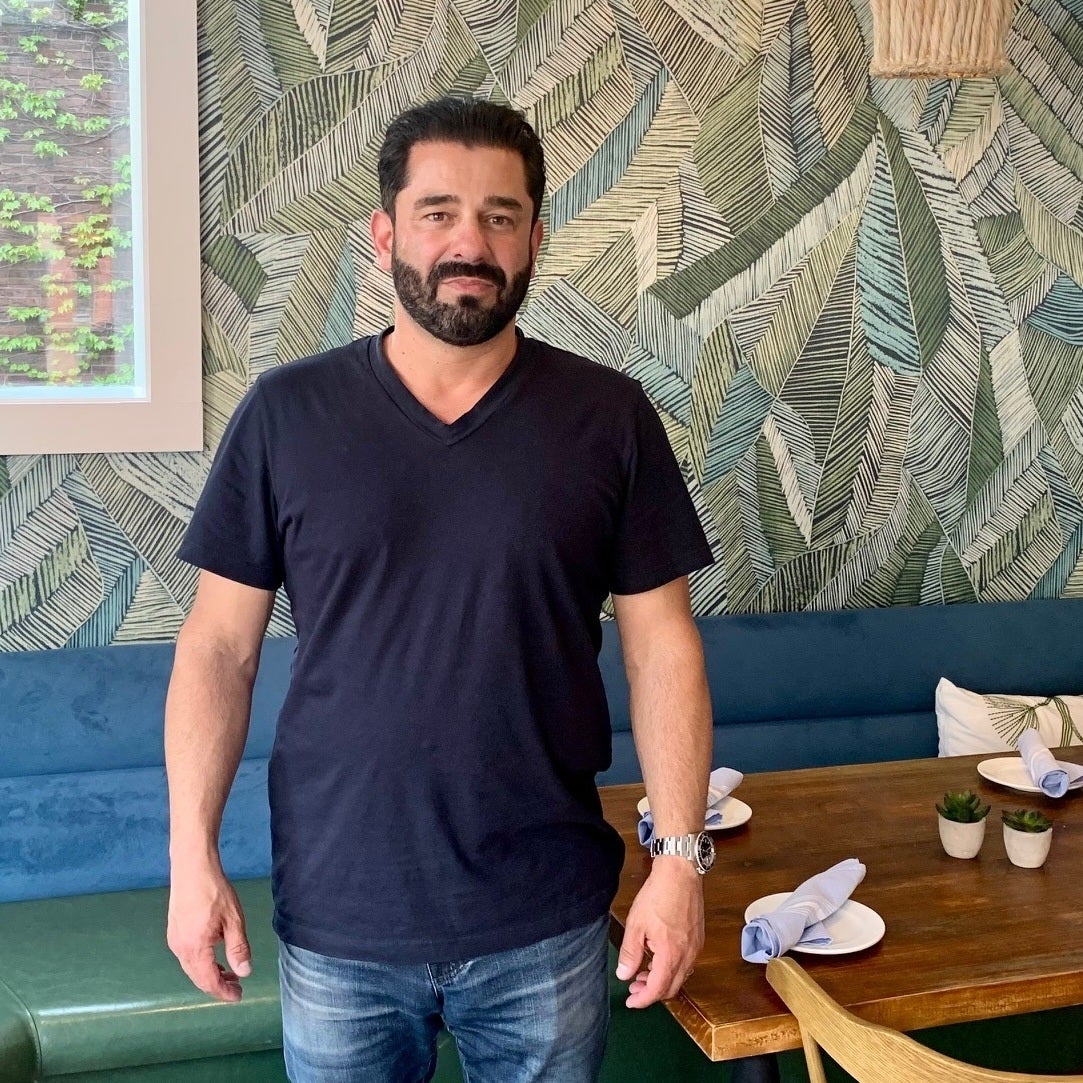
George Aboujaoude. / Photo by Susannah Sudborough/Boston.com
Rich was clear that the documents he showed me represent “only a small fraction of the documentary evidence which has been collected to date.” But when Tsolakis hears about the documents Rich provided, he offers a different account. “George was acutely aware of each of these transactions, and each of them either benefited George individually or Committee as a whole,” he says. He adds that Committee never paid for Krasi’s expenses.
Tsolakis has an explanation for each check and invoice Rich presented. First, he says, he and George hired the architecture firm Silverman Trykowski to redesign Committee’s private dining room, and to look into a potential new project on Melcher Street—a project and an address, he says, that were never related to Krasi, which he says hadn’t been conceptualized at the time of the invoice. As for the wine racks, he says, Krasi’s were designed in Greece; the Woburn-based metalworks company did not provide any products to Krasi, and he doesn’t know why the restaurant’s name appeared on the invoice. He characterizes the Casa Design Group invoice as an “invoice irregularity,” noting that Casa had provided design services to Krasi the year prior, at the time of the restaurant’s opening.
Regarding the Marlborough Street apartment, Tsolakis says it was in his name, but used for Committee, which offered housing to overseas workers, including chefs, as “part of a compensation package” for employees. “George is well aware of this arrangement and authorized this payment,” Tsolakis says.
He also argues that an invoice doesn’t prove a destination. “Where did the table end up, Krasi or Committee?” he asks. “That’s the thing they have to prove.”
As for the books, he places the onus on Committee’s accountants. “During the period of time that I worked and consulted for Committee, there were hundreds of transactions involving Committee’s vendors,” Tsolakis says. “Committee had its own internal accounting firm…who issued payment for submitted invoices. Any payments by Committee for unrelated charges is a product of their accountant’s own negligence for failing to recognize any irregularities in invoices.”
He denies any intent at all. “It was never anything intentional, like, ‘Oh, charge this and do that.’ No, no, no, no, no.”
In early May, Tsolakis’s legal team filed a third-party complaint attempting to shift responsibility for any financial mismanagement onto Committee’s outside bookkeeping vendor, Restaurant Bookkeeping Services, Inc. The filing denied the allegations of financial misappropriation laid out in Pier 50’s complaint.
Rich isn’t buying it. “As Mr. Tsolakis knows, the third-party bookkeeping service was not retained to audit Committee’s books. It was retained to process payments as directed by Mr. Tsolakis.” He adds that the third-party complaint “seems to blame outside bookkeepers for not discovering Mr. Tsolakis’s illicit activities sooner.”
Tsolakis says Committee got whatever Krasi got. “We never shun Committee and say ‘We’re not going to make Committee better,’” he says. “If Krasi had good plateware, Committee had good plateware.”
None of this is settled, of course, but it’s harder now to read Pier 50’s lawsuit as only the flailing of a man who has lost nearly everything else. Though it may be that, too.
Back at the influencer party, the sun is setting over XO. The deep-fried pitarakia with trout roe and roasted tomato-cucumber horiatiki have given way to white and dark chocolate mousse, loukoumades, and Aegean Bingsu, a watermelon shaved ice with pistachio powder and yogurt foam.
Fifteen years ago, Tsolakis helped Aboujaoude open Bijou. The nightclub is where Aboujaoude became a star, before it went bad. It’s where Corey went to work, before that ended in litigation. And it’s the place that started the working relationship between Aboujaoude and his general manager. But Bijou isn’t Aboujaoude’s anymore. And Krasi is packed.
In the ancient Greek myth, the master throws his gifted apprentice off a roof. Nobody has thrown anyone off anything here. There is only a complaint, a docket number, and likely a year or more of legal motions ahead. In the meantime, one man’s restaurants keep opening, and the only contact between the restaurateurs is through their respective attorneys.
Tsolakis is working the patio again. He is carrying a tin of caviar that costs $380, and he’s spooning it onto the webbing between his guests’ thumbs and forefingers—“bumps.” Nobody at the party needs the joke explained. They take it off their hands, one after another. And they thank him.
This story first appeared in the print edition of the September 2026 issue, with the headline, “The Breakup.”
