Entertainment
While the score lacks memorable hooks, “Black Swan” soars through breathtaking choreography, striking visuals, and powerhouse performances.
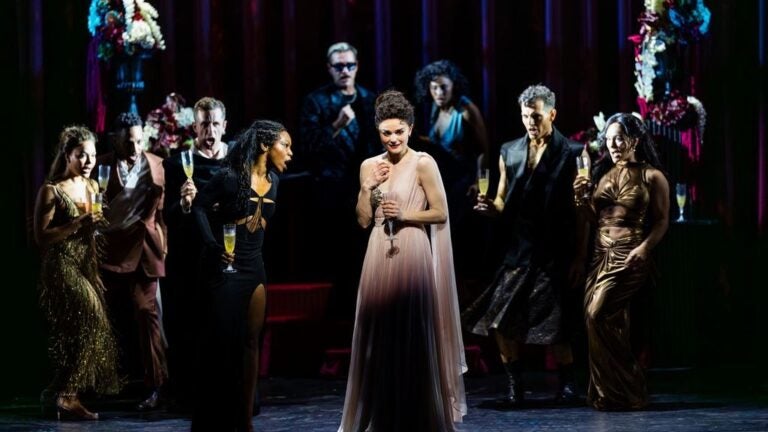
Members of the ensemble surround Melanie Moore (Nina) and Jada Simone Clark (Lily) in performance for A.R.T.’s world-premiere production of “Black Swan.” Hawver and Hall
Nina stares into a mirror as a black swan emerges from her reflection. A club scene pulses with jazz and funk, making the audience feel almost part of the action. And, an almost-murderous drive to reach the top pushes everything forward.
“Black Swan” delivered a spectacle at every turn — from high-tech lighting and an elegantly minimal set to choreography that often says more than dialogue ever could. However, the new musical interpretation, now premiering at the American Repertory Theater, is neither a traditional musical nor a scene-for-scene recreation of the film that inspired it.
The show, which run through July 12, is based on the 2010 film starring Natalie Portman and Mila Kunis. Portman played Nina, a dancer with flawless technique but little freedom, while Kunis portrayed Lily, the passionate rival who embodies everything Nina lacks.
The same dynamic remains in the stage adaptation. Melanie Moore delivers a striking performance as Nina, paired with Jada Simone Clark, who proves to be a formidable presence and a true powerhouse on stage as Lily.
Jen Silverman authored the adaptation, which features music, lyrics, and orchestrations by Dave Malloy. The creative team also includes Or Matias, who contributed additional orchestrations and served as music director and supervisor. Together, they have reimagined the psychological thriller as a haunting musical production.
Director-choreographer Sonya Tayeh pulls out all the stops with the production’s visual and physical storytelling.
While the score does not always showcase the cast as strongly as it could — and few songs linger after the curtain falls — the choreography ties the story together and carries much of the emotional weight of the two-hour musical. Tayeh vividly captures Nina’s unraveling psyche, her movements becoming more fractured and jagged as her grip on reality slips away.
At times, the choreography becomes repetitive, but Tayeh is supported by one of the most dynamic ensembles imaginable. The dancers portray Nina’s colleagues in the New York City ballet company and serve as physical manifestations of Nina’s deteriorating mental state.
Melanie Moore (Nina) in performance for A.R.T.’s world-premiere production of “Black Swan.” – Hawver and Hall
Each ensemble member maintains a distinct presence throughout, elevating every scene they enter. Beyond their technical skill and versatility, the ensemble excels as actors. Several members take on speaking roles, and Kyle Brown’s Ajay provides much-needed comic relief amid the mounting tension.
The set itself remains deceptively simple, and that restraint works to its advantage. Some scenes feature little more than Nina and a mirror, a fitting symbol of a dancer’s often obsessive relationship with self-image. The illusion of a black swan surfacing from Nina’s reflection is a truly stunning effect that, when paired with the physicality of Moore’s performance, achieves a startling sense of realism.
The production’s special effects are used sparingly but effectively. One standout moment of unsettling realism occurs when Nina peels skin from her arm, creating a memorable and visceral impact. Although, the production might have reached even greater heights had it leaned more into these moments of body gore.
Tory Trowbridge delivers a standout performance as Beth, a seasoned prima ballerina and Nina’s idol. Her portrayal of this complex character — forced into a dark, insanity-inducing retirement following a career-ending accident — serves as a psychological catalyst for Nina’s own unraveling. Trowbridge is exceptional throughout the production, but she reaches a new emotional peak during the hospital bed scene.
This specific moment is among the production’s most haunting, featuring a deceptively simple set consisting only of a spotlight and a bed. The use of practical effects and graphic makeup make Beth’s injuries disturbingly realistic, and Trowbridge’s unforgettable depiction of a woman shattered by loss creates a palpable effect that lingers long after the scene ends.
The cast is undeniably impressive, particularly in the case of Melanie Moore. Over the production’s two-hour runtime, Moore demonstrates remarkable control and stamina. While her vocals occasionally lean into a nasal quality, this choice appears to be a deliberate reflection of Nina’s fracturing mental state. Beyond her delivery of the script, Moore utilizes physical nuances and facial expressions to make the character’s psychological spiral chillingly authentic.
Mehry Eslaminia, appearing as an understudy for Kate Jennings Grant during the June 10 performance, provides a powerful portrayal of Barbara, Nina’s overbearing mother. Eslaminia captures the character’s desperate attempt to reclaim her own lost ambitions through her daughter with such skill that her status as a substitute is easily overlooked.
Members of the ensemble face Melanie Moore (Nina) in performance for A.R.T.’s world-premiere production of “Black Swan.” – Hawver and Hall
One of the adaptation’s most significant departures from the film is choreographer Margaux LeRoy, played by Amber Iman. The manipulative male director from the movie has been reimagined as a female mentor figure. The change offers a refreshing alternative, but it also removes some of the pressure that fueled Nina’s collapse in the original story. LeRoy becomes less prominent in Act Two, making her influence on Nina’s downfall feel somewhat underdeveloped. Still, Iman’s commanding stage presence and soaring vocals make every appearance memorable.
“Black Swan” is not a musical audience will leave humming. The score lacks the memorable melodies typically associated with the genre, and the production is far more interested in movement than vocal showcase. Yet, that focus ultimately serves the story. The dancing becomes the primary language of the show, carrying its emotional and psychological weight.
For all of its spectacle, the musical leaves some narrative threads underexplored. Beth’s story, in particular, feels deserving of more attention. The ending also arrives somewhat abruptly, as though a final scene or two might be missing.
“Black Swan” ultimately pushes dance to the forefront in a way few musicals do. Dance is often an important element of musical theater, but here it becomes the production’s most powerful storytelling tool, deepening both the narrative and the performances.
“Black Swan” will be playing at the Loeb Drama Center in Cambridge through Sunday, July 12. Tickets start at $43 and can be purchased here.
Sign up for the Today newsletter
Get everything you need to know to start your day, delivered right to your inbox every morning.