Off Beat
“I feel crazy saying it,” the witness said. “It’s just unbelievable. I keep telling people you have to see it to believe it. I can’t convince you and I’m not even going to try.”
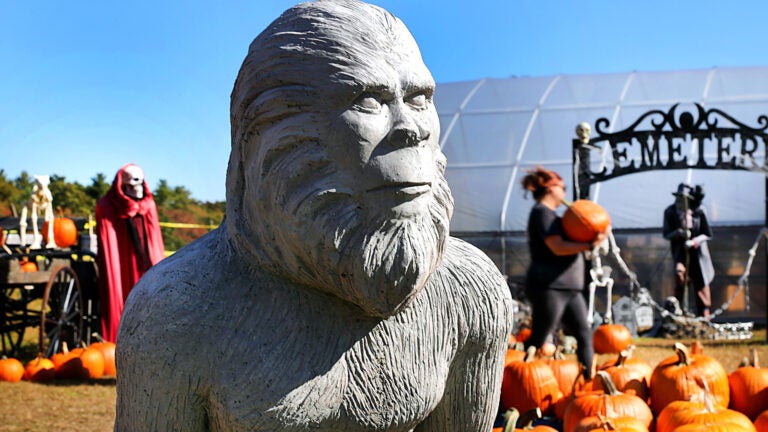
A Bigfoot sculpture looms over the Cervelli Farm Stand pumpkin patch in Rochester, Massachusetts. John Tlumacki/Globe Staff (metro)
Kevin Klimas, a 45-year-old father from Rhode Island, was driving down a dark road in the dead of night, leaving his friend’s remote cabin in Voluntown, Connecticut, on July 5.
Suddenly, he hit the brakes to avoid collision with what Klimas described as a two-legged, eight-foot-tall creature covered with greasy, long brown hair.
The creature, with broad shoulders, thick muscles, and arms hanging down to its knees, quickly crossed the road in three steps, Klimas said. Shaking, he said he rolled up his windows, locked the car doors and took a few minutes to gather himself before driving off.
“Make no mistake,” Klimas said in an official report to The Bigfoot Field Researchers Organization. “This was not a bear. This was a cryptid. I’m no longer a skeptic. I’m certain of that.”
This Connecticut Bigfoot sighting on Beach Pond in New London County isn’t as rare as one might think. There have been 126 “verified” — i.e., investigated and deemed credible — sightings in New England since 1994, according to the BFRO.
Founded by self-proclaimed Bigfoot expert Matt Moneymaker, the BFRO is “the only scientific research organization exploring the bigfoot/sasquatch mystery,” according to its website.
The BFRO’s about 3,000 members across the country verify sightings that are reported in their area, through phone calls with the witness and site visits where Bigfoot was claimed to be spotted. Klimas’s sighting was verified by BFRO investigator Mike Young and Moneymaker.
Klimas said before this experience, he hadn’t thought much about Bigfoot and considered himself an “optimistic skeptic.” But this encounter turned him into a Bigfoot believer.
“I feel crazy saying it,” he said. “It’s just unbelievable. I keep telling people you have to see it to believe it. I can’t convince you and I’m not even going to try.”
Moneymaker, former star of the Animal Planet documentary show “Finding Bigfoot,” said the particular area where Klimas had the encounter is no stranger to Bigfoots.
There are three verified reports in the BFRO database from the same county and 22 unverified reports in the internal BFRO database. In the neighboring county in Rhode Island, Washington County, there are three verified reports and 20 unverified ones.
A Bigfoot expedition led by Jon Wilk, founder of Team Squatachusetts. – John Wilk
Sasquatch or no sasquatch?
Boston University biology and anthropology professor Eva Garrett, whose research focuses on primates, said it’s unlikely these reports are actually “Bigfoot” encounters.
“There’s no scientific evidence that a large ape currently exists that would align itself with the description of Bigfoot,” she said.
Garrett said new primate species are still being identified to this day, most recently with the discovery of a new Colobus Monkey in the Democratic Republic of Congo this year. However, she said it is “very unlikely” that scientists would not have discovered a species as large as Bigfoot by now.
But Moneymaker, who claims to have had a face-to-face interaction with a Bigfoot in Ohio in the 1990s, remains adamant the species exists.
“You can hear about it from witnesses and find footprints and hear their sounds,” Moneymaker said. “But there’s still going to be, naturally, a little bit of nagging doubt until you actually see one. I did and then I knew that all the skeptics were wrong.”
Despite not having the science to back them up, there are many Bigfoot believers who claim the species frequently roams New England’s forests, especially in Massachusetts.
Jon Wilk, a former park ranger for the Mass. Department of Environmental Management, said there are hundreds of reported sightings in the state’s rural areas.
Wilk said he encountered a Bigfoot while working a night shift in Savoy State Forest in the early 1990s. A six-and-a-half-foot-tall, hair-covered creature that had a human face and an ape-like body ran in front of his truck, Wilk said.
“I cannot explain what it was,” he said. “I can tell you what it wasn’t.”
Wilk said when he explained to his boss what he saw, his boss showed him a file of Bigfoot and UFO sightings reported in the same state forest, dating back to the 1930s. Wilk’s Bigfoot encounter caused him to quit his park ranger job out of fear, he said.
Years later, Wilk formed Team Squatchusetts, “a group of amateur researchers and citizen scientists dedicated to collecting evidence that supports the existence of Bigfoot or sasquatch in Massachusetts,” according to its website.
The team partners with BFRO to host Bigfoot expeditions in Massachusetts, including an upcoming expedition in September. Moneymaker said while they don’t often see a Bigfoot face-to-face on expeditions, they frequently hear its sounds or find footprints.
A Bigfoot print? – Team Squatchusetts
Professor Garrett said for the Bigfoot species to be considered “discovered,” scientists would need to observe it in the wild and have DNA samples to analyze. Until they have this, she said there is no science backing the belief in Bigfoot.
However, the myth of Bigfoot likely doesn’t come entirely from fiction, she said. There is fossil evidence of a giant ape species, now extinct, called Gigantopithecus.
“There used to be, up until about 250,000 years ago, an ape that was probably twice the size of a male gorilla that would have interacted with our ancestors that existed back then in Southeast Asia,” she said. “So I think that Bigfoot is a bit of a myth that is a holdover from probably our ancestors and tales that they would tell.”
What’s behind the legend?
But if Bigfoot truly is a myth, why has it remained a prominent story in American culture after all these years? William Giraldi, a master lecturer in the Boston University writing department who teaches a course titled “I Want to Believe”: UFOs & Bigfoot in Myth & Fact, said belief in Bigfoot has a lot to do with the human desire to believe in something, even as interest in organized religion declines.
“The great literary critic Harold Bloom once said that it’s hard to be alive without some belief in the extraordinary,” he said. “So when you’ve lost your religion … you don’t believe in nothing. You will believe in almost anything, and for these men, Bigfoot provides that possibility of the extraordinary … that quite frankly, they’re missing in their lives.”
In Giraldi’s course, he spends half a semester exploring the myth of Bigfoot with his students. Despite not being a Bigfoot believer himself, he said there is some compelling evidence out there.
But when Giraldi heard about the recent Connecticut sighting, he was hardly surprised. Giraldi said Bigfoot sightings are typically in the middle of the night, on an unlit road and with the creature crossing in front of a car.
“That’s the story that you hear again and again,” he said of Klima’s report.
Giraldi noted that where there are the largest percentage of Bigfoot sightings, there is also the largest population of black bears, which can walk on two legs.
Boston College journalism professor John O’Connor, author of “The Secret History of Bigfoot: Field Notes on a North American Monster,” agrees the belief in Bigfoot, for many, is a substitute for traditional religion. O’Connor, who spent a year traveling the country researching Bigfoot, said the belief also has a lot to do with camaraderie.
O’Connor attended many Bigfoot expeditions, including with Moneymaker and Wilk. He said the expeditions, attended by mostly white, conservative, working class, rural men, are akin to “wilderness larping,” with participants excited to use the gadgets like night vision goggles and infrared devices.
“It’s sort of the novelty of the whole thing to get to go out into the woods and look for something that would be totally miraculous and incredible and unlikely to discover, and the thrill of that,” he said. “And sitting around the campfire, talking down Joe Biden and Kamala Harris, that’s the social component, that’s a big part of the draw.”
O’Connor said Moneymaker’s investment in the myth was “a little unusual,” even for the world of Bigfooters. Most Bigfooters were merely curious and enjoyed it as a weekend hobby, he said.
In his year of research, O’Connor said he did not “not hear or see anything” that suggested the existence of a Bigfoot.
“But people I was literally standing right next to did have that impression,” he said.
Giraldi cautioned that while Bigfoot may seem like a childish belief, skeptics should try to understand where it stems from.
“It’s easy to dismiss these believers as unintelligent, uneducated, silly, desperate, boyish, gullible,” he said. “I’m not saying that they aren’t necessarily those things. But what these men find in Bigfoot is really not all that different from what most people find in Christ or Allah or Buddha — there’s that same spiritual or religious longing to believe in the extraordinary.”
Sign up for the Today newsletter
Get everything you need to know to start your day, delivered right to your inbox every morning.