Arts
Tanglewood might look as idyllic as ever, but during a recent week on the grounds, it felt anxious, angry, combustible.
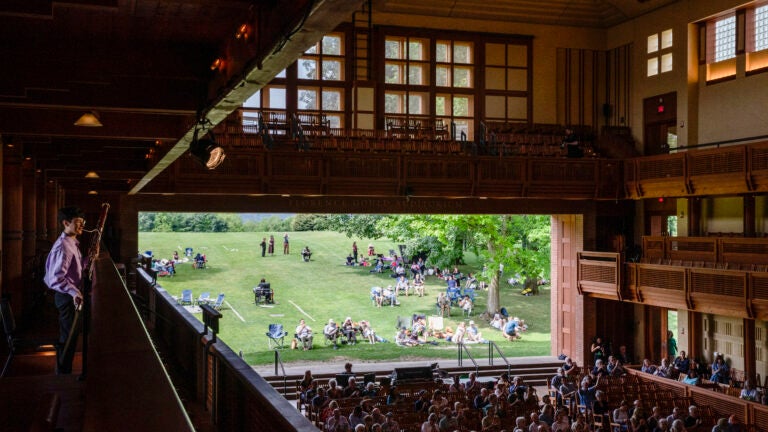
The bassoonist Jackson Bernal, left in the balcony, performs as part of the Festival of Contemporary Music inside Seiji Ozawa Hall at Tanglewood in Lenox, Mass., July 26, 2026. Lauren Lancaster/The New York Times
August 4, 2026 | 1:40 PM
6 minutes to read
Critic’s Notebook
LENOX, Mass. — Tanglewood is special to many, many people. It’s the summer home of the Boston Symphony Orchestra, but also a place where people make memories: where they picnicked with their grandparents or got soaked in a storm. It matters. It means something. To my family, it’s a retreat, a sanctuary, a place where things can rest just a little easier for one sunny afternoon.
Not this year. Tanglewood might look as idyllic as ever, but during a recent week on the grounds, it felt anxious, angry, combustible. It was impossible to escape the warfare that the Boston Symphony is waging on itself: a crisis that is drowning out the music. Somebody needs to quiet things down before even more serious damage is done.
Boston Symphony Orchestra’s music director Andris Nelsons greets musicians inside Koussevitzky Music Shed at Tanglewood in Lenox, Mass., July 26, 2026. – Lauren Lancaster/The New York Times
Composer-conductor Esa-Pekka Salonen observes the Festival of Contemporary Music inside Seiji Ozawa Hall at Tanglewood in Lenox, Mass., July 26, 2026. – Lauren Lancaster/The New York Times
Attendees listen to the Festival of Contemporary Music outside Seiji Ozawa Hall at Tanglewood in Lenox, Mass., July 26, 2026. – Lauren Lancaster/The New York Times
Let’s recap. Primed in years of backstage intrigue, this firestorm was set alight when the Boston Symphony’s trustees and management — led by Barbara Hostetter, the board chair, and Chad Smith, the president and chief executive — announced in March that they would not renew the contract of the orchestra’s music director, Andris Nelsons.
Artistically, this was the correct call. Living in the Boston area, I long ago lost count of how many times I have seen Nelsons conduct over his 12 seasons in charge. I found his evolution exasperating, as did fellow local critics. Many listeners disagree, but either way, reporting by The Boston Globe has confirmed that Nelsons was not doing core parts of his job properly: arriving unprepared for rehearsals, dismissing new scores as “funny pieces” and refusing to do much of the fundraising and other work expected of serious music directors in the United States.
A picnic blanket full of food sits on the lawn during a concert outside Koussevitzky Music Shed at Tanglewood in Lenox, Mass., July 26, 2026. – Lauren Lancaster/The New York Times
Attendees listen to a concert outside the Koussevitzky Music Shed at Tanglewood in Lenox, Mass., July 26, 2026. – Lauren Lancaster/The New York Times
A pie that is part of a picnic sits on a table during a concert outside Koussevitzky Music Shed at Tanglewood in Lenox, Mass., July 26, 2026. – Lauren Lancaster/The New York Times
Managerial screw-ups are nothing new at this organization, but removing Nelsons has opened Pandora’s box. Hostetter and Smith brought a private struggle into public view by choosing to fight a battle over “future vision,” pitting their (frankly timid) plans to modernize a civic institution and erase its persistent operating deficits against the opposition of an old guard that had anointed Nelsons its figurehead. Most of the musicians, preparing for labor negotiations, were irate at their maestro’s departure and a lack of consultation. Nelsons refused to go quietly, stoking what Boston Pops conductor Keith Lockhart called “an emotional turmoil that did not have to be.”
Since then, factions have entrenched. Trust is out, vitriol is in. Critical questions lie under the slung mud, among them: As ticket sales fall, donors become more influential and orchestras operate ever more like corporations, where should power lie? Rather than debate such matters calmly, the richest orchestra in the world has devolved into a morass of anonymous quotations, destructive leaks and social media bile.
Who is going to donate money to an institution capable of acting so embarrassingly? Who will want to work for this orchestra, play in it, perform with it and, as it searches for a new music director, even conduct it?
Supporters of Nelsons wear red flowers, and almost all the thousands of people I saw sporting them last weekend behaved civilly. Management has been accused of “punishing people for loving the orchestra,” but I should note that I also saw an usher taking photos for patrons wearing “Reinstate Andris Nelsons” shirts, protest leaders freely handing out merchandise and a lawn sign right outside Tanglewood’s back gate. If anyone were trying to crush dissent, they would be failing.
But a nasty tension is in the air. Much of the burden, deplorably, is falling on front of house staff. On Tuesday, after Smith withdrew from a talk because of a family matter, a staffer announcing the change in programming pleaded with the audience before him to be kind to box office assistants if they asked for a refund. On Sunday, one stranger wearing a red flower saw me reading a score, asked whom I write for, and then asked where I was staying. Twice.
As for the music, you could not have imagined a starker illustration of the battle playing out than the programming over the past week.
Attendees picnic outside Linde Center for Music and Learning before a performance at Tanglewood in Lenox, Mass., July 26, 2026. – Lauren Lancaster/The New York Times
In the Shed, Nelsons led a trio of concerts pairing Mozart concertos with Tchaikovsky symphonies. Each performance felt like a referendum on his fate, partly because almost everyone onstage was wearing a red flower (including Nelsons), partly because he ended all three basking in raucous applause. Sure, the Bostonians have been playing with more intensity since March, but that intensity is fundamentally undisciplined. Add Nelsons’ in-the-moment interpretations, and things can fray.
The Tchaikovsky did. Basic speeds were lethargic throughout the Third, Fourth and Fifth symphonies, and Nelsons then pushed tempo shifts past their breaking points, especially in a messy, moribund Fifth. Their Mozart was more convincing, conceived in the elegant style of the Karajan-era conductors that Nelsons admires, if without the last twinkle of spirit that aesthetic needs to shine.
Elsewhere on campus, composer-conductor Esa-Pekka Salonen — perhaps the closest musician to Smith in Los Angeles aside from Gustavo Dudamel — directed a stellar installment of the annual Festival of Contemporary Music, performed creditably by the young fellows and alumni of the Tanglewood Music Center. Salonen’s five programs amounted to a sort of life and times: among them was a memorial to his late friends Oliver Knussen, Steven Stucky and Kaija Saariaho; a look at the “next generation” of composers, all women; and a celebration of “Nordic Boomers” that included Salonen’s Cello Concerto, torn into by soloist Senja Rummukainen, and Hans Abrahamsen’s recent classic “let me tell you,” sung by soprano Alexandra Henderson and conducted by Lauren Smith. All five concerts were ambitious, engaging, exquisite.
Attendees watch a performer inside Linde Center for Music and Learning at Tanglewood in Lenox, Mass., July 26, 2026. – Lauren Lancaster/The New York Times
Performers during the Festival of Contemporary Music inside Seiji Ozawa Hall at Tanglewood in Lenox, Mass., July 26, 2026. – Lauren Lancaster/The New York Times
Musicians gather backstage during the Festival of Contemporary Music inside Seiji Ozawa Hall at Tanglewood in Lenox, Mass., July 26, 2026. – Lauren Lancaster/The New York Times
Even the idlest mind might wonder if Salonen would want to become the Boston Symphony’s next music director. His plans suggest he does not. But his presence did illustrate a problem that the orchestra must face as it looks for Nelsons’ successor. Before February, Salonen had led this ensemble once since 1988. Semyon Bychkov last appeared in 2000. Iván Fischer, 2003. Gianandrea Noseda, 2004. Marin Alsop, a Tanglewood alum, has conducted one Boston Symphony program, ever; Daniel Harding, likewise. Manfred Honeck has not returned since 2014; Vladimir Jurowski, 2016. Dudamel came for two weeks in 2019, canceled the second, and has not come back.
The list goes on, and it makes for a pattern. I’ve heard thrilling Boston concerts from Karina Canellakis, Joana Mallwitz and Antonio Pappano. But subscription weeks that were filled a decade ago by titans like Bernard Haitink and Christoph von Dohnanyi are nowadays handed to assistant conductors. Either the Boston Symphony has not been inviting many of the conductors who visit New York, Philadelphia, Cleveland and Chicago, or they don’t want to come.
One newly public anecdote suggests an answer. In April, Susanna Mälkki visited from New York, where she was overseeing Saariaho’s “Innocence” at the Metropolitan Opera, to premiere Andrew Norman’s complicated two-piano rewrite of “Split,” a Boston Symphony commission. Mälkki is one of the world’s leading conductors, someone undoubtedly deserving of respect. But musicians told The Globe that this spring, she instead received “outright hostility.” One player reportedly performed his part wrongly — not in rehearsal, but in concert.
What a mess. What a sorry, sorry mess.
Attendees play frisbee on the lawn between concerts at Tanglewood in Lenox, Mass., July 26, 2026. – Lauren Lancaster/The New York Times
This article originally appeared in The New York Times.
Extra News Alerts
Get breaking updates as they happen.