Local News
GOP candidate Mike Minogue has contributed $13.5 million to his campaign for governor.
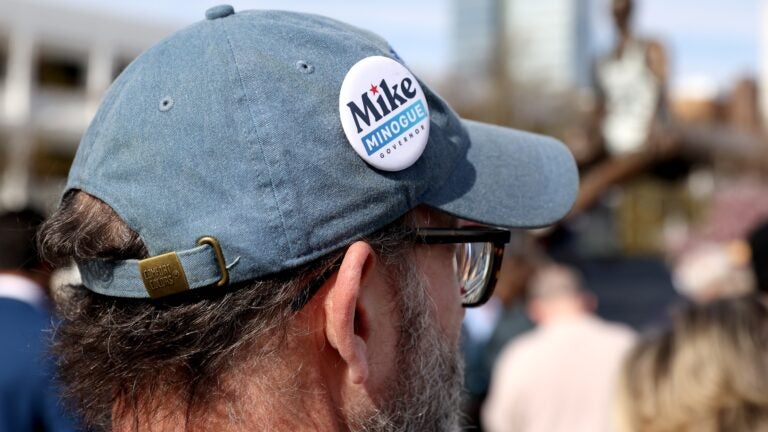
A Mike Minogue supporter outside the Massachusetts GOP convention on April 25. Jonathan Wiggs/The Boston Globe
As a major gubernatorial candidate finances his campaign with millions of his own dollars, a state lawmaker is pushing to eliminate the “loophole” that allows for the unlimited self-funding of political campaigns.
State Sen. Rebecca Rausch, a Democrat from Needham, filed a budget amendment that would remove the provision that allows candidates to self-fund without constraints.
Individuals who want to contribute to political campaigns in Massachusetts can donate up to $1,000 per year. That limit does not apply when candidates contribute to their own campaigns.
“I don’t care what your political affiliation is, that’s flying in the face of our democracy,” Rausch said.
Mike Minogue, a political newcomer who last month secured the endorsement of the Massachusetts Republican party, is using his vast wealth to fund his campaign for governor. He spent nearly 20 years running the Danvers-based medical device company Abiomed before selling his shares in the company when it was purchased by Johnson & Johnson in 2022.
Since last October, Minogue has contributed a record $13.5 million to his own campaign, according to records from the Office of Campaign and Political Finance.
Minogue’s remaining primary opponent, former MBTA Head Brian Shortsleeve, has contributed $400,000 of his own money to his campaign, OCPF records show.
While Minogue’s campaign is putting the spotlight on the lack of limits for self-funding, Rausch said that the problem runs deeper.
“There is a general consensus about concern for the state of our democracy, particularly in this current moment. This is something we’ve seen abused by candidates on all ends of the political spectrum,” Rausch said.
The recent push is not a direct result of Minogue’s campaign, she said.
“I’ve been focusing on election reform and democracy pillars for far longer than Mr. Minogue has been a candidate for public office,” Rausch said.
Spokespeople for Minogue did not return a request for comment Monday.
Minogue has more than $10 million in cash on hand, compared to Shortsleeve’s approximately $605,000. Gov. Maura Healey has about $5.8 million in cash on hand, OCPF records show.
In a recent fundraising email, Healey’s campaign admitted to being at a “disadvantage.”
“Every time we send an email or make a call to ask supporters like you to chip in $10 or $25, he can just open his checkbook and write himself another million-dollar check,” her campaign said in the email to prospective donors, without referencing Minogue by name.
Just how much momentum there is behind Rausch’s amendment remains to be seen. It will be taken up by the Senate at some point this week, before the body likely votes on its budget Thursday, Rausch said. Lawmakers will then have to reconcile the differences between the Senate and House budgets before a version is sent to Healey’s desk.
Whether her amendment passes this year, Rausch views campaign finance reform as a long-term priority.
“The uber-wealthy should not be able to buy their way into elected office. That is not a democracy,” she said.
Ross Cristantiello
Ross Cristantiello, a general assignment news reporter for Boston.com since 2022, covers local politics, crime, the environment, and more.
Sign up for the Today newsletter
Get everything you need to know to start your day, delivered right to your inbox every morning.