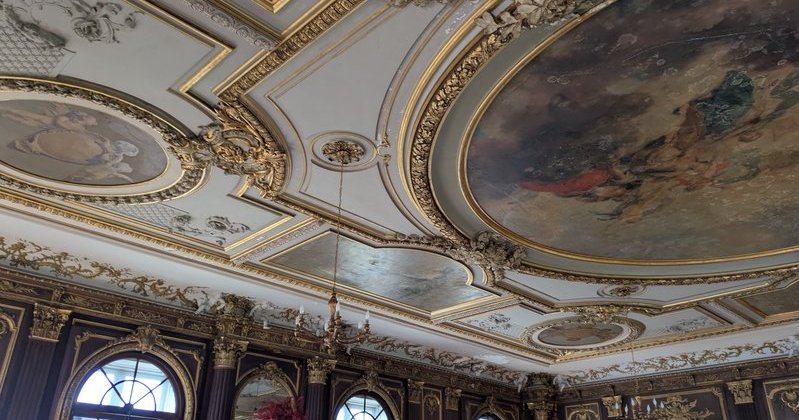
From now through Oct. 4, Elkins Park neoclassic mansion Lynnewood Hall is open to the public for just the second time in 84 years.
The property is hosting Fleurs de Villes: The Gilded Age, a 10-day flower show inspired by HBO’s “The Gilded Age.” In addition to seeing floral sculptures modeled after some of the characters, visitors will also get a look into one of the most unique homes in the Philadelphia region. Lynnewood Hall features 110 rooms, an art gallery, swimming pool and formal ballroom.
The property has been closed to the public since the 1950s, save for a small event earlier this year, and spent 30 years largely abandoned before it was purchased by the Lynnewood Hall Preservation Alliance in 2023. The organization has a 20-year plan to restore the structure and use it as an educational tool for preservationists.
But long before all that, it was once a jewel in the Philadelphia region that was owned by the prominent Widener family. The home and the people associated with it have ties to the city’s streetcar system, the Titanic and the Philadelphia Museum of Art. With the building back in the public eye, here’s a look at its history and significance in the city.
The beginning
Lynnewood Hall was built for Peter A.B. Widener, the son of a poor Philadelphia bricklayer. After taking on a job as a butcher, Widener eventually gained wealth by starting a chain of meat stores. He also worked in politics, becoming the city treasurer in 1873.
He got even richer after gaining control of Philadelphia’s streetcar systems and modernizing them with electric power cables. He later did the same for streetcars in New York, Chicago and other cities. He was also an investor in the U.S. Steel Corporation, American Tobacco Company and Rockefeller’s Standard Oil.
With all of that money, he decided to build himself an extravagant home in Elkins Park, although he already had another at Broad Street and Girard Avenue. After seeing Horace Trumbauer’s work designing the Grey Towers Castle in Glenside — now part of Acadia University — Widener decided to commission him for the project.
The design
Trumbauer was only 29 when he drew up the plans in 1897, but the design came together quickly and was highly technological for its time. The project was completed in just two years using master craftsmen and the best materials around, and the family held a grand opening gala on Dec. 19, 1899. Following his success at Lynnewood, Trumbauer went on to design prominent buildings including the Philadelphia Museum of Art, Duke University and the Whitemarsh Hall mansion in Wyndmoor. Elkins Park houses five of his designs, with Lynnewood Hall being the largest.
The 33 acres surrounding the estate were originally designed by head gardener William Kleinheinz, although they were later redesigned into a French style by Jacques Greber in 1916. Greber, who also designed the Benjamin Franklin Parkway, commissioned his famous sculptor father, Henri-Leon Greber, to make some of the fountain heads.
Peter and his son Joseph were extensive art collectors, displaying works around the estate from Degas, Velasquez, Rembrandt, Raphael, Titian, Monet and Van Dyck. Following his father’s death in 1915, Joseph would occasionally open the home to the public to show the pieces. In 1943, most of the collection was donated to the National Gallery of Art in Washington.
Titanic tragedy
Lynnewood Hall was home to not just Peter Widener, but also his sons George and Joseph and their wives and children. In 1912, George took a trip to Paris with his wife, Eleanor, and son Harry. The family was going abroad to find a new chef for the Philadelphia Ritz-Carlton, another one of the family’s properties, and do some shopping, according to the Lynnewood Preservation Foundation.
They booked return tickets on the RMS Titanic because Peter was an investor in the company that owned the White Star Line, the ship’s operator. On April 14, it is believed that the Wideners were hosting a dinner party for Captain Edward Smith when the ship struck the iceberg that would cause its demise. George and Harry died on board the ship, while Eleanor and her maid survived.
Modern history
Joseph Widener died in 1943, and some of the grounds were sold off before the entire property was acquired by the Rev. Carl McIntire’s Faith Theological Seminary in 1952. McIntire was an evangelical preacher who hosted the “20th Century Reformation Hour” radio program before he was shut down by the Federal Communications Commission.
The controversial figure used the property as a religious school and sold off much of its art and antiques, according to Philadelphia Mag. He also painted many of the walls gray after getting a deal on paint from the Philadelphia Navy Yard, the Daily Beast reported.
In 1996, Lynnewood Hall was sold to the First Korean Church of New York, and it’s been largely unoccupied since. In 2007, the owners attempted to acquire a zoning variance so it could use the property as a church, but it was denied by Cheltenham Township.
In 2014, the church listed the property for sale for $20 million, although that price tag dropped to $11 million by 2019 when it still hadn’t sold. Preservationists purchased it for an undisclosed amount in 2023 and launched the plan to bring it back to life.