

Longform
Everyone knows the FBI protected Boston Mobsters like Whitey Bulger. No one knows about the 20-year-old kid who died because of it—or the father who lost everything trying to avenge him.
Get a compelling long read and must-have lifestyle tips in your inbox every Sunday morning — great with coffee!
Michael Romano spent 21 years in prison for trying to avenge his son’s murder. Now he gives tours of the mob war that bloodied Boston for decades—and claimed his son’s life. / Photo by Tony Luong
Michael Romano doesn’t look like a man who’s been to war. He is 73 years old, beefily built, with dark hair and blue eyes that light up when he talks about his 13 grandchildren. On a recent afternoon, he walks toward a black Chevy Suburban parked outside the Long Wharf Marriott near the Aquarium, wearing a scally cap and a black Baracuta-style jacket. A cluster of tourists is waiting. Each of them paid $79 to climb into this SUV for what Romano has dubbed the Original Boston Mob Tours.
Unlike most tourist operations in Boston, Romano isn’t reading from a script. He’s lived it.
The Suburban pulls out. Romano talks over the recorded narration, adding his own color to the landmarks. At the Rose Kennedy Greenway, he pauses: “She is my hero,” he says. “She spent all her husband’s money helping women and children.” In South Boston, he stops in front of Fox & the Knife, what used to be Triple O’s, the old hangout of James “Whitey” Bulger and his Winter Hill Gang. “If you go right, you get a good Irish meal,” Romano tells the tourists. “If you go left, you go to the basement and come out in a bag.”
He points out Bulger’s former home nearby, then former Senate President Billy Bulger’s house a few doors down. Sometimes, he says, Billy’s daughter comes outside during his tours.
He doesn’t care. He just fiddles with the gold chain around his neck. He has worn it every day since 1994. It belonged to his son.
On September 1, 1994, Michael Romano Jr. climbed into a car in East Boston with two other men. He was 20 years old, a newlywed, a former high school hockey star, and a father of one with another on the way. His wife was waiting for him at their Winthrop home. Everyone called him Little Mikey.
The driver that night was Enrico “Rico” Ponzo, a member of the Patriarca crime family who collected extortion money and sold cocaine, according to court records. Mikey’s old man had called him “a bad character,” warning Mikey to keep his distance. In fact, weeks earlier, Mikey and Ponzo had been arrested on charges of possession of cocaine with intent to distribute, according to court documents.
Ponzo eased the car into the parking lot off Revere Beach Parkway. He was there to shake down Joseph Cirame, who managed the nearby Stadium Café, for an envelope of cash, according to court documents. When the men emerged from the bar a short time later, they found one of the car’s tires had been slashed.
Ponzo was spooked. He’d been part of a botched hit on a rival mob boss five years earlier, and slashing a tire was a classic move to enable an ambush. He went back to the café to call for help with the flat. Little Mikey, on the other hand, was anxious to get home to his wife. He dropped to his knee and made quick work of changing the tire.
Not quick enough.
Moments later, a stolen van carrying three men screeched into the parking lot. One of them leaned out and fired a single shot at Mikey’s face.
The men—later identified in court testimony as David Clark, Joseph Souza, and Stephen Rossetti—peeled out of the lot. Just over a mile away, they dumped and torched the van and got into another vehicle. Then, according to court testimony from someone with knowledge of the incident, they drove back to check out the scene with a camera. They saw they had killed the wrong guy. Ponzo was leaning against a car with the third man they’d arrived with, talking to the cops.
A few miles away, Mikey’s father was on a boat docked at a marina in Eastie, watching the sun hit the steeple of Old North Church across the harbor, when his phone rang. It was Darlene, his wife, who had raised Mikey as her own since he was a kid, calling from their Wakefield home. She told him that she’d just gotten a frantic call from Mikey’s wife, who said that there had been an accident and Mikey was in the hospital. They agreed to meet at Mass General.
Romano hung up and raced through the Sumner Tunnel toward Boston. When he arrived at the emergency room, crowded with cops, doctors told him Mikey was gone. Darlene collapsed to the floor, shrieking. Romano couldn’t comprehend what they were telling him. All he could do was pound the wall, screaming “No, no, no!”
That night, Romano tried to comfort his young daughters, then drank himself into unconsciousness. Before dawn, Darlene shook him awake and brought him to the television. A state trooper had been shot on Route 3. The gunman was David Clark—a convicted murderer out on parole who, investigators would later determine, appeared to have fled the murder scene in Everett hours earlier. In the back of his van, investigators found a gym bag containing a gun, two ski masks, and a police badge. (Clark was later convicted of first-degree murder for killing the trooper.) Romano didn’t need anyone to connect the dots.
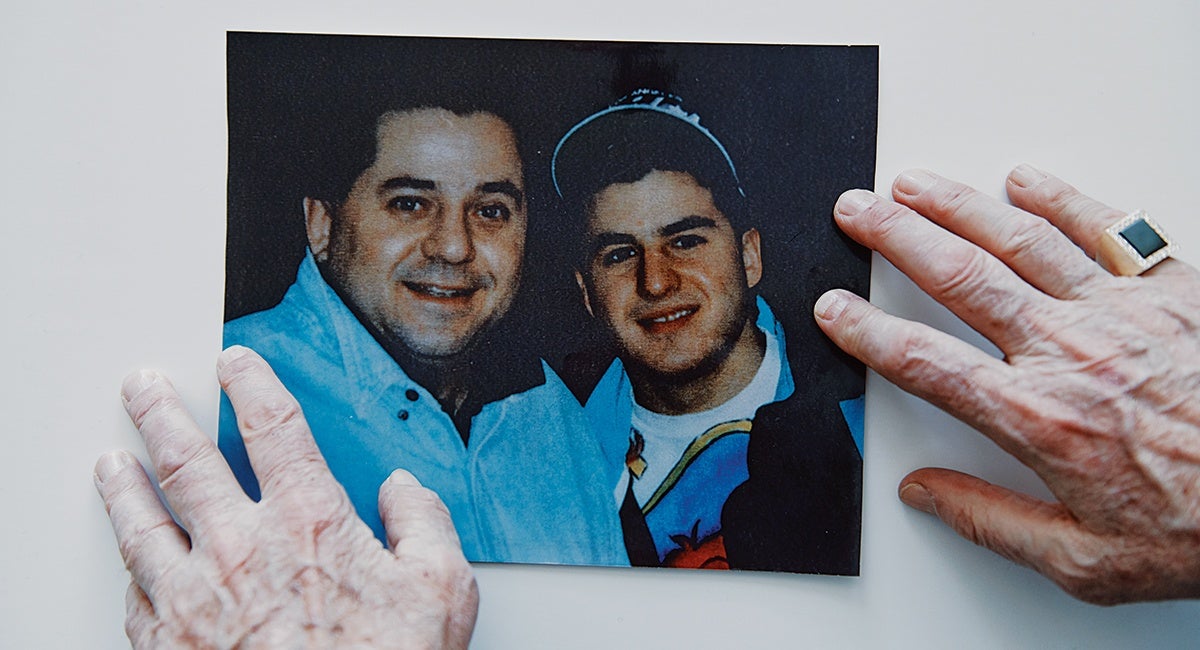
Michael Romano Sr. (left) pictured with his son, Michael Romano Jr., a.k.a. Little Mikey, who was killed in 1994 when he was mistaken for the intended target of a mob hit. / Photo by Tony Luong
The night his son was killed, Romano called Robert Luisi Jr.—a man he’d grown up with in Eastie and met with months earlier at a sit-down between the two warring factions of the Patriarca crime family.
For years, the two sides had been killing each other over control of the organization and its cocaine trade. On one side was the crew of Robert “Bobby Russo” Carrozza, to which Romano was loyal. On the other side sat Francis “Cadillac Frank” Salemme, a longtime Whitey Bulger ally, and his strong arms, including the cousins Mark and Stephen Rossetti. On a June morning in 1989, the two factions clashed when Salemme was shot outside of the International House of Pancakes on Route 1 in Saugus. Four gunmen in camouflage fatigues opened fire on Salemme outside the restaurant, hitting him in the chest and leg. He survived and put the word out that he wanted to know who ambushed him. One name from the Carrozza faction kept coming up: Rico Ponzo. The tit-for-tat killing escalated from there.
In the months before Mikey’s murder, the two sides had agreed to a sit-down, with Romano negotiating for the Carrozza side and Luisi and Stephen Rossetti representing Salemme, according to court documents. They agreed to slow the bloodshed. But something in Romano’s gut told him Salemme wouldn’t honor the deal.
He was right. And now his son was dead.
“I thought we were going to leave the kids out of this,” Romano shouted at Luisi over the phone. Luisi would later testify that he understood—in mob business, children were supposed to be off limits.
“Bury your son, and when you’re done with that, then call me, and I’ll come meet you,” Luisi told him, according to his court testimony. Romano never called. He already had other plans. “There was no talking,” Romano says. “I knew what was coming next; I just had to bury my son first.”
In early September, the family held a wake at Rapino Memorial Home on Chelsea Street in Maverick Square. The place was a fixture in the cycle of Italian-American life—and death—in Eastie.
Inside Rapino’s, a mahogany casket draped in a canopy of white and red roses bore a message that read: “Son, I’ll cry every day.” Inside it, Mikey wore the suit he got married in.
A swell of mourners waited to pay their last respects in a line that stretched down Chelsea Street all the way to Santarpio’s Pizza, where Boston pols stood alongside made men. Mikey’s former high school teammates from Wakefield and East Boston High showed up in hockey jerseys. Every inch of the funeral home was packed with people and flowers. Romano had to extend the wake to three days.
In the middle of it all, Romano stood there in a state of shock, able to do little more than greet people. At some point, an EMT from Everett showed up and handed Romano a gold chain he’d taken from Mikey’s body in the ambulance so he could return it personally. Romano put it around his own neck. He has never taken it off.
Outside the funeral home, uniformed Boston cops and state troopers watched for trouble. The FBI was there, too, photographing license plates and filming the guests.
When the wake ended, Romano and his closest allies met near the casket. Romano opened it and turned to the men assembled around it. “We’re going against some bad guys.… We could get killed, we can go to jail, or get away with it,” Romano remembers telling them. “Whoever wants to leave, you got grace. I understand.”
Not one of them stepped away. As they lowered the lid of the casket, each of them with a hand on the glossy wood, Romano spoke to his son: “Mikey, we bury you tonight, then we bury everybody that put you here. Everyone who had a hand in it.”
Photo by Tony Luong
The crew agreed to meet at midnight, after the burial, in “the war room,” their nickname for the social club they frequented. Romano had already stocked up: cameras and phone bugs and GPS trackers to put on targets’ cars. Later that night, Romano got dressed in a black sweatsuit and a black cap. He packed his diabetes medicine to bring with him. Darlene packed him a bag of fruit, reminding him to eat so his sugar didn’t drop. Then he was on his way to Eastie, speeding through the Callahan Tunnel.
Once they were all together inside the club, Romano laid out his plan. “Let’s make a list. Let’s put it on the wall. Everybody we think that could have been involved.” Like detectives, they generated names and started talking to people around Eastie, tracking alibis, and eliminating anyone who didn’t belong.
The crew hatched a plan to take out Salemme. Not only did Romano ultimately blame him for his son’s death, but, according to court documents, the crew wanted to eliminate him so they could take control of the Patriarca crime family.
But there were others on the list, too—men who weren’t in the van that day, yet who may have set it all in motion. One of them was Joseph Cirame, who ran the Stadium Café and was the man Mikey and the others had gone to see the night Mikey was killed. Romano’s crew believed Cirame may have tipped off Salemme’s men that Ponzo would be there—putting Mikey in the line of fire. As the crew drove around town looking for their targets, Romano played Sun Tzu’s “The Art of War,” on his cassette player.
Their first attempt on Cirame failed. On September 16, Cirame was shot several times but managed to survive. Then on October 13, according to court documents, they struck again in a failed attempt to kill Stephen Rossetti outside his home.
One week later, Souza was waiting for Stephen Rossetti to pick him up on Bennington Street in Eastie when he noticed activity around the Carrozza social club. He walked to a pay phone, dropped coins in the slot, and called Luisi to say he wanted to go over to the club. In court testimony, Luisi later recalled he told him not to. “Don’t go down there, Joe. Just leave it alone,” Luisi said. “We’ll be out tonight, and we’ll go see what’s going on.”
The next time Luisi’s phone rang, according to his testimony, it was Stephen Rossetti, who had arrived to pick up Souza and couldn’t find him. Rossetti called Luisi, saying there were cops and ambulances all over Bennington Street. “I think they got Joe,” Luisi said Rossetti told him.
He was right. Souza—who had walked into enemy territory armed with a handgun—was shot dead in the phone booth next to Barney’s Café. The crew had gotten one of the men they wanted. They were determined to get the rest. But law enforcement had plans of its own.
Photo by Tony Luong
Michael Romano had just gotten home after a late night at Foxwoods when the phone rang at his Wakefield home in the small hours of October 5, 1995. Darlene was asleep. So were their three girls. The voice on the other end was an FBI agent with the organized crime strike force. “Take a look out your window,” Romano remembers the agent telling him.
Romano pulled back his bedroom curtain to see a cavalry of vehicles—unmarked federal cars, state police, and Wakefield cruisers. “We have a warrant for your arrest,” Romano recalls the agent saying. “We know you have small kids in the house. Come down and open the door.”
Romano was not surprised to see them; he figured it was only a matter of time. What did surprise him, he says, was arriving in cuffs to the police station and seeing a group of Colombians detained there, too. This pinch had nothing to do with La Cosa Nostra. The feds had picked him up on money laundering charges connected to a cartel that had been supplying various factions of Boston’s underworld with drugs.
Whatever those charges were for, Romano would not see the outside of a prison cell for more than two decades. A year and a half later, in April 1997, while serving time for the drug case, Romano was indicted again. This time, it had everything to do with the mob war. “Organized crime probably isn’t as organized as it was 15 or 20 years ago,” U.S. Attorney Donald Stern quipped to the press, announcing a 40-count indictment against 15 Boston-area wise guys connected to the Patriarca crime family. All Carrozza loyalists. Among them were the men Romano dubbed the “Boston Nine,” who had pledged their support in Romano’s quest to avenge his son’s murder. They were all hit with federal racketeering charges for conspiring to kill more than a dozen members of the rival faction; attempting to kill Salemme, Mark Rossetti, Stephen Rossetti, and Cirame; and for the murder of Souza, among other related charges.
The bad news kept coming. In July, federal prosecutors told the court they would seek the death penalty against Romano. “It was the emptiest and loneliest time in my life,” Romano recalls of the ride back to lockup after learning the government wanted him dead. He told Darlene the truth but asked her not to tell his parents or his children. They found out anyway—from the papers, the evening news, and, he says, America’s Most Wanted. “I had no words,” he says. “Just worried for my family, how it would destroy them even more.” His attorneys, Peter Ettenberg and Jay Carney, fought the death penalty before a three-judge panel in Washington and prevailed. The death sentence was off the table.
In November 1999, Romano pleaded guilty to federal counts including murder conspiracy in aid of racketeering and other related charges. By then, a lot had happened on the outside. The FBI’s use of mobsters, including Bulger, as informants had made front-page headlines. Romano watched it all unfold from behind bars. On his cell wall, he began building a chart—not only of the mob, but of the FBI agents he believed were dirty. On the day of his sentencing in February 2000, he stood before the judge cradling a framed photo of Mikey.
“Who allowed all this to happen?” Romano asked. “The FBI and the Justice Department. I ask you, where was the FBI agents and the prosecutors and the Justice Department employees and the Boston and state police when all these people were being murdered? Let me tell you. The corrupt ex, ex—and I reiterate ‘ex’—FBI agents and others still to be named were keeping them all in the dark by protecting the likes of Frank Salemme and his partners, [Stephen] Flemmi and Bulger, allowing them to operate, resulting in the murder of many, many more people, one being my only dear son.”
The judge was unmoved. He sentenced Romano to 252 months—21 years—for trying to avenge a murder he believes the government had helped make possible.
Romano Sr. was sentenced to 21 years for trying to avenge a murder he believes the government had helped make possible.
Three years passed. A series of Congressional hearings was held on Capitol Hill regarding the FBI and its unholy alliances with killers. Then, in 2004, a report from the House Committee on Government Reform concluded that the FBI’s Boston field office had been a partner in crime with the Winter Hill Gang from 1975 to 1990, enabling numerous murders. Romano read about it from his cell. In the years since his sentencing, he had spent countless hours studying RICO case law, fighting what he calls “all the lies.” But nothing prepared him for what came next. “How can it be a mob war if one side went to prison and the other side were all rats?” Romano asks.
What Romano didn’t know was that some of those rats were still being protected—even then. It took more than a decade after his sentencing for him to learn that the man who he had come to believe gave the order to kill Rico Ponzo, which led to the murder of his son, was himself a longtime FBI informant. While bullets flew between both sides of the warring Patriarca factions, Mark Rossetti—among the men Romano and the Boston Nine had been convicted of trying to kill—was working with the feds.
And Rossetti was hardly an ideal candidate for the arrangement. “Mark Rossetti,” Luisi would later testify, “was a heroin junkie. Through this whole war and everything that me and Stephen were doing, Mark was in and out of prison all the time: drug violations, different things.” That may be why the FBI hid their longtime alliance with him even from fellow law enforcement officers.
State troopers found out about the arrangement by accident. In the spring of 2010, they had court-approved wiretaps up all over the city trying to stem the flow of heroin and prevalence of illegal gambling, much of it at the hands of Mark Rossetti. During the investigation, they caught Rossetti on more than 40 phone calls with a man that troopers soon recognized as an FBI agent. That FBI agent turned out to be his handler, and in August 2011, Rossetti was outed as another longtime FBI snitch.
Romano was still in prison when the news first broke in a WCVB investigation by this writer. “I realized why they took me off the street,” Romano recalls, explaining that he believed the FBI didn’t want him to take Rossetti out because they wanted to maintain him as their informant inside the Patriarca family. “I felt sick to my stomach.”
Photo by Tony Luong
Five years after the Rossetti revelation, in 2016, Romano was released from prison. He’d served 21 years. On the outside, he made an agreement with the powers that be at the helm of the New England mob. “No more killing, leave it alone,” he says they asked him. Romano agreed. “I accepted the fact that it was an accident. They went to kill Rico Ponzo, and they killed the wrong guy, my son.”
He had to start all over. He and Darlene had divorced, and he couldn’t go back to the house he had walked out of to be arrested 21 years before. He found an apartment on the beach in Revere, got a union job, and started a civil engineering firm, which did quite well. Then, on a trip to Chicago, he saw a mob tour and thought he could do something similar in Boston. “Who knew the mob and what happened better than I?” he says. He joined forces with a friend who had a limo business and now gives the tours year round, driving clients through Southie, the North End, and downtown Boston—past the old clubhouses, the crime scenes, the places where bodies dropped.
Romano had tried justice by violence. It cost him 21 years. Now he tried the courts. “I served my time like a man and didn’t rat on anybody, and I came home, and I sued the government,” Romano said of a lawsuit his family, representing Mikey’s estate, filed against the feds for protecting men like Rossetti who were implicated in murders. He later agreed to give up that pursuit to prevent his daughters—who all hold prominent jobs and now live far from the bloodstained streets of East Boston—from being drawn back into the family’s backstory of mob involvement.
These days, Romano spends time with his slain son’s two children, his daughters, and his 13 grandchildren. He now sits at the helm of the New England chapter of the Italian American Civil Rights League, an organization started in New York City in 1970 by Colombo crime family boss Joseph Colombo to fight what he saw as wrongful discrimination against Italian-Americans. The group’s Unity Day rallies once drew tens of thousands and famously forced the producer of The Godfather to strike the words “Mafia” and “Cosa Nostra” from the script. Romano was honored with the organization’s “Man of the Year” award in December. Closer to home, when the Christopher Columbus statue in the North End was vandalized and then put in storage by city officials, Romano and others pushed to have it moved to a private location where the community keeps watch. “He’s protected by the neighborhood now,” Romano says.
Many of the 14 people indicted alongside Romano served decades behind bars. Rico Ponzo, though, spent 16 years on the run—posing as an Idaho rancher named Jay Shaw—until he was arrested in February 2011 while buying hay for his Black Angus cows. In 2014, he was found guilty of the 1989 attempted murder of Salemme and the 1994 attempted murder of Cirame, among other charges, and sentenced to 28 years in prison.
He didn’t make it that long. Ponzo died in prison on New Year’s Eve 2019 of respiratory failure, according to court records. Romano says he heard Ponzo was poisoned.
Two decades after Romano’s quest for revenge was cut short when he was arrested, there were some mobsters who still had punishment for Mikey’s death on their minds. On the evening of October 29, 2018, Whitey Bulger found himself inside the Hazelton federal penitentiary in West Virginia. The 89-year-old was confined to a wheelchair when the Federal Bureau of Prisons abruptly transferred him there, where a cabal of Boston gangsters was waiting. Among them was Paul J. DeCologero, nephew of one of Romano’s “Boston Nine” loyalists.
Reports of the incident describe how three men set upon Bulger, bludgeoning him with a padlock wrapped in a sock and attempted to gouge out his eyes. According to Romano, as Bulger was dying, DeCologero (who was convicted of assault for serving as lookout during the attack) spoke some of the last words the aged mobster would hear: “This is for Little Mikey. Have a nice trip to hell; your friends are waiting for you, you cocksucker.”
Meanwhile, the murder of Michael Romano Jr. remains a cold case in Middlesex County. No one has ever been charged.
On Father’s Day, Romano does what he has done every Father’s Day since he got out of prison. He visits Mikey’s grave, which lies right next to a plot Romano bought so he can one day be buried alongside his son. “I talk to him,” he says. “I say ‘Rest in peace, Mikey. They are all in hell.’”
First published in the print edition of the June 2026 issue, with the headline,“A Ballad For Little Mikey.”
