On a sunny Saturday morning in London, the soft thump of footwork and the fluid sweep of classical Indian movements fill a studio. Children — some barely eight — move in unison, their eyes bright with concentration. Parents watch quietly, a few holding younger siblings, others tapping along to the beats.
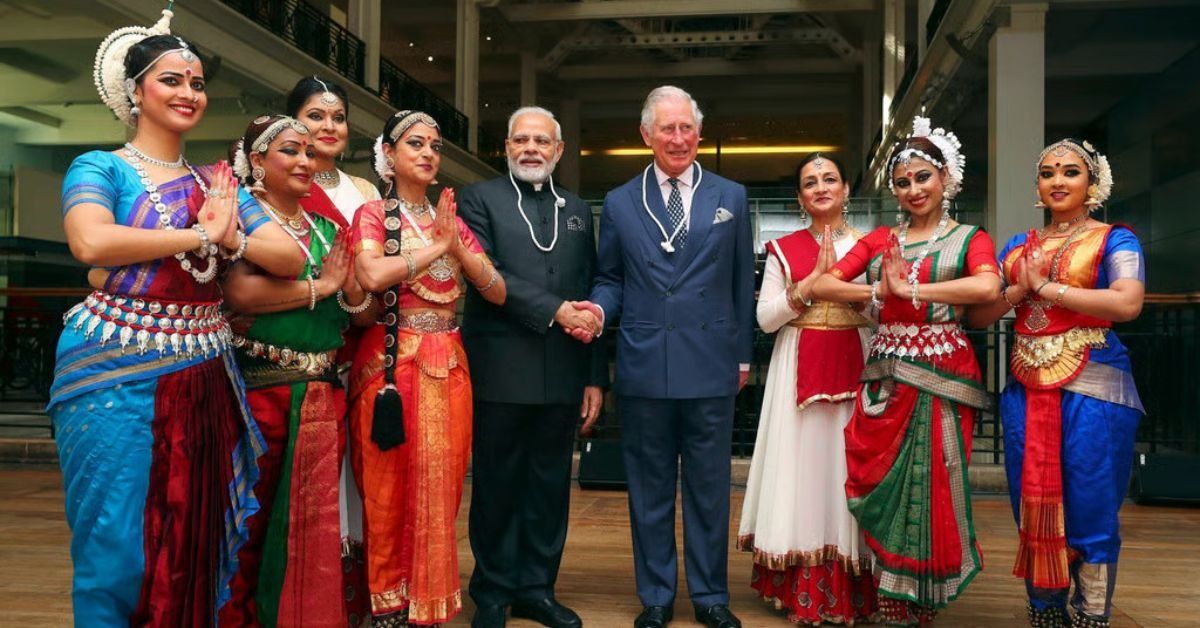
At the heart of it all is their teacher, Arunima Kumar, an Indian-origin dancer and choreographer redefining what Indian classical art can mean to the diaspora. Recently, she became the first Kuchipudi dancer to receive the Honorary British Empire Medal (BEM) from King Charles III — recognition for her “hands-on” service using dance to build community and bridge cultures.
UK Prime Minister Keir Starmer hosts a Diwali reception at No.10 Downing Street on 29 October.
(Photograph: Mina Kim/Getty Images)
Among her students is 12-year-old Aishwarya, who still remembers performing at 10 Downing Street with her guru. “It was really memorable, especially to dance in front of so many important people and spread the message of Diwali to MPs and the Parliament,” she says.
These moments are more than performances; they’re experiences that help a young generation stay rooted in an ancient art form, far from its birthplace.
A diaspora searching for identity
When Arunima first moved to the UK, she encountered something she had not expected — a profound lack of awareness about Indian classical dance, and almost no visibility for Kuchipudi.
The diaspora’s younger generation struggled with a familiar ache: how to connect with their heritage in an environment where such connections were rare. Many felt unsure about their Indian identity, and parents often had no avenues to expose them to meaningful cultural learning.
Arunima, who had learnt Kuchipudi since childhood, now embraced it with a deeper purpose. (Photograph: Arunima Kumar Team)
The problem wasn’t simply ignorance. The UK arts ecosystem was marked by subtle gatekeeping.
Despite being a national award–winning artist from India, Arunima was often slotted into stereotypical spaces — Indian cultural events, temple functions, weddings. Mainstream institutions rarely opened doors. Funding for classical Indian arts was limited and often directed to a handful of legacy organisations.
“Even with decades of training, I had to audition just to be seen,” she recalls.
Her first breakthrough came after a rigorous audition process that led to a performance at London’s Southbank Centre. “That moment changed everything,” she says. Brick by brick, she built a space where Indian classical arts could be practised with rigour — but also with accessibility, inclusion and pride.
Over the years, she created what has now become the largest Kuchipudi institution outside India — an arts ecosystem that welcomes people of all ages, abilities, genders, and backgrounds.
Today, Arunima teaches over 250 students every year across the world, has conducted nearly 1,500 workshops, engaged 100 inmates in prison programmes, and performed more than 3,000 times across 50 countries.
Her dance company has represented India at some of the world’s most iconic platforms — Buckingham Palace, the Queen’s Platinum Jubilee, 10 Downing Street, the Commonwealth Games, and the UK Parliament.
The moment that changed everything
For Arunima, these classes grew out of a journey shaped by discipline, migration, and a near-fatal turning point.
A former finance professional with degrees from St Stephen’s, Delhi, and the London School of Economics, her life veered unexpectedly after a medical emergency. Staring at the clock in an operating theatre as her heartbeat faltered, she made a silent promise: “If I could live, I want to make my life meaningful.”
That meaning returned her to Kuchipudi, the dance form she learned as a child — now embraced with deeper purpose.
The stage was only the beginning. Arunima felt drawn to places where art rarely enters: prisons, hospitals, and shelters. Her belief was simple — dance could be more than performance; it could be a tool for healing.
Dance as rehabilitation and renewal
While London is where she teaches most days, Arunima’s work in India reflects the core of her mission. She has led workshops for survivors of abuse, cancer patients, senior citizens — and most profoundly, for inmates at Delhi’s Tihar Jail.
Inside one of Asia’s largest correctional facilities, she conducts regular Kuchipudi sessions where inmates learn rhythm, movement, and expression.
“We all have an inner rhythm,” Arunima says.
“When that rhythm is nurtured, it can transform the mind, heart, and body. For the inmates, dance becomes a bridge back to themselves. They begin to see that they are not defined only by their past, but by what they can create now.”
Officers who initially regarded the workshop as a box-ticking exercise slowly began acknowledging the shift. Some even shared memories with her — about inmates who hadn’t smiled for months or participated in group activities, suddenly showing up with interest.
Arunima teaches over 250 students every year across the world, has conducted nearly 1,500 workshops, and performed more than 3,000 times across 50 countries. (Photograph: Arunima Kumar Team)
“They saw change before the inmates could articulate it,” Arunima says. “And maybe growing up with an officer father made me understand their lens too — how rare it is for them to witness moments of joy inside these walls.”
Listening to the inmates’ stories was profoundly humbling. Many had lived through circumstances so harsh and constraining. Seeing their humanity up close shifted her understanding of both people and the systems around them.
As trust deepened, the group began creating pieces drawn from their lived experiences — fragments of memory, longing, conflict, and hope.
She recalls meeting a highly educated woman convicted of killing her abusive husband. Initially mistrustful, she slowly opened up during the sessions. When Arunima once asked if she felt like a prisoner, the woman replied, “No, I’m actually free here. I feel free because I am not beaten every day, I can wake up not scared.”
The response became the seed for Bandini — a choreographed piece asking a simple but piercing question: Who is truly imprisoned?
“Healing is not running away from a problem,” Arunima explains. “It’s really going through the problem. And that’s what art does. They are human beings. They have a life. They have a journey till that moment…to really bring back humanity, somebody has to do it.”
These works eventually took shape as full performances, staged at the India Habitat Centre in 2014 with the support of Tihar’s authorities. Arunima still recalls the transformation she witnessed backstage: inmates carefully doing their makeup, fixing flowers into their hair, adjusting costumes, and laughing shyly as they prepared to step into the light.
For those few hours, the walls of the prison fell away. They weren’t inmates; they were performers reclaiming a sense of self that had long been denied to them.
While London is where she teaches most days, Arunima’s work in India reflects the core of her mission. (Photograph: Arunima Kumar Team)
In the UK, she worked with visually impaired multi-instrumentalist Baluji Shrivastav on Antar Drishti (Inner Vision), featuring a fully blind orchestra. The piece began in total darkness. “I wanted people to understand what it’s like to be in darkness all the time,” she says.
Audiences left in tears, shaken by the experience.
Finding healing through art
Over time, her classes have also become a refuge for adults — busy professionals, parents, and first-time dancers seeking balance in hectic lives.
For 42-year-old Swati from Goldman Sachs, it began as a mother-daughter activity. “The journey started when I was looking for a good Indian dance teacher for my daughter, who was four and a half then. She really loved it, and I thought, away from what I do at work, it would be something good that I could try.”
“So the journey started five years ago, where the idea was to do something just for fun. And now it is a part of life where both my daughter and I have been with Arunima and this community,” she shares.
For 50-year-old Paapadu, it’s been about fulfilling a long-cherished wish.
“I was born in the UK and raised in the US. I always wanted to learn classical dance, but as an immigrant with parents who were working very hard, it was too expensive and there was no time. So I was never able to learn. But when Swati asked about adult classes, I thought, okay, why not? I’ll give it a try.”
She adds, “I found that there’s a level of lyricism and fluidity, almost grace, in Kuchipudi that really attracted me. It’s mind, body, spirit — it’s all together. The movement that Arunima has started and the gift she’s giving to us really helps balance us, each of us in a different way.”
Students often say the classes are no longer just about perfecting steps — they’ve become sanctuaries of expression and calm.
A guru’s legacy, passed forward
The sense of community in Arunima’s sessions is palpable, even over a video call.
Children and adults share laughs, exchange knowing glances, and gently tease each other about their guru’s high standards. Beneath the humour, however, is unmistakable affection — for the craft and for the teacher guiding them.
India itself often struggles to preserve its classical art forms, many of which battle shrinking attention, funding, and recognition. Kuchipudi is no exception.
Traditionally performed exclusively by men in its original village troupes, the dance form has undergone a dramatic transformation over the last few decades as more women stepped into roles once denied to them.
Yet even today, many people in India remain unaware of its history, depth, or the rigour it demands.
India often struggles to preserve its classical art forms, many of which battle shrinking attention, funding, and recognition. (Photograph: Arunima Kumar Team)
This makes Arunima’s work not only culturally significant but corrective. By bringing Kuchipudi into global mainstream spaces and to diverse communities, she is helping reshape who gets to be seen as a bearer of this classical form. Her classes quietly chip away at centuries of gendered tradition, allowing a new generation to claim the art in once unimaginable ways.
In taking the dance to children of the diaspora, to British audiences, to survivors of violence, and even to inmates in India, she is doing something deeply Indian at its core: ensuring that tradition evolves, adapts, and stays alive. Her efforts are not just for the diaspora — they are part of a larger movement to keep India’s classical heritage relevant, respected, and accessible in an ever-changing world.
The roots of this ecosystem trace back to a studio in India where eight-year-old Arunima first learned Kuchipudi. Watching her former student’s journey with immense pride is her guru, Vanashree Rao. “She learned up until her marriage, and when she went to London, she did not give up,” Rao recalls.
“She worked so hard to build a complete atmosphere where classical dance can flourish. The rehabilitation work she does for old age homes, for cancer patients…it’s very commendable. Everybody can’t do it. You should really feel in your heart to help like that.”
It is this blend of artistic rigour and heartfelt service — passed from guru to shishya (teacher to student) — that defines Arunima’s work.
The road ahead
Three decades into her journey, Arunima is nowhere near done. If anything, her vision has become sharper: to build a global, inclusive movement for Indian classical arts. She hopes to expand her rehabilitation programmes and create structured, research-backed programmes that showcase how classical Indian dance can support identity and emotional healing.
The goal is simple but ambitious: to bring Indian classical arts into mainstream global spaces where they have historically been overlooked, and to ensure that dancers from India and the diaspora see themselves reflected with pride.
From a hospital bed in Delhi to the halls of London’s Royal Festival Hall and the barracks of Tihar Jail, Arunima’s journey is a testament to how art can rebuild, restore, and reconnect. She is not just preserving a classical tradition; she is activating it as a force for change.