

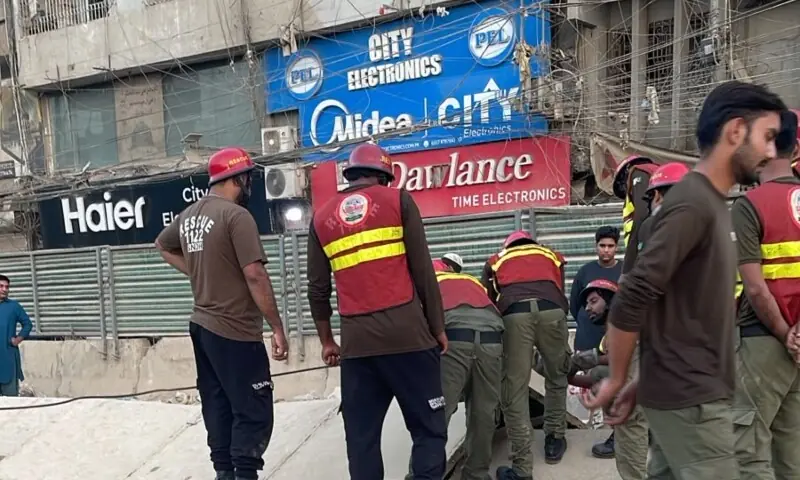
KARACHI: A person whose clothes said “security guard” and who had a whistle was killed on Wednesday after an under-construction bridge structure of the Red Line project collapsed near Baitul Mukarram mosque in Gulshan-i-Iqbal, according to a Rescue 1122 spokesperson.
Rescue 1122 initially identified the deceased as a security guard but later said his identity could not be confirmed.
Rescue 1122 spokesperson Hassaanul Haseeb Khan later told Dawn that they received information about the collapse of the BRT structure at around 5:30am. He said the structure was installed for the construction of a U-turn and the reason for its collapse could not be ascertained.
The urban rescue team reached the scene within three minutes of receiving the information, he added.
“Since the deceased had a whistle and the term ‘security guard’ was written on his clothes, we assumed he was a security guard. However, later on, relevant BRT project authorities told us that the deceased was not their security guard and he might be a drug addict who was passing through the area or was sleeping under it,” he said.
The body was shifted to Jinnah Postgraduate Medical Centre and his identity could not be ascertained immediately, the Rescue 1122 spokesperson said.
The collapse comes as work on the Red Line project continues. Last week, Sindh Senior Minister Sharjeel Inam Memon said efforts were underway to complete the ongoing work and restore traffic flow on University Road.
The stalled construction on the Red Line had resumed in November 2025, after the removal of several bottlenecks following the chief minister’s intervention.
Meanwhile, thousands of University Road commuters continue to face daily hardships.
Designed to cover around 27 kilometres from Malir Halt to Numaish via University Road, the BRT Red Line project was announced in 2017 with an initial cost of around Rs79 billion.
After commencement of the work in early 2022, the project was initially scheduled for completion by 2023, which was later pushed to 2024 and subsequently extended to the end of 2026.
Various factors have been cited by officials to justify these delays, including disputes with contractors, safety stoppages, rising construction costs due to depreciation of the rupee, difficulties in land acquisition, relocation of utilities and coordination failures between implementing agencies.
