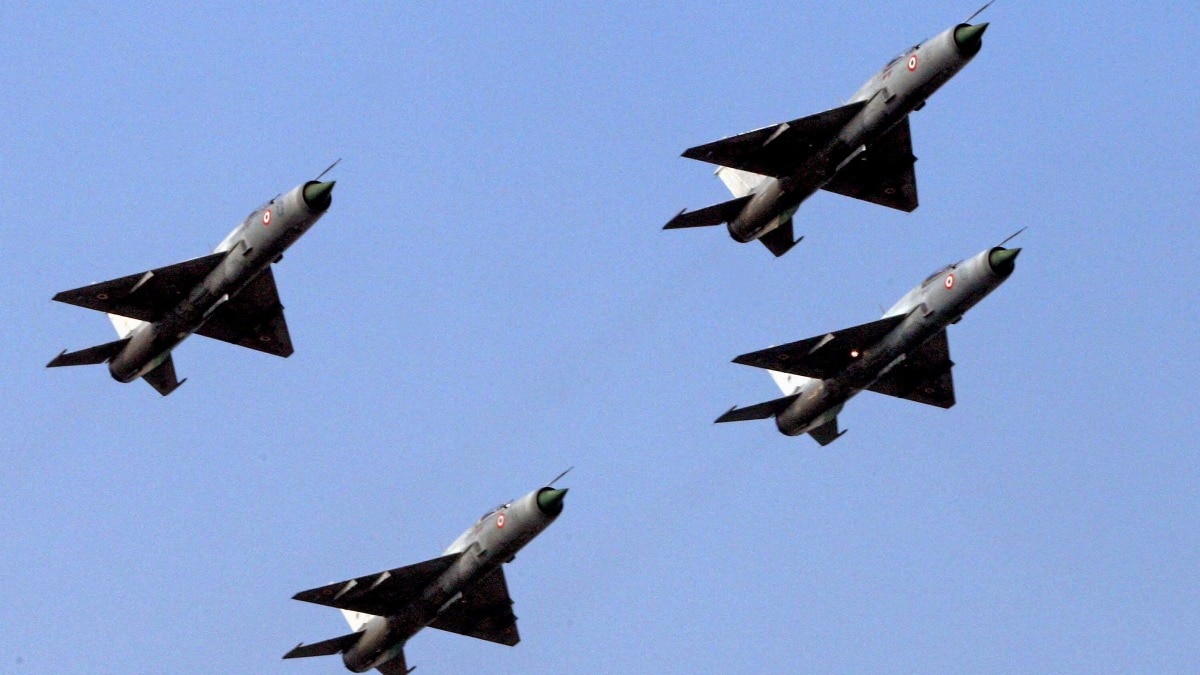
What happens when a trusted workhorse retires? For more than six decades, the MiG-21 wore that tag, serving as one of the Indian Air Force’s most trusted answers to threats facing the country. A year later, after the MiG-21 made its final sortie from the Chandigarh Air Base, a question remains. What happens to the aircraft after their flying lives have ended?
The answer is not a common fate for all of them. Hundreds of MiG-21s have left IAF service over the past decade, with the Indian Air Force phasing out a MiG-21 unit almost every year between 2015 and 2022, except in 2021.
“Age may have caught up with it, but it still went out there to prove itself. Trust me, even today, if something were to happen, this aircraft would go out there and prove itself once again.” That’s how Squadron Leader Parth Vikram, an officer in the Indian Air Force (IAF), spoke about the MiG-21 in the Netflix documentary The Last Salute.
So, do they sit quietly in hangars, their engines silent? Are they stripped of their combat role and turned into trainer aircraft? Or are they kept in reserve, waiting for the day they might be called back into action?
What Sqn Ldr Vikram said about the MiG-21 reflected the emotions of those who flew the beast and maintained it. But fighter jets do not live by sentiment. Retirement is destined.
But for a fighter that spent decades answering the call of duty, retirement does not always mean a single final destination. An senior IAF official told India Today Digital, “One or two aircraft will be available in the heritage flight.”
This means a couple of the MiG-21s will be preserved and maintained not for combat but to showcase the aircraft to future generations. This is not unusual for the IAF. It maintains and operates vintage aircraft such as the Tiger Moth, Harvard and Dakota, flying them during air displays and ceremonial flypasts as a reminder of India’s aviation heritage.
“Others will be available as museum or display pieces at prominent locations after due process is followed,” the official told India Today Digital.
This, too, is standard practice. Legendary aircraft such as the MiG-21 are often preserved as static displays in war and military museums — a rather fitting place for an aircraft that was once the enemy’s nightmare.
“Display pieces at prominent places” refers to the aircraft we see preserved across India, outside defence establishments, cantonments and other prominent public spaces — like the famous Indian Navy Sea Harrier displayed at Mumbai’s Bandra Bandstand.
Another senior IAF officer told India Today Digital, “The decommissioned aircraft’s components that can still be put to use will be saved, while the rest will be disposed of.”
“Some of the recovered material could be made available to engineering colleges for training,” the senior fighter pilot officer also said.
Chief of the Air Staff (CAS) Air Chief Marshal Amar Preet Singh inspects a MiG-21 aircraft before making a sortie. (Image: PTI)
WILL SOME MiG-21s BE SCRAPPED?
There is no official confirmation yet on whether some retired MiG-21s will eventually be scrapped. A senior IAF officer that India Today Digital reached out to refused to answer the query.
When military aircraft reach the end of their technical or calendar life, they are phased out and can be disposed of through the prescribed process.
However, at least one decommissioned MiG-21’s airframe was sold to a private establishment. The fighter, an older variant of the Mig-21, now stands outside Maharaja Dhaba on the Rohtak-Delhi highway in Haryana, alongside two tractors.
That, however, is unusual for a retired fighter in India. Abroad, retired military aircraft have an entire afterlife of their own. Demilitarised fighters are bought by collectors and warbird enthusiasts, who preserve them as pieces of aviation history and, in some cases, restore them to flying condition.
In the US, many retired military aircraft find their way to the famous “Boneyard” at Davis-Monthan Air Force Base in Arizona, where they are stored, preserved for possible reuse, stripped for parts or eventually disposed of.
Such private ownership of former combat aircraft remains far less common in India.
An old MiG-21 variant’s airframe at a dhaba on a Haryana highway. Its engine has been removed. The airframe was reportedly purchased at an auction in Pathankot, Punjab. (Image: samareagleriderindia via Instagram)
MiG-21: THE LEGACY OF A FIGHTER JET THAT DEFINED THE IAF
At its peak in the 1980s and 1990s, MiG-21s accounted for nearly 60% of the IAF’s combat fleet, according to the Ministry of Defence. The Air Force itself described the aircraft as having evolved into the “combat backbone” of the force.
In 2013, then Air Chief Marshal NAK Browne said five generations of combat pilots had “cut teeth” on the MiG-21. The IAF noted at the time that around 90% of serving fighter aircrew had flown a MiG variant at some point in their careers.
But the MiG-21’s long service came at a heavy cost. Then-Defence Minister AK Antony said in 2012 that 482 of the 872 MiG-21s inducted into the IAF had crashed, killing more than 170 fighter pilots. Since 2010, there had been over 20 such incidents. In 2021 alone, five MiG-21 Bisons were lost in accidents, killing three pilots. In May 2023, a MiG-21 crashed near Suratgarh, Rajasthan, killing three civilians after debris struck a house. The IAF then grounded the fleet.
Designed for a service life of 20-25 years, the MiG-21 was expected to retire by the mid-1990s. Yet HAL built more than 650 of India’s aircraft, across several variants, and the fighter served for nearly 63 years. Delays in the Tejas programme extended its life in the IAF.
By its final years, just 36 remained. The MiG-21 helped India win wars, but its legacy also carries the heavy toll of more than 170 pilots and nearly 40 civilians killed in crashes. Now, the MiG-21s will live on as monuments to a legendary era, but only a few will fly again.
– Ends