

Source: The inclusion solution
Halloween is supposed to be about dressing up, being creative, and, depending on your age, collecting enough sweets to make you regret your life choices by November 1. Every year, it arrives with the same excitement and a chance to become someone else for a night. But what happens when a costume crosses the line from spooky or silly into something that reminds an entire community of a painful history?
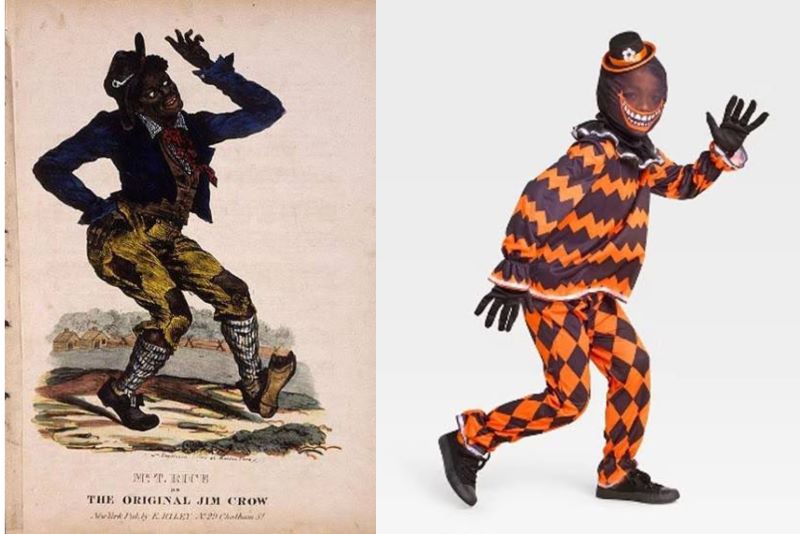
In August, a $25 children’s outfit called the “Kids’ Glows Under Blacklight Circus Clown Halloween Costume,” sold under Target’s seasonal Hyde & EEK! Boutique line was pulled from shelves. The promotional image featured a Black child in an orange and black bodysuit with a dark face covering and an exaggerated grin. This quickly drew criticism, with many online comparing the look to racist caricatures of Black people. It was said to echo something far older and uglier than a clown costume: the imagery of blackface and Jim Crow-era minstrel shows. Many questioned how the product made it through Target’s review process, with one comment on Target’s Instagram account reading: “This had to go through various channels before it even got approved for final production…why this didn’t get flagged from initial adoption is crazy to me.”
“This is exactly why you need a diverse team in the room!” another wrote.
Target issued an apology once the screenshots spread across Threads and TikTok. “As a company, we know we got this wrong, and we are deeply sorry. It is no longer available for sale. We know this is especially hurtful for our Black guests, team members, and partners,” the statement read.
But for many Black people, the issue was not simply whether the costume had been removed. It was why it was there at all. For some, the apology landed flat because this was not Target’s first time in this exact seat.
Actress Viola Davis said so plainly. On Instagram, she wrote: “Target, I do not accept your apology, and I do not believe that you understand the impact… the pain… the dehumanization of the above. These images laid the foundation and the ideology for every atrocity that has been committed against my people. We MATTER!! You have shown us that you are not on OUR side.”
Rev. Jamal Bryant, a Georgia pastor who led a 40-day “Target Fast” boycott last year, was just as direct. “A Jim Crow-era minstrel costume is not simply getting it wrong. It is a profoundly harmful symbol of racism that should never have been designed, approved, or sold by Target,” he said.
Source: Screenshot of the costume previously listed for sale on Target’s website/ Target apology on Instagram
Read also: 10 Halloween Costume Ideas Inspired By Black Characters
This was not a costume that slipped through unnoticed. Somebody sketched it, somebody styled a Black child in it for the campaign photo, somebody signed off on it going to print, and it moved through however many stages of review a national retailer has before it reaches a shelf. None of that happens by accident, and that is exactly why so many Black people heard “we got this wrong” and thought: how, again?
It is also worth saying this pattern is not unique to Target. Halloween aisles have sparked similar backlash for “sexy Native American” outfits sold by lingerie retailer Yandy, and for an “Arab nose” prosthetic and Israeli soldier costume that Walmart and eBay both pulled after protests from civil rights groups. Every autumn seems to bring its own version of the same argument. Somewhere between what a costume department thinks is spooky fun and what an actual community recognizes as its own history being mocked, something keeps going wrong.
For Black communities specifically, the issue hits harder because blackface and minstrel imagery are not just “insensitive”; they were tools that helped justify segregation, discrimination, and racial violence for generations.
This conversation is particularly complicated for Black people because there is a long history of Black appearance being turned into entertainment. Exaggerated lips, darkened skin, wild or unkempt hair, animalistic features, the “funny” Black character, and much more. These were not random creative choices. They were part of a wider culture of racial stereotyping.
Halloween has always involved costumes that borrow from different cultures, historical periods, and identities. The problem begins when cultural identity becomes the costume itself, particularly when the costume relies on stereotypes historically used to demean a group of people.
There is a difference between dressing as a character and dressing as a stereotype. There is a difference between appreciating a culture and reducing its people to caricatures. There is a difference between wearing a traditional outfit respectfully and exaggerating someone’s physical features for laughs. There is also a difference between something that makes people laugh with a community and something that historically made people laugh at that community.
So where do we go from here?
Source: halloweencostumes.com
Read also: Religion, Culture, and the Halloween Debate in Black and African Communities
The Target controversy is a reminder that cultural sensitivity is not a one‑off task; it requires ongoing attention. For retailers, pulling products and apologising is often the first step when something goes wrong, but prevention is better. Real prevention means diverse design teams, strong cultural review processes, and a genuine commitment to inclusion across the business.
For consumers, conscious shopping includes speaking up. The rapid pushback from everyday social media users is ultimately what forced a major corporation to pause and take responsibility.
Some may ask, are Black people offended by every Black character costume?
The answer is no, and this is where the conversation often gets unnecessarily complicated. There is a significant difference between “I’m dressing as a Black character” and “I’m dressing up in a way that imitates or caricatures Black people.” A child wearing a Black Panther costume is not automatically engaging in racism because Black Panther is Black.
Halloween is supposed to be about fun, dressing up as something you are not, from superheroes and movie characters to nurses, cowboys, historical figures, and celebrities for one night. There are literally thousands of costumes available that do not require turning someone’s race, culture, or history into the punchline.
So perhaps the easiest rule is also the most useful: Dress as the character. Do not turn someone’s race into a costume.

