

Media
“Honestly, I’m still messed up,” said Steve Levy during a phone conversation Friday.
Barry Melrose had so much working for him as a beloved, charismatic hockey analyst at ESPN for more than 25 years.
His look — easy smile, sharp suit, and a long slicked-back mullet that ought to have its own tribute at the Hockey Hall of Fame — was memorable and distinct, made-for-TV, and yet somehow authentic.
Melrose spoke about hockey on a level accessible to all, whether the viewer was a passionate lifer raised at a rink or someone who wasn’t quite sure what icing was.
The dual mission seemed to be to share his love for the sport, and the insight gleaned as a player, coach, and analyst, and to have a good time doing it.
All of those attributes made ESPN viewers feel like they knew him, or wish they had. When ESPN announced Wednesday that Melrose had passed away at age 70 after a battle with Parkinson’s disease, the news engulfed the hockey world in sadness.
It was of course especially difficult for those who were in his orbit, and knew him to be everything in real life that made him so likable on our screens.
“Honestly, I’m still messed up,” said Steve Levy during a phone conversation Friday.
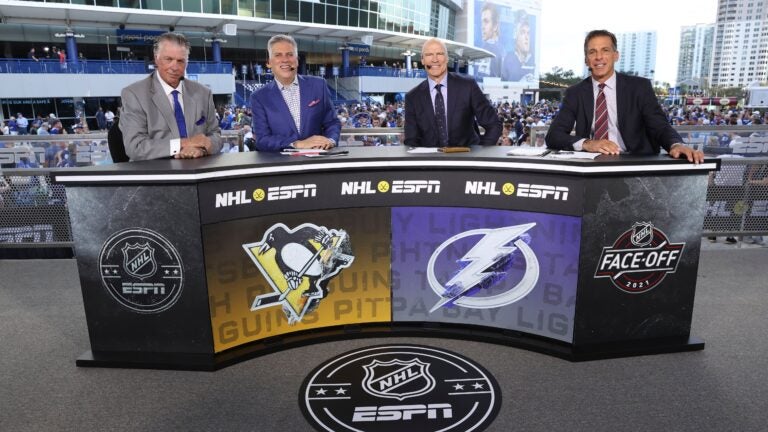
Levy worked alongside Melrose on ESPN’s NHL programming for decades, including every Stanley Cup Final from 1994-2022.
They were such close friends that Melrose’s wife, Cindy, reached out to inform him of her husband’s death. He passed along the news to ESPN management.
“I knew this day was coming,” said Levy. “I knew things had not been good. I’ve lost friends before, people I grew up with, but to lose somebody like Barry, whose such a public figure and who I have such an association with for decades … I’m still working through that. There are just so many memories.”
Levy said he recognized Melrose’s television talent immediately when they first began working together in the mid-1990s.
“Listen, I’m no fool,” said Levy. ”I absolutely attached my wagon to him, and I was smart enough to ride his extremely oversized coattails. Career-wise that was certainly a good move, but I grew to love the man. You start out in this business and you’re a colleague first and then, with any luck, you become friends. But it’s really rare to go from colleague to friend to family, and that’s how we did it.
“Every life event he’s had in the last 30-plus years, I’ve been at, and vice versa. My kids called him Uncle Barry. I just can’t believe I’m never going to hear that big laugh again. It’s really upsetting.”
Levy’s fellow longtime ESPN studio host, John Buccigross, was also close with Melrose. The three are rightfully credited for keeping the NHL in ESPN viewers’ consciousness during the 17 years the network did not have its broadcast rights.
“When I found out, I couldn’t say three words without starting to cry,” said Buccigross by phone Friday.
He was at a rink in Las Vegas, recording interviews with players and working on other material for the upcoming NHL season.
“SportsCenter asked me to be on that night,” said Buccigross. “I couldn’t. I just knew I would not be able to get through it. He was my best friend at ESPN.”
Buccigross said people were drawn to Melrose in part because he had the look of a star but the personality of someone who never forgot where they came from.
“He was this kid from tiny Kelvington, Saskatchewan, [population of approximately 900] who made it big, probably beyond his wildest dreams, but never forgot his roots,” said Buccigross. “He looked like a movie star, straight out [of] central casting, and had that star power mixed in with that farm boy humility where he never had any airs at all.
“He took every picture, signed every autograph, never said no to anything. He would be as friendly to the guy who couldn’t do anything for him as he would to the guy that wrote his checks.”
Levy said that’s exactly it.
“I mean, he came from a pig farm in Kelvington. There’s no more everyman than that right?” said Levy. “Yet on the other hand, he’d wear a $2,000 suit, and his tie was crisp and perfect, and his shoes always shined. He liked the finer things, but he never lost the ability to relate to the regular guy with the mullet.”
Levy paused for a moment, then continued.
“You know what he was, ultimately, in real life and on TV?” pondered Levy. “That guy you want to sit and watch a game with and have a beer or two and some laughs.
“That’s what you’re judged on as a broadcast team. Can you give that feeling to the guy at home? Barry led the league in that, all leagues, every year.”

Get the latest Boston sports news
Receive updates on your favorite Boston teams, straight from our newsroom to your inbox.
