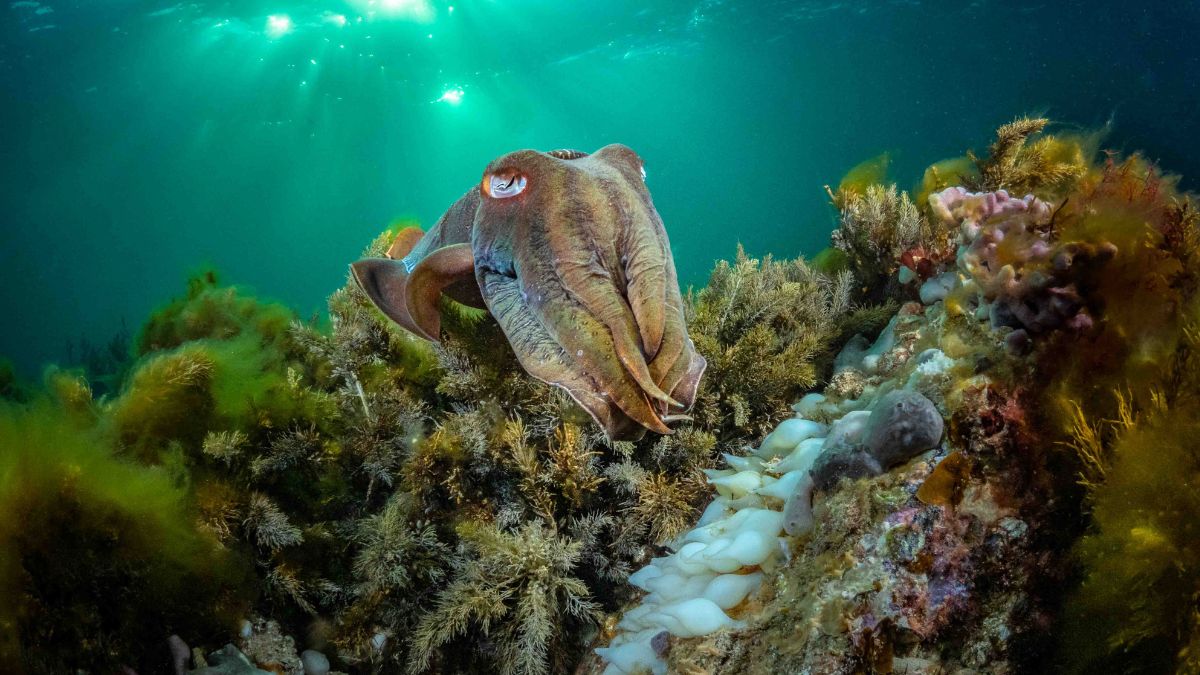
Photo courtesy of Whyalla City Council
South Australia’s famous Giant Australian Cuttlefish population has fallen to its lowest level since monitoring began almost three decades ago, with scientists estimating just 1,811 animals in the Northern Spencer Gulf this year.
The extraordinary figure is a dramatic fall from recent years and well below the previous record low of 13,500 recorded in 2013.
At its peak in 2020, the population was estimated at 247,000 cuttlefish.
The State Government has now expanded monitoring and research into the decline, including investigating whether South Australia’s harmful algal bloom has affected the population.
The annual aggregation at Point Lowly, near Whyalla, sees Giant Australian Cuttlefish gather in huge numbers to breed and is considered a globally unique natural phenomenon.
In strong years, as many as a quarter of a million cuttlefish can gather in the shallow waters off Whyalla for the colourful breeding event, attracting divers, snorkellers and wildlife enthusiasts from around Australia and overseas.
This winter, however, divers reported a vastly different scene, with some areas of reef largely empty.
Australian diver and filmmaker Woody Spark, of Grumpy Turtle Films, spent two weeks in Whyalla in June documenting the aggregation and said the absence was unlike anything he had witnessed previously.
“I spent 15 hours in the water that first week, diving empty, barren reefs, looking in every crack and crevice, and in that time I saw just 3 cuttlefish.”
Spark said he had filmed the aggregation many times before but had never seen numbers so low.
The Department for Environment and Water and South Australian Research and Development Institute completed their latest underwater surveys this month.
While cuttlefish numbers are known to naturally fluctuate significantly, this year’s estimate is by far the lowest recorded since SARDI surveys began in 1998, with some survey areas recording no cuttlefish at all.
The collapse comes as South Australia continues to deal with the impacts of an extensive harmful algal bloom that has affected marine environments across parts of the state.
While scientists have not yet established what caused the cuttlefish decline, the Australian Marine Conservation Society has pointed to the algal bloom as a likely contributor and is calling for further investment in long-term marine monitoring and habitat protection.
AMCS Wildlife and Habitat Campaign Manager Jaimi Webster said the dramatic absence highlighted how much remained unknown about the pressures facing South Australia’s marine ecosystems.
“Our oceans are changing in ways we can’t always predict or fully understand, and that’s exactly why we need to do everything we can to protect them and build their resilience.”
AMCS has called on the Australian and South Australian governments to coordinate further measures to protect marine wildlife, including greater transparency around current and future funding for long-term monitoring of marine species and habitats.
A new joint project involving the State Government and Adelaide University will look more closely at what is driving the changes.
Researchers will update population modelling to assess population size, variability and extinction risk, including the potential impact of the algal bloom.
Cuttlebones will also be collected and analysed to determine the age at which animals are breeding and whether the population contains two distinct age groups.
The research is expected to help fisheries, tourism operators, Whyalla City Council and government agencies better plan for future breeding seasons.
SARDI Executive Director Professor Mike Steer, who has studied the species for much of his career, said the latest result was difficult to see but history showed the population could recover rapidly.
“While this is the lowest population estimate we have recorded, we know from the past that this population has the capacity to recover when conditions are favourable.”
After numbers fell to the previous low of about 13,500 in 2013, the population rebounded to more than 100,000 animals by 2015.
Scientists say the species’ significant boom-and-bust cycles can be influenced by environmental conditions including water temperature and food availability.
There were also encouraging signs during this year’s breeding season, with adult cuttlefish continuing to arrive at the aggregation site, spawning taking place and eggs being laid.
The low numbers come after a temporary 90-day exclusion zone was introduced on July 1 around the Upper Spencer Gulf breeding site.
Swimming, snorkelling, diving and vessel anchoring were restricted within the zone to minimise disturbance to breeding animals, eggs and hatchlings.
Minister for Climate, Environment and Water Emily Bourke said understanding what had caused this year’s decline would be critical.
“The Giant Australian Cuttlefish aggregation is one of South Australia’s and the world’s most remarkable natural events and we are committed to understanding what has driven this year’s very low numbers.”
The new research is being funded through the Australian and South Australian governments’ $165 million algal bloom response and recovery package.
Taking Giant Australian Cuttlefish in the northern Spencer Gulf is prohibited, with penalties of up to $20,000.