A rusted shack appears first. Then an old filling station with black holes for windows. Around them is red dirt, weathered timber, pale grass and a few barrels sitting out in the sun. It looks like a Western movie set after the crew has packed up and left.
“This is the town of Cisco,” says Neal Taylor, our tall, silver-haired guest services manager, looking dapper in an olive-green suit and orange bow tie. “Population four,” he adds, breaking into a wry grin.
From the train window, four feels generous, though Cisco was not always this empty. It began as a saloon and water-refilling stop in the 1880s, then gathered the modest machinery of a service town: stores, hotels and fuel for anyone crossing this dry stretch of Utah. Now it sits low and crumbling against red dirt and the long wall of the Book Cliffs beyond.
“Johnny Cash once rolled up near Cisco in a black Cadillac,” Taylor says as the ruins pass the window. Behind the counter was Ballard Harris, a filling-station owner whose business was doomed by the new interstate diverting traffic away from town. Cash turned the encounter into the 1968 track Cisco Clifton’s Fillin’ Station, about a man watching the cars — and his livelihood — pass him by.
ROAM. Landing in your inbox weekly.
A digital-first travel magazine. Premium itineraries and adventures, practical information and exclusive offers for the discerning traveller.
By continuing you agree to our Terms and Privacy Policy.
It’s one of many stories stitched into this historic rail corridor. Now Cisco is being passed again, this time by a glass-domed train moving slowly enough to make a spectacle of it.
ROAM is aboard Canyon Spirit’s newly extended three-day route from Denver to Salt Lake City, tracing a railway completed in 1883. The scenery delivers — ruby-red canyons, snow-capped mountains and the gleaming Colorado River — but the route is made richer by its roadside oddities — ghost towns, Butch Cassidy legends, rusted sculptures and the occasional fisherman mooning the train. True.
Meals, drinks, snacks, luggage handling and station transfers are included, with guests stepping off each evening into hotels along the line. Credit: Andrew Maguire
Inside, Canyon Spirit feels old-school in the right ways — deep reclining seats, hosts working the microphone, cocktails on cue. Meals are served at-seat and nod to the territory outside — bison Benedict, Colorado trout, local whiskey, cheese and honey — while passengers drift between the open-air viewing platform and the bar carriage, where you might catch an impromptu piano song.
The Canyon Spirit’s newly extended three-day route travels from Denver to Salt Lake City, tracing a railway completed in 1883. Credit: ROAM/ROAM
By the time the train reaches Cisco, it’s already spent the better part of two days working west from Denver, crossing the Continental Divide, following the Colorado River and stopping overnight in Glenwood Springs. Canyon Spirit runs only by day and travels at an average of 56km/h, so the landscape is never lost to darkness or speed. Each evening, passengers step off the train and into the towns along the route.
The grand Hotel Colorado was opened in 1893 and still looks the part — red brick, arched windows, taxidermy, chandeliers, a lobby pitched somewhere between hunting lodge and faded palace. Credit: Haizhan Zheng/Getty Images
“And now, we are approaching what is known as the White House of the West,” Taylor said over the microphone the afternoon before, as the train pulled into Glenwood Springs. He was referring to the grand Hotel Colorado, opened in 1893 and still looking the part — red brick, arched windows, taxidermy, chandeliers, a lobby pitched somewhere between hunting lodge and faded palace.
The scenery delivers — ruby-red canyons, snow-capped mountains and the gleaming Colorado River. Credit: ANDREW MAGUIRE
The nickname comes from Theodore Roosevelt, who stayed here often enough on hunting trips for the hotel to become a kind of western base. Across the road, Glenwood’s other institution is even older. The hot springs pool opened in 1888 and is billed as the world’s largest outdoor mineral hot springs pool — vast, steaming and absolutely worth it after a day on the rails.
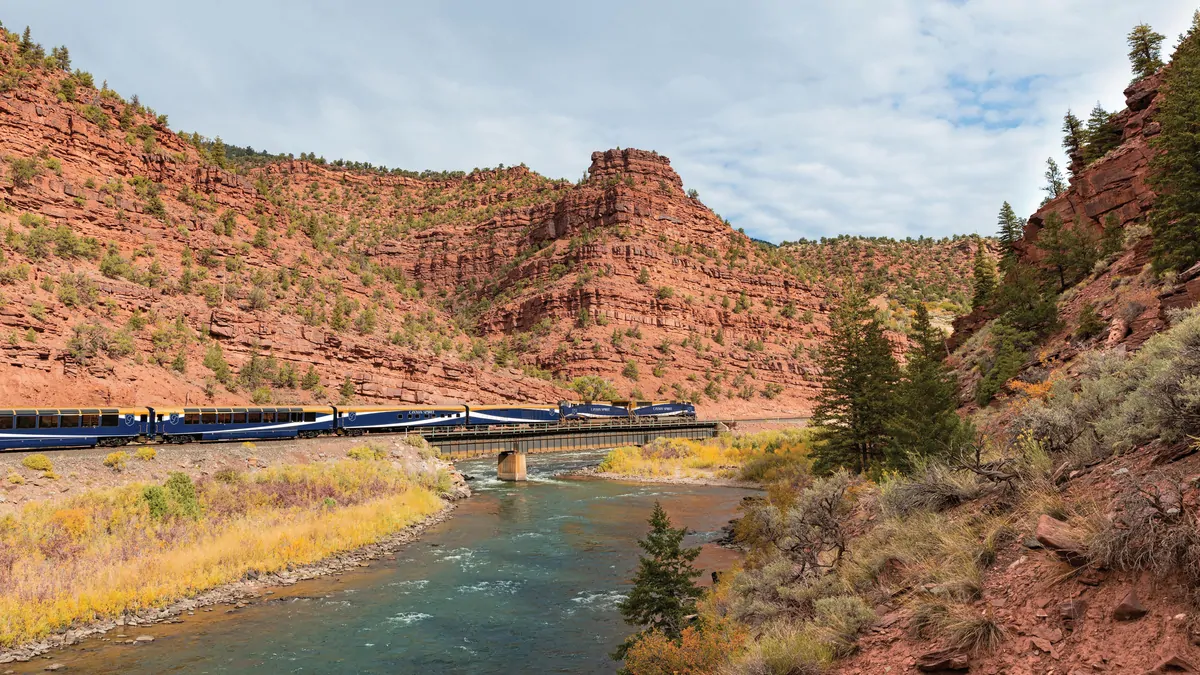
Presidential lodgings aside, the route saves its biggest flex for Ruby Canyon, 40km of red sandstone cut by the Colorado River along the Colorado–Utah border. The train hugs the cliff edge, the river flashing below, walls of rust, oxblood and blackened rock rising close on either side. It feels faintly unreal, like being inside a video game set to maximum landscape.
A little further along, as the train crosses the State line, Taylor points out the Moki steps — small hand- and footholds cut into the sandstone, once used by Ancestral Puebloan people. In a canyon this vast, they are a quiet jolt; human marks in stone, older than the railway, older than the border, and a reminder that history in the west stretches far beyond Johnny Cash and Butch Cassidy.
The train hugs the cliff edge, the river flashing below, walls of rust, oxblood and blackened rock rising close on either side. Credit: ROAM/ROAM
By the time Canyon Spirit rolls into Salt Lake City, the route’s delivered the west in all its registers — grand, strange, funny, sun-drenched, sparse. At the station, more than 50 people form a guard of honour, waving the train in. After three days of canyons, ghost towns and mooning fishermen, it feels about right — a welcome party for a train that’s taken the scenic route seriously.
VISIT
Canyon Spirit’s three-day Rockies to the Red Rocks journey runs between Denver and Salt Lake City from April to November, with hotel nights in Glenwood Springs and Moab included. The route operates in both directions and fares for the three-day journey start from about $3441 per person.
KNOW
This is a daylight train, not a sleeper. Meals, drinks, snacks, luggage handling and station transfers are included, with guests stepping off each evening into hotels along the line. Signature Experience includes glass-dome seating and at-seat service; the Premier Upgrade adds access to the lounge/bar carriage. Add time in Moab for Arches and Canyonlands national parks, or, use Salt Lake City as the start of a longer Utah trip.