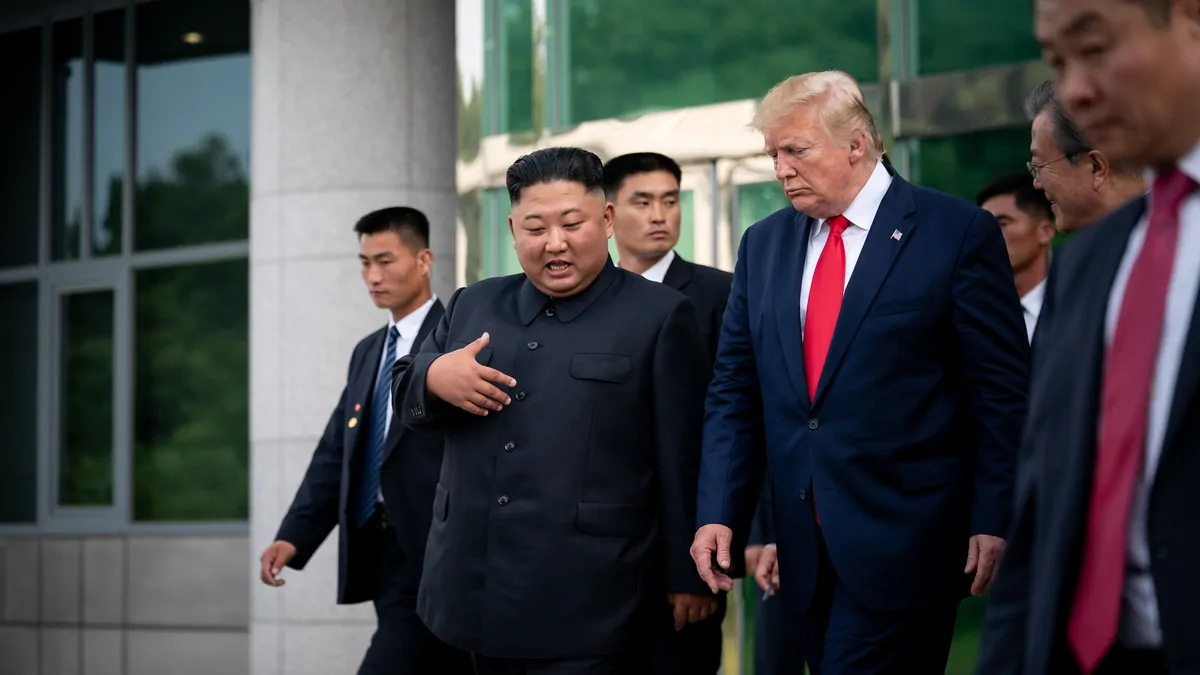
President Donald Trump meets North Korea’s supreme leader Kim Jong Un on February 27, 2019, in Hanoi, Vietnam, to discuss a potential denuclearization deal.Evan Vucci/AP
Get your news from a source that’s not owned and controlled by oligarchs. Sign up for the free Mother Jones Daily.
North Korea launched several ballistic missiles toward the Sea of Japan on Thursday, according to South Korea’s military—just a day after the North dismissed Donald Trump’s seeming attempt at appeasement by cutting back on joint military training with South Korea.
“The provocative, aggressive nature of the drills won’t change even though their duration and size were reduced,” Kim Yo Jong, a top figure in North Korea’s ruling party and supreme leader Kim Jong Un’s sister, said on Wednesday, pointing to other military drills the US and South Korea carried out earlier this year and to South Korea accelerating its development of nuclear-powered submarines.
Before the drills began this week, North Korea said it would retaliate with “a new level of a deterrent.” North Korea had already fired at least two ballistic missiles into the sea earlier this month before the barrage on Thursday.
While Kim Yo Jong said relations between her brother and Trump are “still excellent”, she said she was “completely unaware” of any communications between the pair following Trump’s decision to scale back the joint drills this month by about half—a claim the US president made earlier this week.
The back-and-forth between Kim Jong Un and Trump goes back to Trump’s first term, where peace negotiations between the pair collapsed in 2019 amid disputes over how much sanctions relief North Korea would receive for partial denuclearization. Kim has since sought to further militarize and cooperate with Russia, but he said last September that he would be open to resuming talks if the US dropped its “obsession” with eliminating North Korea’s nuclear weapons.
But Trump’s decision to cut military training with South Korea looks to have had only negative consequences, angering that country to the point of President Lee Jae Myung calling to retake full control of its military operations from the US—despite Trump both claiming that the move would keep countries like South Korea and Japan safe and pushing other countries in Asia to ramp up their own defense spending and look for new allies.