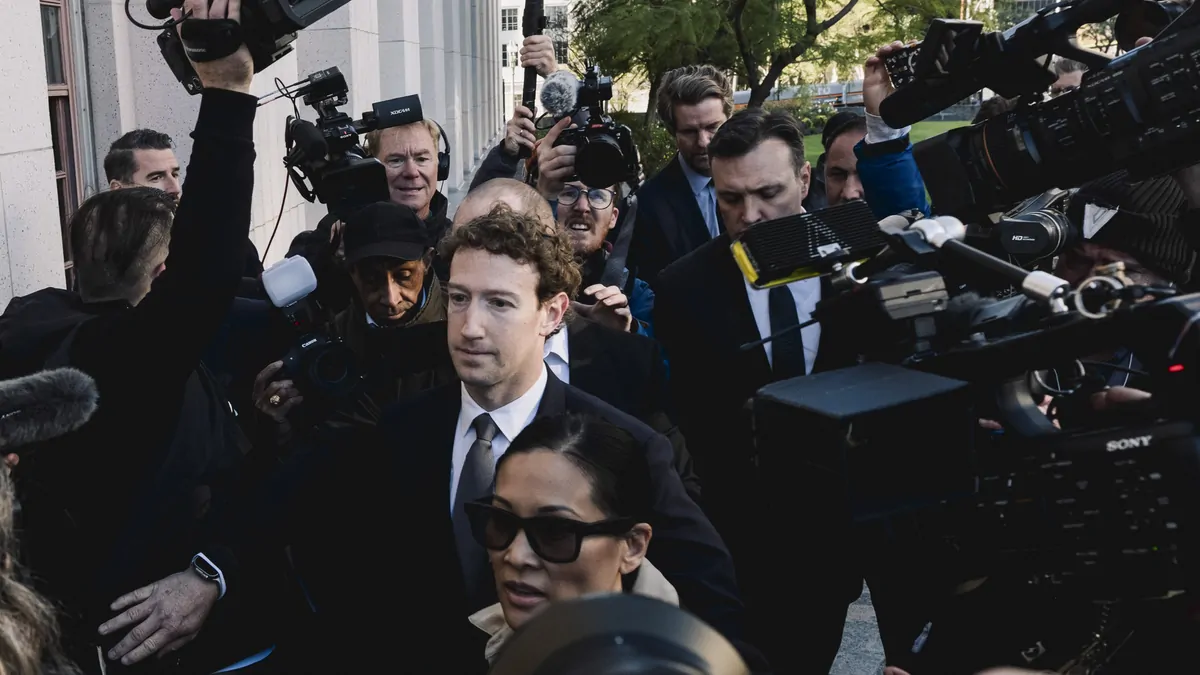
WASHINGTON — Meta on Tuesday again defended itself over claims it addicted young people to social media, this time in the first bellwether federal trial, brought by states seeking roughly $200 billion in damages.
In opening statements, California, Colorado, Kentucky and New Jersey accused the social media giant, which owns Instagram and Facebook, of harming children with technology designed to be addictive like cigarettes. Meta helped fuel a national youth mental health crisis and deceived users by promoting its apps as safe, the states argued in U.S. District Court for the Northern District of California in Oakland.
The suit charges the company with violating federal child privacy laws and state consumer protection laws.
Sign up to The Nightly’s newsletters.
Get the first look at the digital newspaper, curated daily stories and breaking headlines delivered to your inbox.
By continuing you agree to our Terms and Privacy Policy.
“Hook the users. Hold them for as long as they can. Harvest their data. Hide the truth from the public when making public statements,” Megan O’Neill, a lawyer for the states, said during her opening statement. “Meta’s business model worked especially well for kids.”
Meta argued that it put in safeguards to protect young users and that it was truthful to consumers.
The lawsuit is among thousands of personal injury and consumer protection lawsuits filed by states, school districts and individuals against Meta, YouTube, TikTok and Snap, which owns Snapchat. The cases claim that social media sites have harmed children with addictive products, drawing inspiration in part from a legal playbook used against Big Tobacco in the 1990s.
The strategy has already paid off. In March, Meta and YouTube were found liable in a landmark personal injury case in California’s Superior Court of Los Angeles County, where a young California woman was awarded $6 million in damages. This month, a New Mexico judge ordered Meta to pay damages totaling nearly $1 billion in a case brought by the state attorney general for violations of consumer protection laws. The companies have settled several other cases that were headed for trial this year.
The four states’ case — the first in a series of federal test cases — poses a significant legal threat to Meta after those earlier losses. If the states win, they have said, they will seek damages approaching $200 billion for consumer protection violations, according to a court filing. That would be nearly 14% of the entire stock value of the company, which stood at $1.45 trillion on Monday, according to a court filing.
Concern about social media use has mounted globally. Australia last year became the first country to bar children under 16 from using social media. Since then, Denmark, France, Germany, Spain, India, Indonesia, Malaysia and others have carried out or are considering similar rules. The European Union last month took the first step toward its own ban, which would be the largest in the world.
In the United States, lawmakers this year reintroduced the Kids Online Safety Act, a bill that would strengthen privacy for minors and allow them to opt out of algorithmic features that have been linked to compulsive use of social media. States have also passed multiple laws to protect children from social media harms.
Meta has faced the most scrutiny. In Tennessee, a trial is underway after the state attorney general charged the company with disregarding internal research that found its platforms were hurting young users.
Defense costs are adding up. From April through June, Meta said, it spent more than $2 billion on legal expenses related to the social media addiction trials and other litigation. While that is a fraction of its $18 billion quarterly profit, thousands of similar lawsuits remain.
Meta has argued that it is being singled out for challenges faced by all internet companies, such as verifying the ages of its users. Its safeguards include its Instagram Teens feature for users 13 to 17, which makes data private by default and restricts the ability of strangers to directly message young users, the company has said.
The company has also said the case should be thrown out because of speech protections and a federal shield, Section 230 of the Communications Decency Act of 1996, which protects it from liability for what its users post. The 9th U.S. Circuit Court of Appeals this month tossed Meta’s motion to dismiss the case on free speech grounds.
The state attorneys general “may call this a landmark case, but their limited claims are unsubstantiated and their financial demands are vastly disproportionate,” Liza Crenshaw, a Meta spokesperson, said in a statement. “We’ve listened to parents, worked with experts and law enforcement and conducted in-depth research to understand the issues that matter most.”
The four states bringing Meta to trial in Oakland were selected by Judge Yvonne Gonzalez Rogers from a group of 29 states that have sued the social media giant on claims that it violated federal child privacy and state consumer protection laws. She chose the cases from California, Colorado, Kentucky and New Jersey.
The trial is expected to last six to eight weeks. An eight-person advisory jury will give a recommendation to Gonzalez Rogers, who will ultimately determine a verdict and damages.
The states plan to call prominent witnesses including Meta CEO Mark Zuckerberg, to testify. The attorneys general also plan to use internal documents and interviews with current and former Meta employees to show the company internally discussed how tools like infinite scroll and beauty filters — photo effects that alter a person’s appearance — contributed to compulsive use and anxiety among young users. Still, the company promoted its platforms as safe for youths, the states claim.
The states also argued Tuesday that the tools that Meta promotes as teen safety features are rarely used.
The state attorneys general have asked for changes to the company’s technology to better protect young users. Those include bans on infinite scrolling, auto-play of content and “like” buttons for users under 18. They have also asked for bans on beauty filters that can contribute to body image and mental health issues, and engagement-optimized algorithms that lead users to additional content.
© 2026 The New York Times Company