

Local News
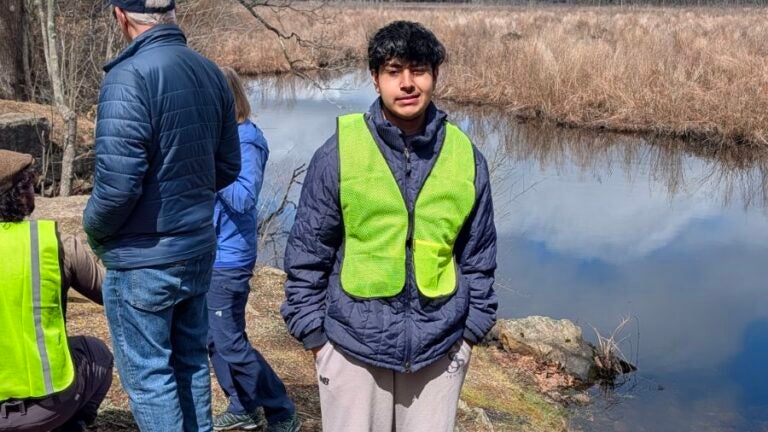
Rising St. John’s Prep senior Arush Shangari, 17, developed Project IRIS, an AI-powered flood prediction and disaster response tool that he’s working to roll out across the U.S.
Arush Shangari, 17, has lived two miles away from the Ipswich River his entire life. Now, in what started as a school project, Shangari is working to protect communities along the river and others alike across the country.
Having spent his Sundays volunteering at the Ipswich River Watershed to test water quality, Shangari was shocked when he learned in 2021 that the Ipswich River was named one of the 10 most endangered rivers in the United States.
“This was really surprising to me, especially since I lived just a few miles away and I canoe there,” he said. “So I was like, ‘Wait, that’s actually a big issue.’”
The Ipswich River, which flows for 45 miles from Burlington to Plum Island Sound, is under the grave threat of excessive water withdrawals and flooding, according to the American Rivers Organization.
Shangari said there are only two gauges in the whole Ipswich River, which measure real-time water levels. He said this is a problem because the Ipswich River is “known to be volatile,” and with just two gauges you’re unable to track water levels in all parts of the river.
“Installing another [gauge] would cost more than the [Ipswich River Watershed] association could afford,” he said. “I kept returning to one question: If we could not collect more data, could we learn more from the data we already had?”
This prompted Shangari, a rising senior at St. John’s Preparatory School in Danvers, to develop Project Integrated River Intelligence System. Project IRIS is an AI-powered flood prediction and disaster response tool using real-time public source satellite imagery.
Project IRIS is designed to help local governments and rescue teams respond faster when flooding happens, with 24- to 72-hour emergency flood alerts, Shangari said.
The app automatically alerts appropriate authorities and disaster-relief organizations on a geolocated basis. It’s currently only been trained on the Ipswich River, with a 98.08% AI prediction accuracy, but Shangari said it is a watershed-agnostic tool that can be applied anywhere.
It is in the process of being integrated in Wilmington and North Reading by town engineers, Shangari said.
Real-time data
Erin Casey, executive director of the Ipswich River Watershed, said while they have not yet implemented the data Arush brought forward with Project IRIS, real-time satellite imagery can be a helpful alternative to additional gauges.
“In rivers like ours, which are relatively small and very responsive to both rainfall events and drought events, water levels go up pretty quickly and they also drop pretty quickly,” she said. “Having that real time data that satellite imagery provides is really helpful in understanding how the entire system works together.”
Shangari began the development of Project IRIS last September, through his Advanced Research Capstone class at St. Johns Prep. The capstone class is a course that guides students through a college-level research cycle.
Shangari, who was the first junior to ever take the course, was encouraged by his teacher Danielle Poché to explore his passion for the Ipswich River when it came to selecting a research topic. Students can research any topic of their choice, Poché said, but she encourages backyard research and the topic must align with values in Catholic social teaching, including “care for God’s creation.”
“It’s all on him, that [Project IRIS] became what it did,” Poché said. “I just helped plant seeds.”
Creating prototypes to actually resolve the identified problem is optional for students taking the class. Poché said “Arush went above and beyond” when he created Project IRIS.
“The level of engagement he has with learning is pretty amazing,” she said. “He has amazing ideas. It’s one thing to have amazing ideas, a lot of students do. It’s another thing to have grit and grind out the time to do it and to follow those ideas and to believe in oneself and believe in one’s ideas enough to do it.”
‘Many failed designs’
Before he began developing the AI tool, Shangari said he had to learn more about the problem through interviews with leaders of the Ipswich River Watershed and the Engineering Department of Wilmington, located on Ipswich River.
These interviews were meaningful in understanding what the problem was and how he could address it, Shangari said.
“The whole interviewing process was definitely the most impactful part of the journey,” he said. “I knew the problem was big, but the power of learning about those who are impacted by the problem was really beneficial because it helps you understand what is truly needed.”
Shangari also gained knowledge from John Little, founder of the Missisquoi River Basin Association in Vermont. Each student in Poché’s class is paired with an alumni mentor. Shangari was paired with Little, who said he helped teach Shangari about the “older style stuff” on the Ipswich River throughout his research process.
After the interviews, Shangari began designing the project using AI deep learning and machine learning, skills he developed through programs at Massachusetts Institute of Technology.
“Through MIT Beaver Works and MIT CSAIL, I taught myself artificial intelligence and time-series forecasting,” he said. “The learning curve was brutal: weeks of failed code and models that misread basic weather patterns. But that frustration built the technical foundation I needed to create a tool.”
While it only took about three weeks to train the final AI model, Shangari said he had “many failed designs” in the process.
“There were times when I built something that wasn’t really solving the direct problem,” he said. “That’s where it was important to get the feedback, communicating with local government, seeing, is this a tool that is really needed? Is it something that you can use on a regular basis? Is it a useful tool? So there was a lot of that error analysis and just learning in general.”
Poché said she was “really proud” to see Shangari listen and learn from the people around him about how his project could best make a difference.
“He went into his project thinking he had a good idea for what needed to be done or how he could help, and he was right about some of those things,” she said. “But some of those things, he didn’t know or realize until he listened to people at the Ipswich River Watershed, people in the AI world, and his alumni mentor.”
A ‘weather guy’
Shangari won the 2026 Trailblazing Student Award from the Ecological Society of America for his work on Project IRIS, presented at their annual meeting in Salt Lake City in July.
He was also awarded a $4,000 grant prize for Project IRIS by the Shane McConkey Foundation. Shangari said he will be using this funding to build drones he can deploy on the site, to improve accuracy in the AI training.
In the future, Shangari said he hopes to expand Project IRIS by reaching out to additional town governments, engaging regional municipalities across the Ipswich River Watershed and continuing to pursue grant funding. Shangari said he wants to expand to other U.S. watersheds once Project IRIS becomes public, and raise awareness of an alternative solution to building new gauges in rivers.
Little said while Project IRIS is impressive, it’s going to take more work to get it entirely figured out.
“All the latest and greatest things always take time,” he said.
Shangari, who calls himself a “weather guy” and has been interested in meteorology since he was a kid, said his success with project IRIS showed him the importance of following your passion.
“I really have my passion,” he said. “As long as you do what you love, you can be as successful as you want … It’s really important to be a leader who really cares about something, then take initiative from that.”
Shangari said he hopes to one day create a community of climate tech engineers who can work together to solve the world’s largest environmental issues.
Poché said it was inspiring to watch a class project turn into such a success.
“It’s every teacher’s dream,” she said. “So much came from him, but it made me so thrilled to do what I could, the small part that I could, to provide the path for him and to provide the environment for him to succeed.”
Shangari said through it all, he’s kept in mind an early conversation in his research that reminds him why Project IRIS is important.
“Something that motivates me to this day, I wrote it word for word on a piece of paper, the director of Ipswich River Watershed, Erin Casey, said, ‘This is a significant need for an unmet problem,’” he said.
Despite juggling a summer research internship at NASA, a Mantis AI internship at MIT, serving as leader of several school clubs and founder of other AI initiatives, along with typical teenage activities like college applications and sports, Shangari said he remains committed to Project IRIS knowing it can “save a lot of lives.”
“Even one minute matters, and being able to predict in advance, but also respond in advance, is very critical and a critical problem that we need to solve as a community,” he said. “That’s the driving urge behind it.”
Sign up for the Today newsletter
Get everything you need to know to start your day, delivered right to your inbox every morning.
