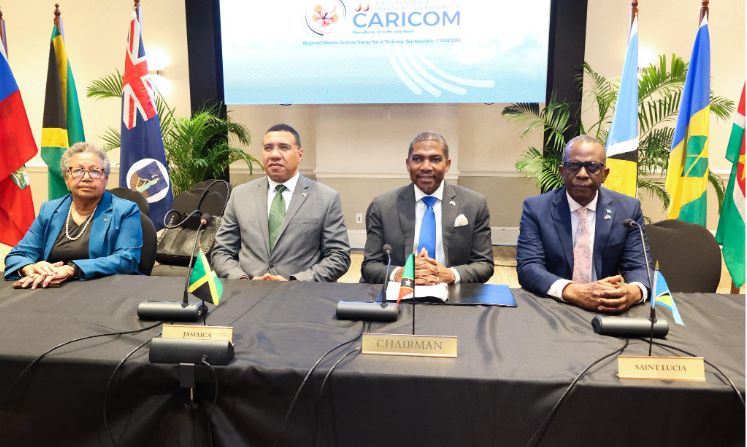
Source: Caricom.org
For decades, the question of reparations for slavery and colonialism has remained one of the most difficult and controversial issues in international affairs. The devastating consequences of slavery and colonialism are well documented, yet debates over the legitimacy, scope and merits of reparations have continued to generate strong arguments on both sides.
For the Caribbean, however, it has never been simply a debate about the past. It is a question of how historical systems of exploitation shaped the present and whether the countries and communities that suffered from those systems should receive meaningful support to address their consequences.
Today, the reparations campaign led by the Caribbean Community (CARICOM) appears to have gained new momentum. What was once largely viewed as an activist or academic demand has increasingly developed into an organized diplomatic, political and international campaign.
In March 2026, the United Nations General Assembly reached a significant milestone when it endorsed a Ghana-sponsored resolution that formally recognized the transatlantic trafficking and enslavement of Africans as among the most grievous crimes against humanity.
As noted on the United Nations Ghana website, “The United Nations General Assembly voted to designate the Transatlantic Trafficking of Enslaved Africans and the system of racialized chattel enslavement as ‘the gravest crime against humanity.’ Adopted on Wednesday, 25 March 2026, with an overwhelming majority of 123 Member States voting in favour, UN Resolution A/80/L.48 marks a historic shift in the international community’s engagement with the enduring legacies of slavery.”
This resolution represented an important step in the long-running global campaign for historical justice and reparations.
In June 2026, the momentum continued when Ghana convened a High-Level Consultative Conference on Reparations in Accra. Attracting representatives from governments, international institutions, legal and academic circles, and civil society organizations. Participants focused on strengthening international cooperation and developing a common approach to pursuing reparations and addressing the enduring consequences of slavery.
The foundation of the Caribbean reparations argument is rooted in the history of the transatlantic slave trade, African enslavement, Indigenous dispossession and European colonialism.
For centuries, millions of Africans were forcibly transported across the Atlantic and subjected to a system of plantation slavery that generated enormous wealth for European empires and commercial interests. Caribbean economies were structured around this exploitation, while enslaved Africans were denied freedom, education, political rights, property ownership and basic human dignity.
The end of slavery did not immediately produce equality. Instead, many formerly enslaved people entered societies where economic and political structures continued to favor the descendants of slave owners and colonial authorities.
These historical experiences became central to CARICOM’s reparations agenda. CARICOM’s argument is therefore broader than simply demanding financial compensation for slavery. Its Ten-Point Plan for Reparatory Justice calls for measures including formal apologies, repatriation, cultural restoration, educational development, debt cancellation, health initiatives and economic assistance.
The CARICOM Ten-Point Plan for Reparatory Justice is both a policy framework for Caribbean governments and a broader statement of purpose for the global movement seeking justice for the descendants of people affected by slavery, colonialism and exploitation. Developed within the Caribbean context, the plan provides a foundation for addressing historical injustices committed against Indigenous peoples, Africans and other communities while highlighting the enduring consequences of these actions.
At the heart of the plan is CARICOM’s demand for reparations from European states and other countries that benefited from the transatlantic slave trade, African enslavement and colonial exploitation. The initiative recognizes that the effects of these historical systems did not disappear with emancipation or political independence. Instead, their consequences continue to influence economic inequality, social development, institutional structures and the quality of life across many Caribbean societies.
Source: Caricom.org
Read also: The African Union’s 2025 Reparations Agenda
The framework places particular emphasis on three interconnected historical experiences: the destruction and displacement of Indigenous populations, the enslavement and exploitation of Africans, and the system of indentured labor that brought large numbers of Asians to the Caribbean under oppressive conditions. Rather than treating these histories as isolated events, CARICOM presents them as interconnected components of a wider colonial system built around exploitation, extraction and the concentration of wealth and power.
Importantly, the Ten-Point Plan goes beyond a demand for financial compensation. It connects reparations to the broader development needs of Caribbean nations and identifies areas where meaningful redress could contribute to long-term social and economic transformation. In this sense, reparatory justice is presented not simply as compensation for past suffering, but as an opportunity to address some of the structural disadvantages that historical exploitation helped to create.
The plan also provides a platform for international advocacy and public mobilization. It gives governments, civil society organizations, communities and advocates a common framework through which the case for reparations can be articulated and advanced.
This distinction is important. Reparations, in the CARICOM framework, are not presented as charity. They are presented as a repair program designed to address historical injustice and its ongoing consequences.
This position is aptly reinforced by the Chairman of the CARICOM Reparations Commission (CRC), Professor Sir Hilary Beckles, who noted that, “In the CARICOM Reparations Commission, we are of the view that reparatory justice is part of our development conversation, the conversation is about repairing the economic, social, and cultural resources that are necessary for human development.”
One of the strongest reasons the campaign has gained momentum is that Caribbean governments have moved beyond individual voices and adopted a collective regional position.
This has given the campaign something that many historical justice movements have struggled to achieve: an institutional structure.
Rather than leaving reparations dependent on a single government or political administration, CARICOM has maintained the issue as part of its regional agenda. That collective approach has also strengthened the Caribbean’s negotiating position.
This represents a significant evolution. The conversation is increasingly moving from asking why reparations should be considered to addressing what reparations should look like, what their scale should be and how they can be negotiated.
Another important development behind the renewed momentum is the changing international conversation surrounding slavery and racism.
For years, advocates faced resistance over whether slavery and its consequences should be discussed primarily as historical events or as continuing issues of justice. Increasing international recognition of the extraordinary scale and lasting consequences of these crimes has provided the reparations movement with a stronger diplomatic platform.
It does not automatically create an international legal mechanism requiring governments to pay compensation. However, it strengthens the political and moral environment in which Caribbean governments are making their case.
Another reason the campaign is gaining traction is the growing recognition that reparations should not be reduced to a single cheque.
CARICOM’s Ten-Point Plan connects historical injustice to contemporary development challenges affecting Caribbean societies. Its proposals include improvements in education and healthcare, cultural institutions, debt relief, economic development and measures addressing the consequences of racial discrimination.
The significance of this lies in the fact that as discussions increasingly take place across political, religious and civil society institutions, rather than solely within Caribbean activist circles, the reparations movement is gaining broader legitimacy and moving closer to the mainstream of international diplomacy. This makes meaningful dialogue, negotiation and concrete reparatory action increasingly possible.
CARICOM now has an established institutional structure, a revised regional plan, stronger international recognition and growing cooperation with African and African-descendant movements. The 2026 United Nations resolution has provided an important diplomatic milestone, while recent engagement with British political and religious institutions demonstrates that the conversation is moving into spaces where concrete negotiations may become possible.
For Black Caribbean nations, therefore, reparations are no longer simply about remembering what happened centuries ago. They are about asking what justice should mean in the present.
And with CARICOM increasingly united, international institutions giving greater recognition to the crimes of slavery, and former colonial institutions facing growing pressure to acknowledge their historical responsibilities, the reparations campaign has more momentum today than it has had in generations.
Okechukwu Nzeribe works with the Onitsha Chamber of Commerce, in Anambra State, Nigeria, and loves unveiling the richness of African cultures. okechukwu.onicima@gmail.com