Morning Sports Update
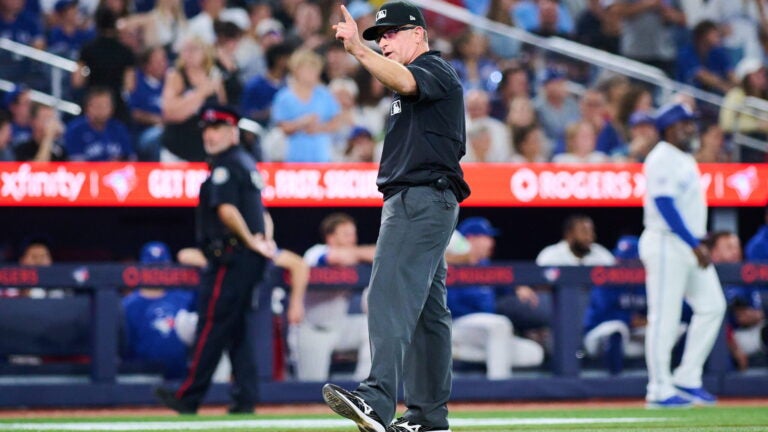
“In this play, it’s what you call an apparent fourth out.”
Umpire Chris Guccione announces a rules check during an umpire review during the seventh inning of the Red Sox-Blue Jays game. Sammy Kogan/The Canadian Press via AP
August 11, 2026 | 10:40 AM
5 minutes to read
The strange “fourth out” play in the Red Sox game: The final outcome was a Blue Jays 2-1 win, but the defining play came via a strange Red Sox run scored in the seventh inning.
It involved a scenario that Red Sox interim manager Chad Tracy admitted afterward was “very rare.”
So what exactly happened?
The sequence began when Boston had runners at first and second in the top of the seventh with nobody out. Shortstop Nick Sogard hit a one-hop ground ball to Blue Jays first baseman Vladimir Guerrero Jr. The power-hitting infielder got the force out at second base.
With Sogard now at first (and Anthony Seigler at third), the first inkling of an issue cropped up: The MLB-controlled scoreboard at Rogers Centre incorrectly displayed that there were two outs. This was later shown in a video shared by NESN:
So when the ensuing Red Sox batter, Ceddanne Rafaela, hit a catchable fly ball to center field, both teams’ body language appeared to indicate that they thought the inning was over. Both Sogard and Seigler jogged the bases as more of an obligatory movement in case the fly ball was dropped. Blue Jays players began to depart the field, thinking the inning was over after Toronto’s Brett Bateman made the catch.
Not everyone was caught unaware, however. After Bateman threw the ball to Blue Jays second baseman Josh Smith, he correctly identified the situation and relayed the ball to Guerrero at first base (doubling off Sogard for the actual third out of the inning).
The ENTIRE FIELD thought there were two outs (scoreboard even had it) 🤯
Umps have been deliberating for 15 minutes, but it seems the #RedSox might still get a run out of this? 🤷 ⬇️ pic.twitter.com/8xe7uvfnW9
— NESN (@NESN) August 11, 2026
Seigler noted that Boston third base coach Chad Epperson had told him there ws only one out, but he still took his (erroneous) cue from the scoreboard.
“The ball was hit. I saw it. I looked up as it was going to the outfield. I looked at the scoreboard coincidentally and saw two outs. So I just took off,” Seigler told reporters, per Tim Healey of The Boston Globe. “But no excuse. No excuse there. It’s unacceptable.”
Though the sequence appeared to be over, it was still being reviewed when Boston took the field for the bottom of the inning. Umpire crew chief Chris Guccione conferenced with his colleagues before telling the crowd that he would be speaking to MLB officials in New York regarding what he dubbed as a “timing play.”
The decision hinged on the rarely used Rule 5.09(c)(4), which includes this section about a rarely used “fourth out” scenario:
Appeal plays may require an umpire to recognize an apparent
“fourth out.” If the third out is made during a play in which an
appeal play is sustained on another runner, the appeal play decision
takes precedence in determining the out.
So how does that apply to this case?
Basically, the Blue Jays only tried to double up Sogard after Seigler had crossed home plate, and then Toronto didn’t appeal the out at third (since neither player tagged up) before leaving the field.
“In order for the run not to score, Toronto would’ve had to make the appeal at third base before the infielders left the infield,” Guccione told a pool reporter, per Healey. “Once they left the infield, then at that point, the run scores.”
Had the Blue Jays also checked with a throw to third base, they would’ve realized the “fourth out” and the run would not have counted. Since they did not, the run counted (making the score 2-1). This decision was predictably greeted with boos by a confused Toronto crowd.
Here’s more of the explanation that Guccione gave to the pool reporter afterward, per MLB.com’s Keegan Matheson:
Both Boston runners, thinking there were two outs, just took off. When the second out was made, now we have two runners who have failed to return and tag up correctly. At that time, the guy from third had crossed home plate and the guy who was at first was standing at second. Toronto knew he hadn’t tagged up and threw to first base to make the third out. Well, that’s a time play, meaning it’s not a force play. If it’s a force play, the run does not score automatically. If it’s a time play — meaning, ‘Was the out made before or after the runner crossed home plate?’ — in this case, the runner crossed before the appeal play was made [at first]. In this play, it’s what you call an apparent fourth out.
In the end, the review took more than 15 minutes, with Rafaela officially being given an RBI sacrifice fly in the inning-ended double play.
Here’s the final NESN recap of the rule itself:
Reason for the run: the Blue Jays “left the field” without appealing to 3rd.
Rule 5.09(c)(4): Appeal plays may require an umpire to recognize an apparent “fourth out.” If the third out is made during a play in which an appeal play is sustained on another runner, the appeal… pic.twitter.com/9b3GNFGsBa
— NESN (@NESN) August 11, 2026
Trivia: What MLB manager has the most all-time ejections?
(Answer at the bottom).
Hint: A four-time MLB Manager of the Year, he won one World Series in the role in 1995.
Scores and schedules:
The Red Sox lost to the Blue Jays 2-1 on Monday, a third straight defeat. The two teams play again this evening in Toronto starting at 7:07 p.m.
On Thursday, the Patriots begin their slate of preseason games at home against the Colts at 7:30 p.m.
On Saturday, both the Revolution and Legacy take the field. The Legacy travel to play Racing Louisville at 6:30 p.m. The Revolution face Toronto on the road at 7:30 p.m.
More from Boston.com:
The legacy of Don Nelson: Whether it was helping the Celtics win titles, or innovating the game as a coach, there was always more to Nelson than he initially appeared to be.
On this day: In 2009, Kevin Youkilis took exception to a fastball in the back from then-Tigers starter Rick Porcello, promptly charging the mound and triggering a benches-clearing brawl.
Porcello, who would go on to pitch for Boston (winning a Cy Young Award in 2016, and a World Series two years later), eventually threw Youkilis to the ground as the two players tussled. They were each ejected and handed five-game suspensions.
The Red Sox won 7-5, with Mike Lowell (inserted into the game to replace the ejected Youkilis) going 2-for-3 with two home runs and three RBIs.
Daily highlight: From Monday night’s game, a great diving play from Red Sox catcher Connor Wong.
Trivia answer: Bobby Cox (162 career ejections)
Hayden Bird
Hayden Bird is a sports staff writer for Boston.com, where he has worked since 2016. He covers all things sports in New England.
Sign up for the Today newsletter
Get everything you need to know to start your day, delivered right to your inbox every morning.