Local News
Newhouse Wildlife Rescue is continuing its search for a new space to rehab animals after some abutters in Carlisle opposed a move there.
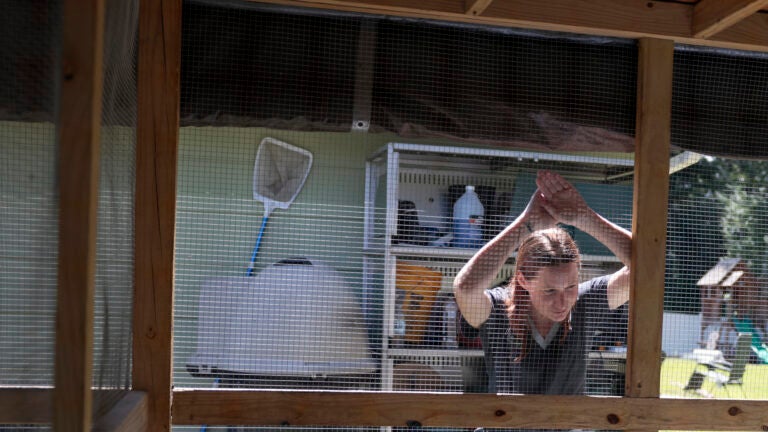
Jane Newhouse peers into an enclosure at Newhouse Wildlife Rescue on her residential property in Chelmsford in 2023. Jessica Rinaldi/Boston Globe
For the past eight years, Jane Newhouse has operated one of the most well-known wildlife rescue clinics in Massachusetts out of her home in Chelmsford. Her two-car garage was fully renovated into a medical facility. More than a quarter of her home and much of her half-acre yard is dedicated to the rehabilitation of a variety of wildlife, from amputee foxes to baby raccoons and ducklings. A famous beaver was allowed to remain there in 2024 after Gov. Maura Healey intervened.
With almost half a million followers online, Newhouse Wildlife Rescue is now a go-to resource for people who find animals in need of saving. As Newhouse’s popularity grew, so too did the need for more space. Three years ago, the clinic began a concerted effort to find a new location.
That search brought Newhouse to a seemingly “perfect” property in Carlisle. But now, after believing that she was on the verge of securing the property, Newhouse is pivoting away from Carlisle and continuing her search.
At a planning board meeting earlier this month, Newhouse said she was blindsided by outcry from some abutters who voiced safety concerns related to the prospect of a growing wildlife clinic coming to their quiet neighborhood. After her plans came “crashing down” at the meeting, Newhouse is choosing to let the Carlisle property go instead of picking a prolonged fight with some of the abutters, she explained in a lengthy Facebook post last week.
“I don’t think they would have been able to stop us. But how much time would we waste? How many donor funds would we waste? All just to be in a community where the people living directly abutting us do not want us there,” Newhouse recently told Boston.com.
The Carlisle property, located at 1090 North Road, was appealing for multiple reasons, Newhouse explained. With 13.1 acres, there was plenty of room to house recovering wildlife. The heavily wooded area would have provided an ideal setting for wildlife rehab. The 4,865 square foot home on the property did not need much remodeling to function as a clinic. The sellers were supportive of Newhouse’s mission, declining a more lucrative offer in favor of the clinic’s offer. It was only a 10-minute drive from the clinic’s current location in Chelmsford.
The stars appeared to be aligning for the clinic. Faced with an “unexpected increase” in costs this spring, Newhouse’s network of supporters donated almost $145,000 to finance the project. The clinic secured a bank loan and put in its offer in May. Crucially, Newhouse received a conditional “Dover Amendment determination” from the Carlisle Building Commissioner.
The Dover Amendment is a state law that exempts certain “high-priority” land uses, like religious and educational uses, from some forms of local regulation. According to Newhouse, her wildlife clinic is “first and foremost” an educational facility. She and her staff routinely bring animals out to schools and libraries, provide hands-on experience for aspiring wildlife rehabilitators, and educate the larger public through regular online outreach that relies on content from the clinic.
It is thanks to the Dover Amendment that the clinic can operate on residential properties, Newhouse said. She has received favorable Dover Amendment determinations from the towns of Chelmsford and Westford, she said.
The Dover Amendment can sometimes trigger intense public debates over “hot-button” issues due to its vague language. The law in no way identifies what is meant by the term “educational,” according to the Massachusetts Municipal Association.
In June, Newhouse spent time going door-to-door, attempting to reach abutters and secure their support ahead of the crucial planning board meeting. She got in touch with most of them, and believed she had overwhelming support.
“Everything was in line,” she said. “We went to the planning board meeting thinking that it seemed like it was all going to work out.”
The discussion about the clinic lasted nearly two-and-a-half hours. While some residents voiced their strong support for the Newhouse’s move to Carlisle, others were more skeptical. One meeting attendee asked about potential legal recourse. There were concerns about the spread of disease and the potential for the clinic’s outdoor animal enclosures to attract predators.
But the major throughline of the resistance was based on fears that the clinic could notably increase traffic, thus endangering residents and other motorists. Despite his expressed support for Newhouse’s overall mission, abutter Rajeev Venkayya highlighted the narrowness and blind curves of the nearby roads in articulating his opposition to the move.
“Safety concerns that you hear from those in the neighborhood do not take away from our support of wildlife and conservation,” he said during the meeting. “We have reasons to believe that any significant increase in traffic will present a risk to drivers in the area.”
Citing Newhouse’s significant online following and its intention to move to a much larger property, Venkayya worried that Newhouse would likely come back to the town in the future to ask for an increased ability to educate members of the public on-site.
“Our backs are going to be against the wall and it will be hard to say no to these uses,” he said.
Newhouse said that the clinic would have very limited traffic impacts. She purposefully does not publish the clinic’s address online and actively dissuades members of the public from bringing animals there directly, she said.
In the days after the meeting, Newhouse and the clinic’s other board members made the decision to relinquish the Carlisle property and continue their search.
“It was one of the hardest decisions I’ve ever made in my life. We were so close,” she said.
Reflecting on the experience, Newhouse said she holds no animosity toward the residents who opposed the move.
“I don’t want to come out attacking or trying to get anybody to try to attack the abutters,” she said.
“They have a right to say what they do and don’t want in their backyard. I just wish they had said it weeks ago when we first knocked on their doors,” Newhouse added.
For now, Newhouse is back to square one.
“We’re never going to stop looking,” she said. “I so love our community, and we want to be able to do this for them.”
Ross Cristantiello
Ross Cristantiello, a general assignment news reporter for Boston.com since 2022, covers local politics, crime, the environment, and more.
Sign up for the Today newsletter
Get everything you need to know to start your day, delivered right to your inbox every morning.