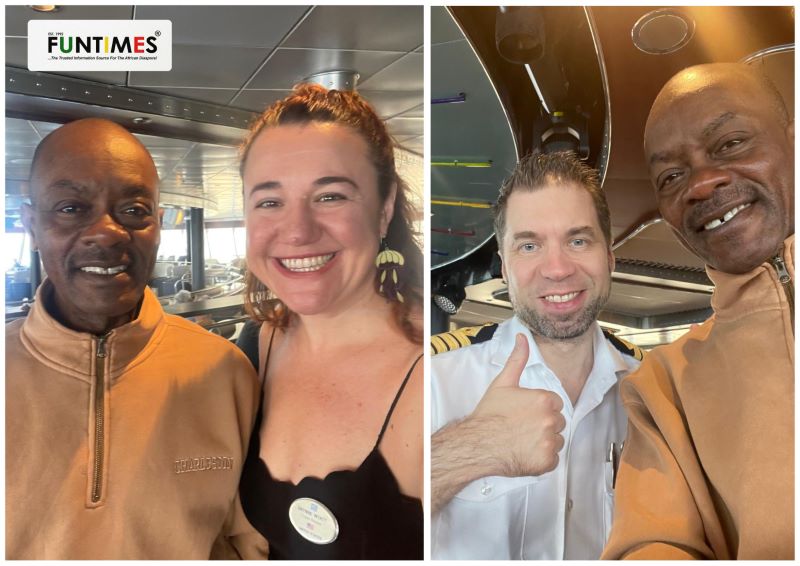
Dr. Eric Nzeribe and Ms. Brynee Wyatt; Captain Mikko Kovalainen and Dr. Eric Nzeribe. Photo courtesy of FunTimes Magazine
On the Norwegian Jewel’s first voyage from Philadelphia in more than fifteen years, I took my first cruise and found a temporary community of strangers, the hidden labor that carries a week of ease, and a Bermuda that demands respect.
The city marked the return of a cruise ship for the first time in more than fifteen years. That was the ceremony. The experience, for the roughly two thousand travelers who had chosen this sailing precisely to be part of it, ran on a different track. It moved from the Clarion Hotel to a bus to the port to a second line, and for many of them the whole passage took three to four hours before they reached the ship.
I was spared the worst of it by timing. I arrived at the Clarion around three in the afternoon and was on a bus fifteen minutes later. Others were not so fortunate, and they told me so plainly.
Martina Gorham of West Philadelphia was on her sixth or seventh cruise, and she called this one of the longest embarkations she had experienced. What stayed with her was the silence around the occasion. “We didn’t get greeted. There was no signage as far as this being the inaugural cruise,” she said. She had wanted a keepsake, some small sign that the day belonged to the passengers as well as the dignitaries. “I think we should have gotten maybe a souvenir.” Brent Carter, a city contract auditor who has taken many solo cruises, put it more bluntly. The port experience was rough, he said, and the terminal was not finished.
Not everyone was troubled. Ned Wimberley, eighty-two, a Marine Corps veteran on his twenty-fifth cruise, gave the calm version. “They told us how it was going to be, so I didn’t expect everything to go smoothly,” he said. “So when things were a little chaotic, I didn’t have issue with it.”
That was the gap I carried onto the ship. Philadelphia had regained something real, and the promise attached to it was large. PhilaPort projects that homeport cruising will support 2,185 direct and indirect jobs and generate about 300 million dollars in annual economic output across Pennsylvania, timed to a year when the city welcomes visitors for the nation’s 250th anniversary.
The city that disappears
Once the lines were behind us, the ship did what a ship does. It cut us loose from land.
As the Norwegian Jewel moved down the Delaware River, I watched the familiar edges of Philadelphia fall away. Bridges, docks, and shorelines slid into the background. The city was still close, and already the ship had begun to rearrange my sense of distance. Ahead were seven days, more than two thousand fellow passengers, several hundred crew, and Bermuda.
I had no earlier cruise to measure this one against. Before Bermuda came into view, the ship itself became my first destination. It was a hotel, a theater, a restaurant district, a power station, a water plant, a laundry, a workplace, and a home, all of it moving through the Atlantic. I felt the floor shift underfoot and wondered how long my body would take to trust it.
A vacation that began at home
Once aboard, I began asking passengers what had drawn them to this particular voyage. The answer, again and again, was the departure city itself.
Shereen Larry took her first cruise in 1994. She enjoyed it and wanted to sail again, but her friends resisted the water, the flying, or both. More than three decades later, she boarded the Jewel with eight members of her family. “That was a kick right there. That was a joy,” she said of leaving from Philadelphia. She had tried for years to gather relatives for a trip, and this time the short distance made it possible.
Clockwise: Joy Pegram, Bobby Edoo and Antoinette Montgomery; Linda and Elizabeth; Brent Carter; Martina Gorham; Solo traveller group picture. Photo Courtesy of FunTimes Magazine
Dolly Richards, a retired Delaware resident who came from Guyana fifty years ago, found the sailing while searching online for cruises out of Philadelphia. The usual alternative meant traveling to Florida. “I kind of jumped on it,” she said. Antoinette Montgomery came up from Washington by bus, then fifteen minutes from the station to the port, and valued the ship’s smaller size. “It just feels like a family,” she said.
The inaugural also drew people who wanted to mark a Philadelphia moment for its own sake. Brent Carter had sailed from New York and other ports, but chose this one because it was the first from his own city in years. His aunt had booked it long in advance. Tony Monroe II came for the same reason. “Being a part of that historic moment where Philly starts cruises again was really what we wanted to get out of the experience,” he said.
A cruise also changes the usual social rules of a vacation. In a hotel or a city, you may see a stranger once and never again. On a ship, people circle back. Carter described it well. A cruise ship is large enough to avoid someone when you wish to, and small enough to meet the same faces all week. A conversation at breakfast resumes beside the pool. “You get to know people a little bit more personally,” he said.
The voyage gathered many kinds of travelers into that closeness. Reverend Clifford Richards, born in Georgetown, Guyana, and trained for the ministry in Jamaica, received the trip as a birthday surprise arranged by his daughter and his former wife, and praised the crew for their patience with older guests. “If you seem to slip or fall, they’ll help you,” he said. Jazmyn Stokes, a software developer from Pittsburgh, came with her mother and brother for the first family vacation they had taken together in a long time. “It was a time to disconnect from the internet, because I’m always in front of screens,” she said.
Not every verdict was warm, and the honest ones were worth hearing. Mary Wimberley, Ned’s wife and a veteran of some twenty Carnival cruises, rated the Jewel a four. She missed having anywhere to find solitude and did not expect to book this ship again. “Norwegian is not for me, at least not this ship,” she said.
The ship beneath the vacation
The public decks made the week look effortless. Meals arrived. Beds were made. Towels came back clean and folded, and fresh bread appeared each morning. Below and behind those spaces, the Jewel ran without pause.
My curiosity about how it all worked took me into the crew corridors most passengers never see. The longest of them is called the I-95, an interior highway that runs uninterrupted from bow to stern. Crews use it to move supplies, food, and laundry, which is why a guest never meets a cart of linens rolling down a passenger deck. The scale showed itself in ordinary things. About 350 pallets of food and beverages come aboard during a single turnaround in Philadelphia, and the galley uses roughly 200 dozen eggs at breakfast alone.
The laundry has a character, and his name is Christian. Twenty-one years with the company, he showed us a flatwork ironer built in Chicago that has pressed and folded sheets for as long as he has worked there, and an automatic sorter twenty-five years in service that he called, with affection, a machine heading into its retirement contract. “This is what I love about old machine,” he said. “Old machine, it’s tough and very easy to maintain.” He teased the room about sending flowers, then chocolate, then his paycheck home in the weeks before his leave. Underneath the jokes sat the shape of his life. He is aboard for six months, then home for two.
Five diesel engines supplied the ship’s power. The engine control room monitored fuel, oil, electricity, air conditioning and water around the clock. There is a backup for nearly everything. The ship could produce close to 740,000 gallons of water a day through evaporation and reverse osmosis. On the bridge, a joystick about the size of a finger could help maneuver the vessel. Physical navigation charts remained available if electronic systems failed.
Willis Woodrow aka Bobo; Jazmyn Stokes; Ned Wimberly; Tony Monroe II and Dolly Richards. Photo courtesy of FunTimes Magazine
When the map of the world becomes visible
Rumi Khatao, the general manager, told the room that close to 900 crew members work in hotel operations alone, drawn from fifty-four countries. Their dining hall carries an Asian section, an Indian section, a Caribbean section, and a European one, because a workforce from that many places also needs a taste of home.
That figure sat with me, and during the officers’ session I stood and asked about it. Fifty-four nations aboard, I said, and a crew mess that serves Indian and Caribbean and Asian food to the people who run the ship. When would that variety reach the guests? When would there be African food, jollof rice, on the buffet?
The general manager, who told the room he came from Mumbai, answered with candor. He had tasted bunny chow and liked it, he said, but the older ships carry space constraints, and the menus come down from a corporate team rather than from the galley. Put it in the survey, he offered, and it can be looked into. It was a small exchange about a large thing. The word international, on a ship staffed by the world, still describes a shorter list of kitchens than the crew itself represents.
A captain who chose the sea
Captain Mikko Kovalainen decided that life at sea would become his career as a boy in Finland. He recalled watching ferries and entered maritime school in 1998. He has worked on tankers and cargo ships, then joined cruise operations, and rose through the ranks before becoming a captain. I asked him what passengers worry about without cause; he named the weather. “Do not worry about the weather,” he told me. “I take care of it.”
I had further questions, which moment aboard, I asked, had reminded him that the boy was right? He paused, and for a moment the ease left his voice. “I almost get emotional here,” he said. When he delivers a ship full of strangers safely from one port to the next, having chosen the right route and spared them the roughest water, he knows.
Finally, I asked him what passengers misunderstand about this work. “Some guests do not understand that we live here,” he said. “We do not change the crew every Philadelphia.” The ship is their residence. Senior officers may work ten weeks aboard and ten weeks away. A restaurant server may remain for eight months at a stretch. The general manager, nine years on this vessel, said about a third of his crew had stayed with him for seven years. In earlier years, the crew waited months for a letter. Now video calls carry the distance.
Bermuda beyond the view
Bermuda announced itself through color and care. Turquoise water met pale stone, green hedges, and roads that looked almost startlingly clean. How, I kept asking, does Bermuda stay this orderly?
I put it to Willis Woodrow, known to everyone as Bobo, an eighty-one-year-old who once worked in the flight kitchen at the airport and has not held a regular job in twenty-two years. Government crews maintain the roads and cut the grass all week, he said. He lives on a government pension and the odd hustle, painting houses and driving visitors around the East End, the historical part of the island where Bermuda was settled in 1609.
Korie Minors placed the island’s appearance inside a larger idea. An architect, designer, and DJ who lived in Hong Kong, Istanbul, and the United Kingdom before returning home in 2014, he said beauty he has found in many places. Bermuda holds him because of the people and his tie to the land. We spoke near Clearwater Beach, across the water from Nonsuch Island, home of the cahow, the national bird found nowhere else. “Respect the island,” he said, “because the people are just as much a part of the island as everything else around us.”
The Norwegian Jewel. Photo courtesy of FunTimes Magazine.
Coming home
By the final days, the Jewel no longer felt unknowable. I had found the quiet seats, the familiar servers, the passengers I had interviewed earlier in the week. Tony Monroe, who had begun the trip reserved, told me he would open himself to it sooner if he could do it again, having realized everyone aboard had come to enjoy the same historic sailing. “There are a lot of interesting people to meet on this cruise,” he said.
Captain Mikko spoke about the Delaware River with respect. It is a tight channel where wind, current, and commercial traffic all demand attention, and local pilots join the bridge team to supply the knowledge that instruments cannot, chiefly how the current is pushing on a given day. On the final night he announced the exact hours the Jewel would pass beneath the Delaware Memorial and Commodore Barry bridges before reaching its berth near five in the morning. Those bridges, crossed by car all these years, became something else on the way home. They were markers telling more than two thousand travelers that the city was close again.
Before dawn, the Jewel came back up the Delaware. The bridges passed overhead on the captain’s schedule, and Philadelphia waited beyond them.
Dr. Eric John Nzeribe is the Publisher of FunTimes Magazine and has a demonstrated history of working in the publishing industry since 1992. His interests include using data to understand and solve social issues, narrative stories, digital marketing, community engagement, and online/print journalism features. Dr. Nzeribe is a social media and communication professional with certificates in Digital Media for Social Impact from the University of Pennsylvania, Digital Strategies for Business: Leading the Next-Generation Enterprise from Columbia University, and a Master of Science (MS) in Publication Management from Drexel University and a Doctorate in Business Administration from Temple University.