Overview:
The Haitian Times held conversations with leaders in Haiti’s soccer realm concerning the necessary steps for a return to the World Cup in 2030. They said Haiti must tackle mismanagement from the soccer federation, play home games at home and prepare properly to smoothen its road to the next World Cup.
NEW YORK — During Haiti’s first World Cup appearance in 52 years, flashes of glory such as the two stunning goals in the 4-2 loss to Morocco made lifetime memories for many. Yet, along with the pride and cheers, many fans and analysts saw a team that looked under-prepared overall.
After the loss, they are now asking: How can Haiti make sure it qualifies for the 2030 games?
Yves Jean-Bart, former president of the Haitian Football Federation (FHF) who is better known as Dadou, is among those not shy with his assessment.
“I heard that we’re preparing, but we’re going to need a lot of effort to make it in 2030,” Jean-Bart said in a recent phone interview.
Jean-Bart was among eight experts The Haitian Times interviewed, a group that also included several Haitian soccer club owners, long-time observers and the founder of Haiti-Tempo, the renowned Haitian sports outlet.
Nearly unanimously, they said for Haiti to qualify for the 2030 FIFA World Cup, it will need to tackle certain persistent problems occurring off the field. Several interviewees railed against perceived conflicts of interest at FHF, favoritism that weighs on player selection and team cohesion, and even allegations of funds disappearing.
“If we had more unity, we could’ve gone further.”
Duckens Nazon, Haiti’s veteran striker
FHF’s secretary Patrick Massenat agreed to an interview with The Haitian Times for this article after three emails were sent, but he has yet to respond to further WhatsApp messages to set it up.
Another key issue is ensuring Haiti plays its home games in the country during the qualification stage. Finally, the experts pointed out, fans and sports analysts must be more supportive during difficult times.
On the field, the makeup of teams participating may block Haiti in the qualifiers. In 2030, there’s room only for six teams from the Concacaf region, plus a possible intercontinental playoff winner, in the 64-nation tournament. The region’s three soccer powerhouses — the United States, Mexico and Canada — will certainly participate in the Concacaf qualifiers after skipping last year’s because they were hosting.
Alleged corruption must be cleared out
A woman [center] claps her fingers together during Haiti’s encounter with Brazil in the 2026 FIFA World Cup on June 19, 2026 at Philadelphia Stadium. Photo by Bill Farrington for The Haitian Times
Over the years, longtime insiders and observers have told The Haitian Times that the national team’s operation mirrors the country itself: Both are rich with potential, but are held back by mismanagement.
“Everything Haitians put their hands on turns into politics,” said an FHF insider who asked not to have their identity revealed out of fear of being targeted.
“There’s a lot of corruption,” added the insider, who has worked with FHF for more than 22 years. “They’re hiding stuff and because of that, this person has to cover for that person.”
“Who chose the coach?”
Yves Jean-Bart, former president of Haitian Football Federation
Take, for example, Haiti’s World Cup roster. While it included several top-tier players, two insiders speaking independently of each other in separate interviews said some allegedly made the team because relatives of theirs had donated money over the years. Those relatives are treated like “unofficial” federation members in making team decisions. As a result, the insiders say, more talented players with no financial ties were left off the team.
Jean-Bart said in another interview on Jul. 20 that he is aware of the allegation.
“I don’t have information on this but I heard those rumors,” Jean-Bart said. “If you’re [FHF] not transparent, it’s normal for people to spread all types of rumors.”
Yves Jean-Bart, better known as Dadou, standing at Boston Medical Center in April 2026. Photo courtesy of Yves Jean-Bart
Since 2020, a FIFA-appointed three-member Normalization Committee has been running FHF. That year, Jean-Bart was banned for life after being accused of sexually abusing minors, then cleared in 2023 due to insufficient evidence.
This caretaker committee’s mandate to revise statutes, stabilize governance and organize new elections has been repeatedly extended by FIFA. Monique André, who now serves as FHF president in succession to three others, was appointed in 2024, along with Gally Amazan and Yvon Sévère as committee members.
An election to choose a new federation committee is scheduled for December 2026.
Through the election or otherwise, some say they hope to see new, more competent faces in FHF.
“There’s a lot of corruption inside this federation, a lot,” said one club owner, who asked to remain anonymous out of fear of jeopardizing his club. “One solution is to replace the familiar faces.”
Relatable coach, unified locker room needed
Throughout the World Cup matches, Haiti fans complained that the coaching staff did not advocate enough for the team during the games, especially against Scotland. They said now ex-coach Sébastien Migné failed to put the best players on the field at the appropriate moments, particularly during the Scotland and Brazil matches. After the Brazil match, the players themselves rejected that critique of Migné, saying their role is not to question the coach, but to follow his lead.
Migné has since parted ways with FHF. He has not yet replied to The Haitian Times’ interview request sent via email.
“Everybody is being influenced by social media and are blaming the coach. But who chose the coach,” said Jean-Bart, who was president from 2000 to 2020.
FHF has yet to announce who will replace Migné. But many hope it will be an experienced coach familiar with Concacaf play.
“We need a coach who’s more connected to us Haitians,” Benson Petit-Clair, founder of Haiti-Tempo, said in a phone interview.
“A coach who knows the Concacaf region and the Conmebol in South America,” Petit-Clair added. “For example, a lot of Argentinian coaches led teams to the World Cup. I think we could enter this logic too.”
Les Grenadiers players often looked disconnected on the field, with passes made leaving the impression the team was not prepared properly. Migné added four new players on the roster just less than three months before the World Cup — Isidor, Dominique Simon, Woodensky Pierre and Lenny Joseph. These players only featured in a couple of friendlies ahead of Haiti’s group stage opener against Scotland.
Haiti was the first team to be eliminated from the World Cup, losing to Scotland 1-0, Brazil 3-0 and Morocco 4-2 in the group stage. It dropped from 83rd to 88th spot in FIFA’s rankings after the World Cup.
Speaking during a press conference in Cap-Haïtien July 5, veteran striker Duckens Nazon attributed their performance to a lack of chemistry.
“On the team,” Nazon paused, then muttered, “If we had had more cohesion, we could’ve gone further.”
“But I want to tell you that it’s normal because we were in a period of transition,” Nazon added.
Haitian veteran striker Duckens Nazon walking into New England Revolution Training Center on June 12, 2026 for a training session in preparation for Haiti’s World Cup opener versus Scotland the following day. Photo by Fredner Cayemitte/ The Haitian Times
Petit-Clair said Haiti also needs to strengthen its roster because several players are playing in low divisions. Key players close to retiring also need to be replaced.
For instance, goalkeeper Placide, who is 38, already announced his retirement. Ricardo Adé, one of Haiti’s center backs, is 36. Carlens Arcus will be 34 during the last stage of the 2030 qualifiers.
“The team needs to be rejuvenated,” Petit-Clair said. “I think there’s room for fresh blood on the team.”
Bring team back home, and build its fandom
To James Louis-Charles, owner of F.C. Juvenat, a soccer academy based in Port-au-Prince, it is critical for the team to start playing its home games in Haiti instead of Florida or other Caribbean countries. There will be more Haitian fans in Haiti to cheer for the players than in other Caribbean countries.
Les Grenadiers have not played at Stade Sylvio Cator in Haiti since July 2021 due to the gang violence in Port-au-Prince. There is a field in Cap-Haïtien, Parc Saint-Victor, but it must be upgraded to meet FIFA regulations.
Louis-Charles, who holds a master’s degree in Sustainable Peace through Sport, also said the federation must be more transparent and allow fans to provide input, as it did in the past.
“Despite the fact that many things have improved inside the federation, I feel like there’s a lack of information,” Louis-Charles said. “It doesn’t make sense that I have people contacting me so they could be in touch with the federation.”
In the early 2000s, fans felt like they had a voice in Haitian soccer, primarily through a forum online called Sakapfèt. Louis-Charles recalls getting on the forum and suggesting that the team adopt “Les Grenadiers,” one of several nicknames in use at the time, as the official name. After an open vote, the federation made ‘Les Grenadiers’ the official name.
Fans on the forum, which operated through 2016, also reportedly pushed the federation to start bringing players from abroad such as Duckens Nazon and Johny Placide, according to sources.
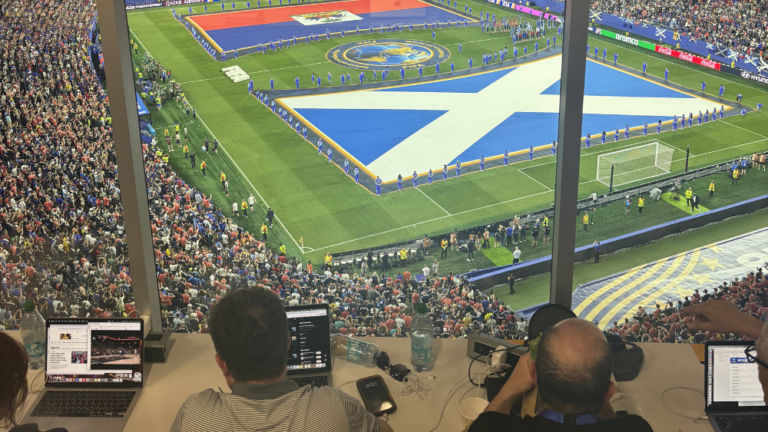
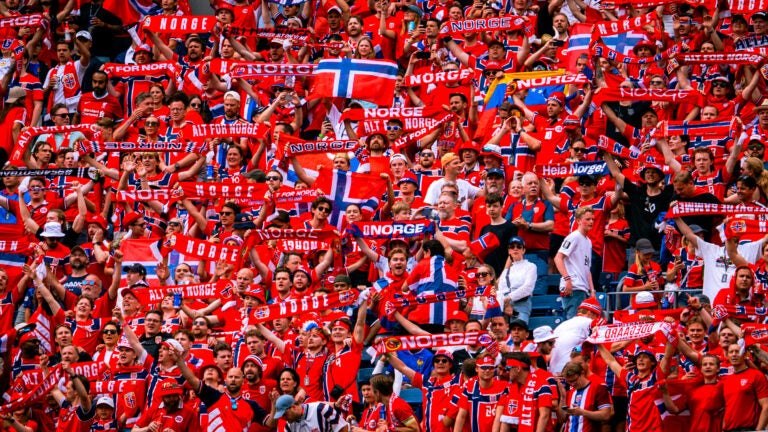
Haiti team fans also appeared disconnected at the matches. During the Scotland match at Gillette Stadium in Boston, for example, fans sat in disparate groups, compared to the large contingents Scotland had. Grenadiers fans were often drowned out and their chants limited, compared to the European team’s supporters – who came in cultural grab, and with instruments and homegrown cheers to inspire the players.
Seeing the contrast, some Haiti fans have suggested starting supporters’ groups. Their hope is that an organized fan base at home and away might significantly spur the players.
Haiti fans in blue or white Grenadiers jerseys sticking out from a sea of Scotland fans at Gillette Stadium in Boston on June 13, 2026. Photo by Fredner Cayemitte/ The Haitian Times
“If we had supporters’ clubs, we would’ve supported the team better by buying tickets in blocks and coming up with chants,” Louis-Charles said. “Something needs to be done. Everybody loves soccer in Haiti, but not everybody is willing to come in together and have a fan club.”
In about two months, Les Grenadiers will compete in the 2026-27 Concacaf Nations League, which will serve as the qualification stage for the 2027 Concacaf Gold Cup. For Haiti fans, it will also mean a serious opportunity to prepare the team for the World Cup qualifiers in 2029.
“We need to work three times harder than other countries because our conditions are less favorable,” Jean-Bart said.