Long before “organic”, “local”, or “sustainable” became fashionable food vocabulary, communities across Assam, Arunachal Pradesh, and Sikkim were already living through those ideas quietly, through necessity and inherited ecological knowledge.
For many families here, food is a way of remaining connected to the land.
The first thing Sumi Borah remembers about home is not a particular dish. It is the smell.
Smoke is drifting from the kitchen fire. Fermented bamboo shoots rest in jars for months. Fresh herbs drying near the window after being collected from nearby forests. Pork hanging above the stove slowly absorbing woodsmoke while rice simmered below.
“In our home, the kitchen was always active in some way,” Sumi says. “Something was always being smoked, boiled, dried, or preserved.”
When The Better Indiasat down with Sumi and her mother to talk about food from Northeast India, the conversation moved quickly beyond recipes. It became a discussion about forests, seasons, memory, migration, and survival, all the things that quietly shape kitchens across the region.
Because in much of Northeast India, food has never existed separately from the land. But to speak of “Northeastern cuisine” is, in many ways, a simplification. The region is home to hundreds of Indigenous communities, each with its own food traditions, ingredients, and cooking techniques shaped by local landscapes.
While recipes differ across states and communities, they are united by a shared philosophy of cooking with seasonal produce, preserving what nature provides, and passing culinary knowledge from one generation to the next.
“For people in Northeast India, food has always been deeply connected to nature and the land around us,” Sumi says. “Growing up, I never saw ingredients as something that only came from supermarkets or packaged shelves. A lot of our food came directly from forests, rivers, kitchen gardens, or nearby farms.”
Across Nagaland, Manipur, Mizoram, Meghalaya, Assam, Arunachal Pradesh, and Sikkim, traditional food cultures evolved through close observation of rain, rivers, forests, hills, and difficult terrain. Long before sustainability became a global lifestyle conversation, communities here were already living through local, seasonal, low-waste food systems because there was little other choice.
“People would go out and collect wild herbs, leafy greens, bamboo shoots, medicinal plants, or seasonal vegetables depending on what nature was offering at that time of the year,” Sumi says.
“That is how people cooked,” she says. “You cooked what was available.”
Recipes carried through memory
Some of Sumi’s earliest memories revolve around smoked pork with fermented bamboo shoot — one of the most recognisable dishes across many Northeastern homes.
The preparation in her house remains uncomplicated even today. Smoked pork is boiled until slightly tender before fermented bamboo shoot, ginger, king chilli, salt, and water are added to the pot. The dish is then left to simmer until the meat softens completely.
“There are no heavy spices in it,” Sumi says. “The smoked meat and bamboo shoots naturally create rich flavours.”
Her mother still prepares bamboo shoots in large batches during the harvesting season. Fresh bamboo is cleaned, sliced, and fermented naturally before being stored for months.
“In monsoon season, those preserved bamboo shoots become very important,” Sumi says. “That is when you understand why preservation became such a central part of the cuisine.”
The same bamboo appears in another family staple, bamboo shoot chicken, where chicken is cooked slowly with fresh bamboo shoots, ginger-garlic paste, green chillies, and minimal oil.
“The bamboo shoots add a slightly sour and earthy flavour,” Sumi says.
Much of Northeastern cuisine follows this style of cooking, where ingredients are allowed to retain their natural character instead of being buried under spices. Broths remain light. Oil is used sparingly. Herbs, smoke, fermentation, and chillies build flavour gradually.
Boiled bamboo shoots are a dietary staple in Assam because of their unique earthy flavor, and immense health benefits. Photograph: (India Trade Port)
“Traditional Northeast meals are usually lighter, less oily, and heavily dependent on herbs, fermented ingredients, boiled vegetables, smoked meats, and natural flavours rather than excessive spices or processed additives,” Sumi explains. “I genuinely feel this connection with natural food systems has played a role in keeping many communities healthier over generations.”
In fact, a study by the National Institute of Science Communication and Policy Research (NIScPR) also highlights that in the biodiversity-rich eastern Himalayan ecosystem, communities, particularly women, have preserved local crops, wild edible plants, traditional vegetables, and Indigenous fruits for generations, while using fermentation and other preservation techniques to strengthen food and nutritional security.
Even recipes themselves are often preserved orally rather than through written documentation.
Sumi laughs while describing how her mother cooks.
“She never measures anything properly,” she says. “Most traditional cooking at home depends on experience, smell, texture, and instinct.”
Her mother agrees.
“You know from the smell if the bamboo is ready,” she says. “You know from the broth if the meat has cooked enough.”
Smoke hanging above the fire
In many Northeastern homes, smoke is not treated as a culinary flourish. It is part of daily life.
“In many parts of Northeast India, these preservation techniques were never seen as trends or special culinary methods,” Sumi says.
Historically, many tribal communities across the hills and forests lived far from large markets. Seasonal rains often made travel difficult.
Refrigeration did not exist.
“Smoking, drying, and fermentation became practical ways to make ingredients last through heavy rains, cold weather, difficult terrain, or periods when certain vegetables, fish, or meat were not easily available,” she explains.
In traditional kitchens across Nagaland and Mizoram, strips of smoked pork still hang above wood-fired stoves for days or weeks at a time. Fish is sun-dried. Soybeans are fermented. Excess seasonal produce is stored carefully instead of discarded.
“Nothing was wasted unnecessarily because people knew how much effort it took to grow, forage, catch, or hunt food,” Sumi says.
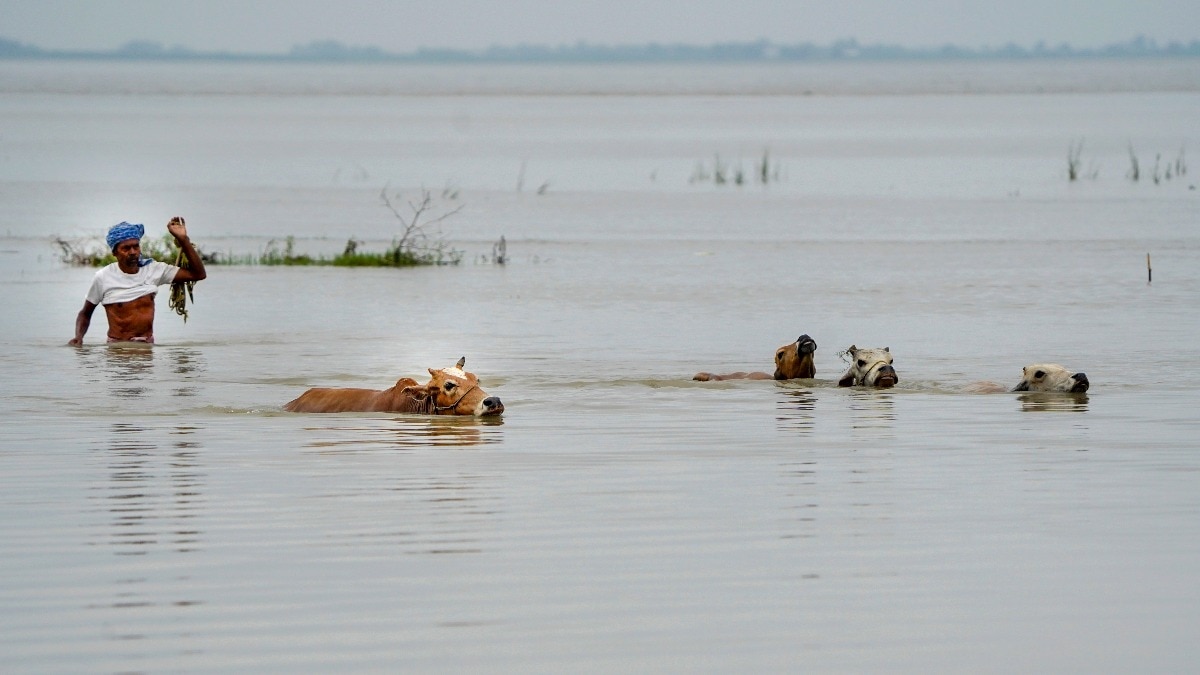
Before refrigeration, these traditional methods were the only way to store perishable, seasonal foods like pork, fish, and bamboo shoots during heavy monsoon flooding. Photograph: (Riya Das/ Padma Priya)
One of the strongest examples of this preservation culture is akhuni, also known as axone, the fermented soybean ingredient central to many Naga kitchens.
Soybeans are boiled until soft before being wrapped in banana leaves or placed inside bamboo baskets to ferment naturally over several days. The resulting ingredient develops a strong smell, sticky texture, and intense umami depth.
Sumi’s family often cooks akhuni with smoked pork.
“The fermented soybean creates a deep smoky umami flavour,” she says.
For outsiders unfamiliar with axone, the smell can seem overpowering. For families across the Northeast, it often carries emotional familiarity.
“When people move away from home, these are the foods they miss first,” Sumi says.
Food that comes from somewhere visible
One of the sharpest differences between Northeastern food culture and industrial urban food systems, Sumi says, is proximity.
“The relationship with food in Northeast India is very different from most urban or industrial food systems today because the connection between people, nature, and what they eat is still very direct and personal,” she says.
Ingredients often come from nearby forests, rivers, backyard farms, or local markets rather than long industrial supply chains.
“People often know exactly where their food has come from, who grew it, or which forest or river it was collected from,” she says.
That closeness shapes not just eating habits but attitudes towards waste and consumption itself.
“What also makes the cuisine inherently sustainable is that there was very little waste,” Sumi says. “People used what was available around them, consumed according to seasons, and preserved ingredients carefully for future use.”
Her mother recalls growing up in homes where banana leaves were used to wrap food, bamboo containers stored grains, and woven baskets replaced plastic bags entirely.
“People used what nature already provided,” she says.
Sumi believes that lifestyle reflects a naturally circular relationship with resources.
“Things were reused, repaired, composted, or returned to nature,” she says. “Even kitchen waste would often go back into farming, feeding animals, or composting.”
Climate change reaches the kitchen
But the ecological systems supporting these traditions are beginning to shift.
“Climate change and environmental shifts are definitely affecting food systems in the Northeast,” Sumi says.
People who have spent generations living close to forests, rivers, and farms increasingly notice that seasons no longer behave predictably.
“Certain herbs, vegetables, and forest produce are becoming harder to find in the same quantities or during the same months people were once used to,” she explains.
Fishing patterns are changing too as rivers face irregular rainfall, pollution, and rising temperatures.
“In some places, people say the taste and texture of fish or even certain vegetables are not the same as they were years ago,” Sumi says.
Researches suggest,Naltenga (Passiflora assamica), a wild sour fruit once commonly foraged in Assam and used in traditional fish curries, has become increasingly rare in the wild.
Because of its rich, meaty texture, the mahseer holds up perfectly to the souring agents native to Northeast India and the Eastern Himalayas. Photograph: (Derek Dsouza)
In parts of Sikkim, communities have also reported that native sour plants such as tothne and other seasonal wild herbs are becoming harder to find as forests dry and seasonal patterns shift. Freshwater ecosystems are under pressure too.
The golden mahseer (Tor putitora), one of the Himalayan region’s most iconic fish, is now listed as Endangered by the IUCN, with habitat loss, river modification, pollution, and overfishing contributing to its decline.
Even cooking itself is subtly affected, Sumi adds.
“I have also heard people speak about how some traditional foods now take longer or shorter to cook because the quality of ingredients, firewood, moisture levels, or soil conditions have changed over time,” she says.
These observations may sound small, but they reveal larger environmental shifts unfolding quietly across the region.
‘Nothing goes to waste’: Sumi’s mother shares her family’s khaar recipe
If there is one recipe that Sumi’s mother says defines an Assamese kitchen, it is khaar. It’s no really a dish, but a cooking technique that traditionally begins every Assamese meal.
“It’s made from dried banana peels,” she says.
The process starts by collecting the outer peels of local bananas and drying them completely under the sun.
“Once the peels are fully dry, we burn them into ash,” she explains.
The ash is then mixed with water and carefully filtered through a cloth or sieve.
“The liquid that comes out is alkaline. That is the actualkhaarwe use for cooking.”
While the core alkaline liquid remains the same, it can be combined with various ingredients to form distinct dishes. Photograph: (Soyuz Sharma/Wikimedia Commons)
Only a small amount is needed.
“We add it while cooking papaya khaar, lau(bottle gourd) khaar, fish khaar, or even mati dal. It gives the food that smooth, slightly earthy taste Assamese cuisine is known for.”
“It is a cooking technique. Traditionally, an Assamese meal begins with akhaar dish before moving on to the rest of the meal.”
Recipes travelling across cities
Today, many younger Northeastern people move outside the region for work or studies. Ingredients become harder to access.
Recipes adapt.
“The challenge is that many young people move outside the region for studies or work, and once they leave, it becomes difficult to maintain the same food habits,” Sumi says.
Yet she does not believe the traditions are disappearing entirely.
“There is still a strong emotional attachment to traditional food,” she says. “Whenever people return home, food becomes one of the biggest connections to family and culture.”
People carry bamboo shoots, smoked meats, fermented soybean, dry fish, and chillies back in suitcases. Recipes are recreated through phone calls and family instructions.
“So I would not say these traditions are disappearing completely,” Sumi says. “They are evolving and adapting with changing lifestyles.”
Today, Northeastern cuisine is finally beginning to receive wider recognition beyond the region. But for families like Sumi’s, bamboo shoots, smoked pork, fermented soybean, sticky rice, and dry fish were never culinary trends waiting to be discovered.
They were simply life.
“At a time when the world is trying to rethink sustainable food systems,” Sumi says, “I feel Northeast India already holds many answers through its traditional practices. These cuisines show us that sustainability can be deeply cultural, local, and rooted in everyday habits rather than just being a modern global conversation.”