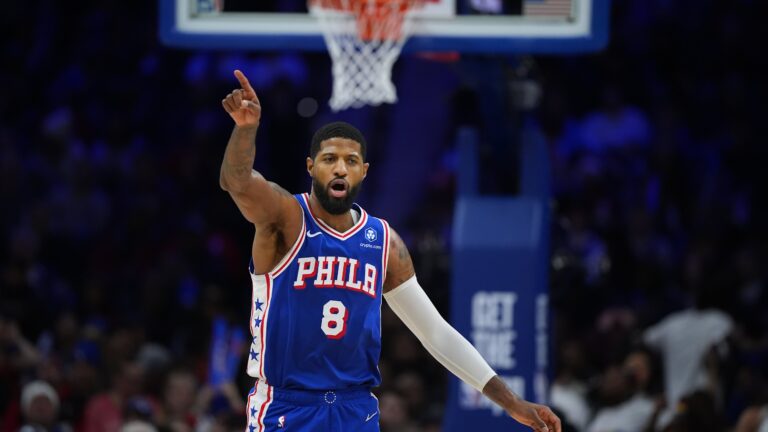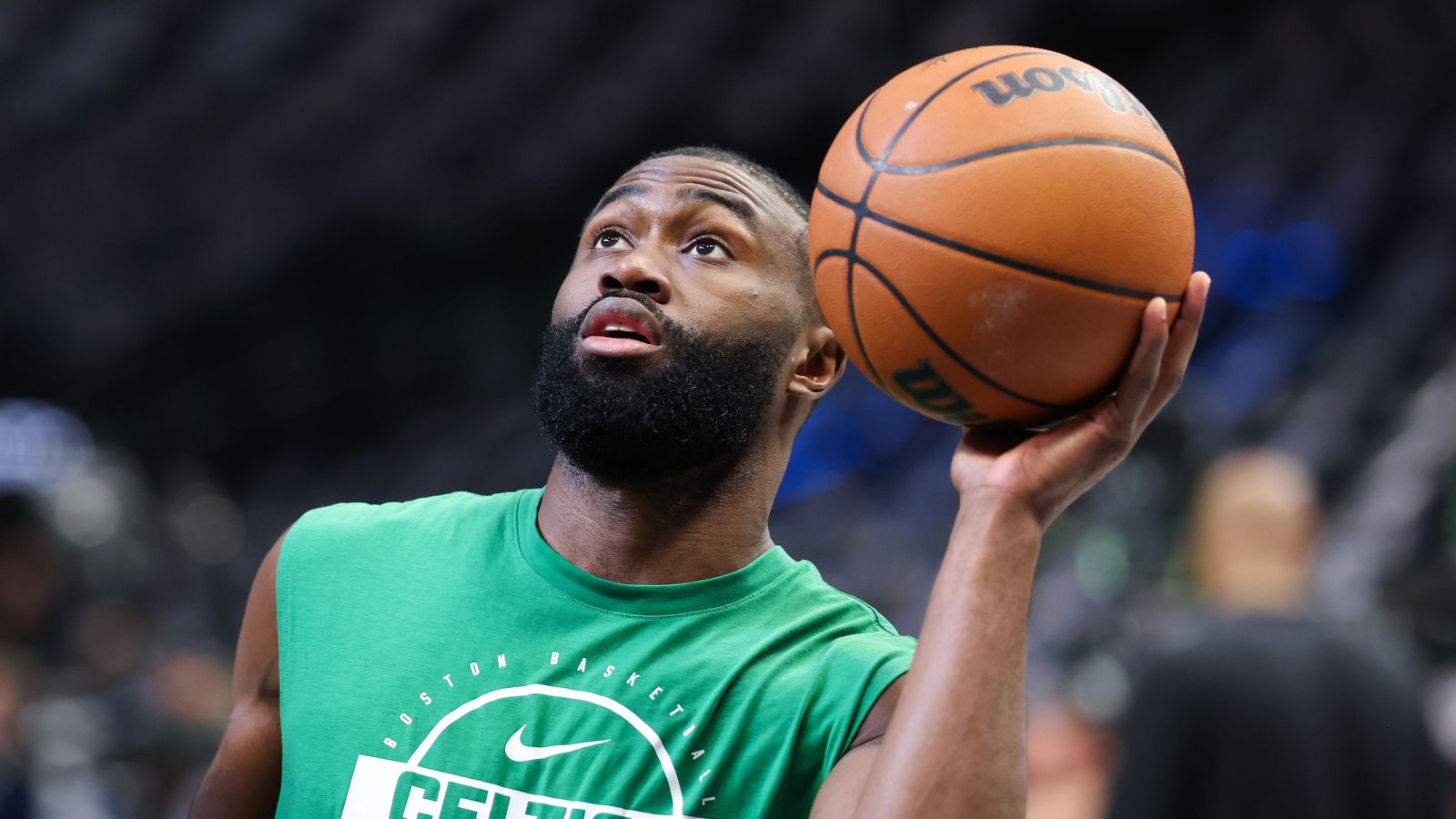
BOSTON — On Monday afternoon, the Boston Celtics made the Jaylen Brown trade official. They sent the 2024 NBA Finals MVP to the Philadelphia 76ers in exchange for Paul George, two first-round picks, and two second-round picks.
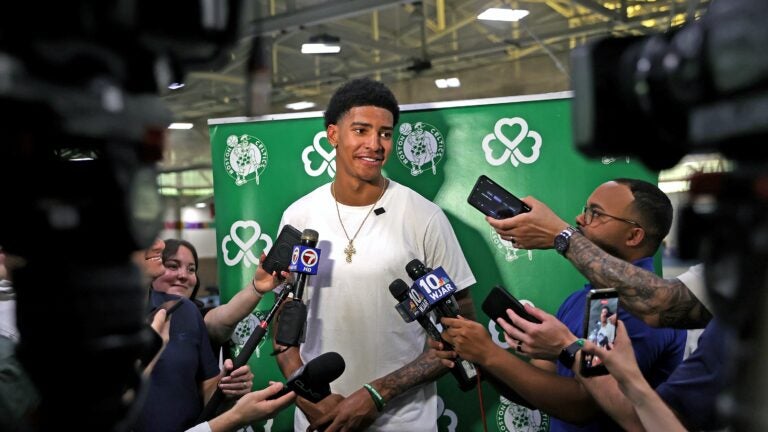
Just over two hours later, Celtics President of Basketball Operations Brad Stevens and lead owner Bill Chisholm sat down in front of the media to answer questions. But before any of those queries were asked, Stevens began with an opening statement, all starting with a ‘thank you.’
“First of all, I think on behalf of Bill, his whole investor group, obviously all of us in basketball operations, everybody in this building, certainly the entire Celtics organization, we want to first, before we do anything else, take a moment to thank Jaylen,” Stevens said. “Not only for all that he did on the court, but just as much for all the incredible impact he’s had off the court.”
He went on to note the length of Brown’s stay in Boston. How he blossomed from a 19-year-old kid to a pillar of the community. His admiration for Bill Russell. The continuation of Brown’s Bridge Program in Boston. And perhaps most interestingly of all, the impact of his departure.
“As Jaylen and I sat down in early June, we talked about a potential future in Boston or elsewhere,” Stevens said. “I told him that if we were to ever trade Jaylen, that would be a really sad day for me, personally. And certainly the emotions that all of us have felt, and the consternation we’ve all felt, have been tied a lot less to the moments of highlights in a game, but a lot more to [his] meaningfulness to fans, meaningfulness to the people in our building, and just meaningfulness of relationships.
“And so, I felt that. I am with our fans, and feeling that. I think Bill would say the same. Bill and I have talked about how our kids have felt that, and so I do think that we are empathetic and understand this is a really hard thing.”
Then, he jumped into the why. Why did the Celtics trade Brown? Why did they choose this summer to do so? Why did they choose the package they ultimately chose?
Questions that have been spiraling around the fanbase and national media for days were boiled down to a few key answers, again, all before a single reporter asked a question. It was a long explanation — one that Stevens elaborated on during later responses — but it boiled down to two points: Future roster optionality and on-court usage rate.
“When I looked at our team, and I looked at where the league was heading, looked at the way that we’ve finished the last couple years, and also looked at the unbelievable way we’ve played in the regular season the last couple years, the path looked a little bit more challenging to me,” Stevens said.
“I might be wrong. I’m not going to stand up here and be defensive about that, but the path looked a little bit more challenging with 70% of our cap and such a high percent of our usage tied into two players.”
© Winslow Townson
Jaylen Brown and Brad Stevens
The Collective Bargaining Agreement (CBA) and new tax penalties played a large role in the deal. Inevitably so. Stevens’ comment about having 70% of the cap tied up in two players admits as much. For context, Stevens pointed out that Tatum and Brown took up just 47% of the cap when Boston won the title in 2024.
Supermax contracts were introduced as part of the 2017 CBA. The point was to allow teams to pay their own, homegrown stars more money so they would stick around. Now, in a way, the new CBA punishes those teams the most.
“It is an interesting time,” Stevens said. “The new CBA coincided with seven years after the supermaxes were instituted. We may not be sitting here if there was a rule in the CBA that said, ‘The guys that you drafted that you signed for 35% supermaxes count as 25% of the cap,’ because then that would allow you to build out towards the aprons with a lot less flexibility, or with a lot more flexibility. But the reality is that those are hard to build.”
With Jayson Tatum and Brown’s salaries increasing each year, Boston’s flexibility decreased alongside them. So, by Stevens’ logic, this move should reverse that correlation.
Yet in the post-trade world, that problem still exists because, in the short term, the money is the same. George makes almost as much money as Brown next year. It would have been almost the exact same number had George picked up the trade bonus in his contract, but he chose to decline it, per ESPN’s Bobby Marks. So, how does this move create more flexibility?
“I think the biggest thing is that it’s the, again, it’s that, plus the picks, plus the optionality moving forward,” Stevens said. “Paul’s contract is shorter. He’ll have his choice with his player option next year, but I think that… And again, I keep going back to, like, myself as a kid, like, I don’t want to hear about picks and optionality. I don’t. Unfortunately, in my position, that matters.”
If George picks up his player option — which seems inevitable, barring an extension in Boston — he will be off the books ahead of the 2028-29 campaign. At that point, the Celtics will have more room to make changes. But that extra wiggle room will provide them space to do more than consider external additions.
“We have both really good young depth, some guys that I think will not only be good in the in the near term but just continue to get better,” Stevens said. “And you talk about Paul’s contract a little bit, and how it times up, that will give us optionality not only in adding to our team, but also retaining some of our team, which I think is important.”
Ultimately, a huge part of Stevens and the Celtics’ decision to trade Brown came down to optionality. Future financial relief. A desire to better navigate the cap in future years. Yet when directly asked if this trade was primarily made to help restructure the books, Stevens balked.
“No, I would say that it’s a move to keep us at a very competitive level and give us optionality moving forward,” Stevens said.
Stevens believes in that. He noted the Celtics’ fondness for George: “Paul’s a really good player. We’re not very far removed from all sitting in our series against Philadelphia and watching Paul be a guy that could carry you for portions of a quarter or a half, but also play a complementary role on both ends of the floor at the highest of levels. He’s excited to come to Boston. He actually already came in this weekend.”
Boston likes its depth. It believes in Tatum. It wants to put winning first, and the front office believes this trade will help it do that in the long run.
And it was solely the team’s decision. Not ownership. Chisholm said as much, point-blank: There was no mandate from ownership to shed long-term money.
“No, absolutely not,” Chisholm said when asked if there was a mandate to trade Brown. “This is all about basically trying to win, and I think really trusting in our process. I think we have the best front office in the NBA, and they put in their work, and they came to the conclusion this was the best way for us to win, and that’s the mandate: Is to win. And I just have to keep saying that.
“We’ll spend whatever it takes to do that; the mandate is to win. Brad and his team came with a recommendation, this is the way we’re gonna win, and I looked at it, and I had the same reaction, I was like, ‘Wow, this is the fan in me like really tough,’ And then recognizing, I said this back in the fall, like I recognize that I have accountability and I’m accountable for it.
“Brad’s accountable to me for it, and his team’s accountable to him, but the mandate here is to win, and we came to the conclusion; they convinced me this was the best way for us to win, and then I got there. But it was, it was hard, it was really hard. And I recognize this is a big, big move, and frankly, I didn’t anticipate it would happen this fast in our ownership, but here we are.”
© Eric Canha
Bill Chisholm
Since Chisholm took over as the Celtics’ new owner, big changes have ensued. In fact, it’s been under his leadership that most of Boston’s 2024 title team has been shipped out. Jrue Holiday and Kristaps Porzingis, casualties of the second apron. Al Horford and Luke Kornet, largely the same. And now, Brown.
But in Chisholm’s eyes, all of those were basketball-first decisions. From a technical standpoint, they were financially motivated, but not from the perspective of his pockets. Rather, the viewpoint of apron and tax penalties that affect the Celtics’ ability to build a competitive, sustainable team.
“I just don’t necessarily agree with the premise there, that they [the moves] were salary-based. Every decision that was made, even the prior decisions, I should say, those were