Local News
The review found that the hospital’s facility did not cause the tumors.
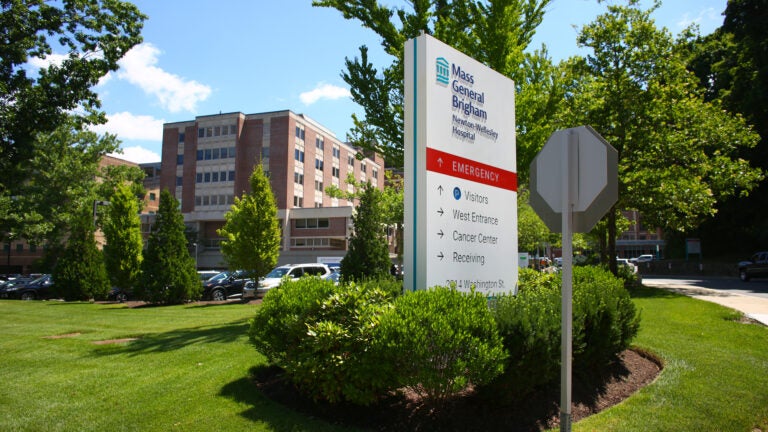
Newton-Wellesley Hospital Pat Greenhouse/Globe Staff
An external review concluded there is no evidence of a workplace tumor cluster at Newton-Wellesley Hospital after 11 nurses working on the same floor reported being diagnosed with brain tumors.
According to the report published March 30, Stefanos Kales, a professor of medicine at Harvard Medical School, concluded that “the overall hospital environment is safe” and that the reported cases do not appear to represent a true workplace tumor cluster.
-
Another Newton-Wellesley Hospital staffer reports brain tumor
-
Hospital responds after multiple nurses in same unit report having brain tumors
“The most important result is that no known, reported or documented carcinogenic/ tumorigenic exposures have been identified on the 5th floor, nor in any of the other randomly selected patient-care units,” Kales wrote.
In the investigation, Kales, along with the Environment Health & Engineering, reviewed the 11 reported brain tumor cases. Two of the tumors were malignant, while the remaining cases involved benign tumors, according to the report.
The cases involved nurses who worked on the hospital’s fifth floor over the past 23 years, according to Newton-Wellesley Hospital President and Chief Operating Officer Ellen Moloney.
“Their findings align with all previous assessments: no environmental risks have been identified in the hospital workplace,” Moloney wrote in a letter to the Mass General Brigham staff announcing the results of the external review.
The findings come after concerns were first raised in April 2025, when Newton-Wellesley Hospital disclosed that five nurses working on the same floor had been diagnosed with non-cancerous brain tumors.
Hospital officials confirmed a sixth case a week later, and by May at least seven current or former staff members had reported brain tumors.
At the time, hospital officials said an investigation by Mass General Brigham Occupational Health Services found no evidence that workplace conditions caused the tumors. The review examined potential exposures, including radiation from x-rays, drinking water, and ionizing radiation from chemotherapy.
The Massachusetts Nurse Association criticized the hospital’s environmental testing, calling it “not comprehensive.” The union said the hospital’s investigation focused on the maternity unit, while reports of cases extended beyond that area.
In the external review, however, Kales endorsed the findings of the hospital’s earlier assessment, writing that investigators had “gone well beyond the expected” and conducted “exhaustive environmental evaluations” that identified no relevant exposures.
The external review included testing air and water quality, radiation exposure, and chemical and pharmaceutical safety, along with conducting interviews with current and past staff and reviewing potential risk factors, according to Moloney.
“No exposures or environmental conditions were identified that could cause the types of benign brain tumors reported,” Moloney wrote.
The report stated the cases do not meet the public health definition of a tumor cluster because they do not involve an unusual number of the same type of tumor. Instead, the 11 diagnoses included several different tumor types with different causes and risk factors.
Extensive environmental evaluations found no workplace exposure that could explain the tumors, and the review also found no evidence of harmful chemical exposure and excess radiation exposure, according to the report.
“The likelihood that additional investigations will yield evidence-based information leading to a different conclusion is highly unlikely,” Kales wrote.
Independent Occupational & Environmental Medicine and Epidemiology Evaluation of Brain Tumors on the F… by samantha.genzer
Sign up for the Today newsletter
Get everything you need to know to start your day, delivered right to your inbox every morning.