Local News
“Because this summary materially misstates the true scope of the proposal, it is unfair,” the SJC wrote.
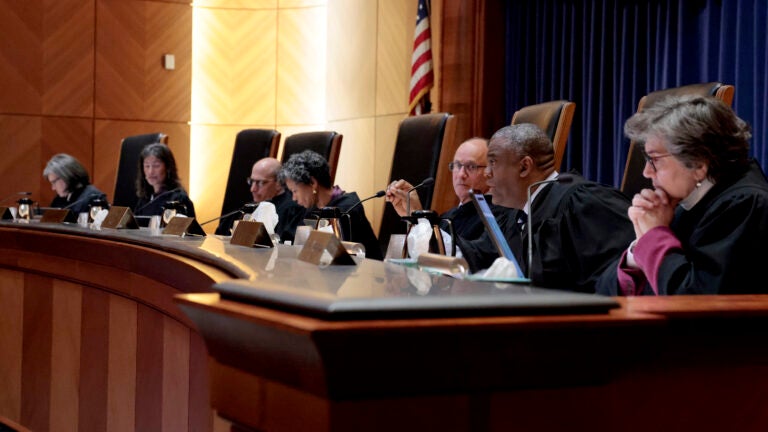
The Supreme Judicial Court on Wednesday April 8, 2026. (Pat Greenhouse/ The Boston Globe Staff)
June 18, 2026 | 11:35 AM
2 minutes to read
Massachusetts’ highest court on Thursday barred a proposed ballot question aimed at lowering the state’s income tax rate from appearing before voters in November, ruling that the measure’s official summary was misleading.
In its decision, the Supreme Judicial Court found that the summary of the initiative petition prepared by Attorney General Andrea Campbell’s office failed to fairly describe the proposal’s effect on long-term capital gains taxes, a flaw the court said was significant enough to disqualify the initiative from the 2026 statewide ballot.
Justice Serge Georges Jr., writing for the court, said the summary incorrectly suggested that capital gains income would not be subject to the proposed tax reduction. In reality, the court found, most long-term capital gains income would be affected under current law.
“The summary does not merely leave something unsaid,” Georges wrote. “It affirmatively tells voters, in ordinary language, that capital gain income is outside the proposed tax reduction when, under current law, most long-term capital gain income would be affected.”
The court added that the summary “materially misstates” the measure’s scope and could not be remedied through campaign messaging or the official “yes” and “no” statements distributed to voters.
“Because this summary materially misstates the true scope of the proposal, it is unfair,” Georges wrote.
The proposed ballot question sought to lower the state’s income tax rate from 5% to 4%. It had sparked debate over Massachusetts tax policy, drawing support from business advocates — and from Boston.com readers — who argued the state has become increasingly unaffordable for residents and employers.
Opponents, including legislators and other advocacy groups, contended that the measure would significantly reduce state revenue and could give high-income households the most benefit while sidelining middle- and lower-income residents.
Following Thursday’s ruling, that debate came to a head once again, as groups in favor and against the initiative reiterated their positions.
The Massachusetts Opportunity Alliance, a business advocacy organization that had backed the proposal, criticized the court’s decision.
“Today’s unprecedented ruling prevents Massachusetts voters from weighing in on a popular proposal to address the state’s cost-of-living crisis,” spokesperson Colin Reed said in a statement.
Reed said the decision does not change broader concerns about affordability and competitiveness in Massachusetts, and added that the organization would continue advocating for policies designed to make the state more affordable for residents and businesses.
On the other hand, leaders of the Protect Massachusetts’ Future ballot committee, which opposed the initiative, celebrated the ruling.
“The ballot initiative would have delivered the largest tax breaks to the ultra-rich, while low-income and middle-class residents would have been stuck paying the price,” Shanique Rodriguez, executive director of the Massachusetts Voter Table, said in a statement.
“Slashing local aid and public services to fund tax breaks that mostly benefit millionaires is the wrong direction for our communities, and we’re all better off without this initiative on the ballot,” she added.
An analysis from Tufts University’s Center for State Policy Analysis found that households across the income spectrum would see relatively similar benefits from the tax cut, with most households keeping an additional 1% of their income.
However, the study also found that higher-income households would see much more actual savings — roughly 30 times as much as the median household.
The ruling brings an end to the contested initiative and leaves any future changes to the state’s income tax structure to lawmakers or a new ballot campaign.
See the SJC’s decision below.
SJC blocks tax cut proposal from ballot: Do you agree?
Annie Jonas is a Community writer at Boston.com. She was previously a local editor at Patch and a freelancer at the Financial Times.
Sign up for the Today newsletter
Get everything you need to know to start your day, delivered right to your inbox every morning.