Rain on holiday is generally received about as well as the news that Uncle Steve is, in fact, a walking cliché who’s been having an extra-marital affair with a younger colleague.
Beyond this familial overshare, you get the point that rain on holiday is met with the same embrace as minor scandal – it’s all denial, denial, irritation and a lot of uttering “what the actual hell?”
See, rain doesn’t care for your carefully planned days or the itinerary or the fact Thursday morning was set aside for snorkelling across a tropical reef that illuminates under a penetrative 10am sun.
The rain arrives without ceremony nor apology — it has no interest in the fact you’re a sun-powered creature of intent. And yet, it also brings a sprinkling of positivity; a sense of light among the grey.
ROAM. Landing in your inbox weekly.
A digital-first travel magazine. Premium itineraries and adventures, practical information and exclusive offers for the discerning traveller.
By continuing you agree to our Terms and Privacy Policy.
These are my thoughts, at least, on a recent Thursday about 10am as it becomes obvious the day’s planned reef excursion was to be cancelled “due to the weather”.
But I came to discover that the rain (and I might add that this recent event involved a heavy showing of meteorological power) actually enables something else, something truly rare in modern life — the removal of options.
See, the great lie of modern travel is that holidays are about doing more. Seeing more. Experiencing more. Rain quietly exposes such nonsense — it offers a sense of tangible relief in that you’re no longer required to enjoy yourself so aggressively
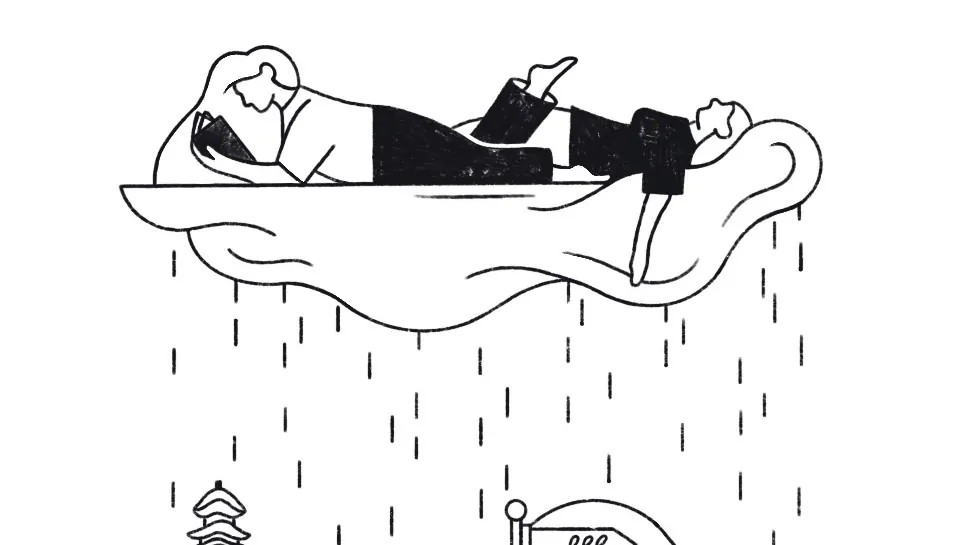
And so you surrender — to the rains and the situation — in favour of different possibilities and a good lie down. Not sleeping, not resting, but the specific holiday state of horizontal neutrality where time is something happening elsewhere.
There’s reading, too. And not the aspirational kind where the book travels unchanged and crisp throughout an entire trip, but the full collapse into narrative dependency.
There’s also bathing at inappropriate hours and, of course, there’s eating, which rain liberates from any sense of social justification or constraints of time. You order things you’d normally only consume during illness, grief, or long-haul flights — soup with no discernible origin, toasties that taste of childhood, a BLT and chips, because, well, a BLT and hot chips.
You’ve entered a rare, socially sanctioned excuse to do nothing, and you need not actually label it “wellness”.
Camping, of course, does not share in this whole “rain is OK” philosophy. Camping in rain is no bueno. It’s awful and can lead to more regret than that being carried by Uncle Steve.
But a hotel or a resort in the rain is a different species of experience. There’s a genuinely real and unique pleasure in watching weather you’re no longer required to participate in. Rain from a distance, viewed from the dry confines of within, becomes aesthetic, almost tasteful.
It also forces you to notice small, overlooked elements — the sound of corridors at midday, the absurd seriousness of bathrobes, the truly banal tone of daytime television. You begin to notice details hidden by sunshine —the sound of cutlery in an empty dining room at 3pm (which is either melancholic or luxurious depending on your levels of blood sugar) or the faint existential drama of indoor plants trying their best. Rain also does something socially subversive in that it equalises ambition. The overly active and the mildly hungover find themselves united in a single doctrine — stay where you are, do little, hell, do nothing.
Eventually, the rain stops. Of course it does. The world outside is now rinsed and slightly improved. “What a shame about the weather,” people will say, as though the purpose of the day was production.
But rain days are not defective, it’s a different kind of contract. One that asks very little and in doing so offers the rarest luxury of all — permission to disappear into a room and call it a holiday.