Media
“Coaching in the Premier League is not that easy, man.”
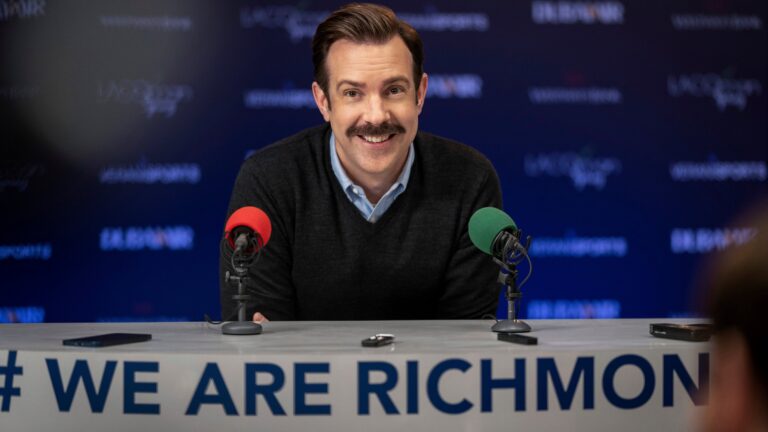
Jason Sudeikis plays the title character in “Ted Lasso.” Colin Hutton
June 11, 2026 | 10:44 AM
7 minutes to read
Upon initial consideration, the lasting lessons of “Ted Lasso” are the frequent aphorisms and epigrams deployed by the title character on the Apple TV hit show about a big-hearted, open-minded, hopeful-but-silently-hurting Division 2 college football coach who heads to England to coach Premier League futbol.
Be a goldfish. (Don’t let a bad experience or memory linger. Forget about it!)
Believe. (Reiterated in a sign affixed above the exit to his AFC Richmond team’s locker room.)
And perhaps the most popular one: Be curious, not judgmental. (Emphasizes one of the show’s overriding themes: The world is a better place when you keep an open mind, ask questions, and are willing to accept and even celebrate the people around you for who they are.)
“The show resonated because it’s about people first and soccer second,” said Ali Krieger, an American soccer legend who won two World Cups while playing for the United States. “You didn’t need to have a deep understanding of soccer to connect with the show, and arrived at a time when people were craving that optimism and that connection and that hope.”
“Ted Lasso” debuted in August 2020, seven years after the title character, played by Jason Sudeikis, debuted in an NBC Sports commercial for its Premier League coverage. Developed by Sudeikis, Brendan Hunt (Sudeikis’s close friend, who plays his loyal, quirky, and highly literate assistant coach, Willis Beard), Bill Lawrence (“Scrubs,” “Shrinking”), and Joe Kelly, the show has had three seasons, with a fourth featuring Lasso coaching a women’s team coming in August.
It was a massive hit — according to “Deadline,” its third season streaming on Apple TV totaled 16.9 billion viewing minutes. It arrived during the COVID-19 pandemic, when a show with a lead character guided by hope felt like a gift.
And its impact is felt beyond Lasso’s memorable turns of phrase. Taking one of them to heart — yep, be curious, not judgmental — there are two questions about the show that must be asked, and before the start of the World Cup feels like the proper time.
Those two questions: Did it do soccer — the tactics, strategies, culture, and camaraderie of a team — justice? And did “Ted Lasso” make soccer more popular in the United States?
Close to the real thing?
Taylor Twellman, the former Revolution star and current Apple TV soccer commentator, is a big fan of the show. He knows Sudeikis, a genuine sports fan, and has met Hunt for a long lunch to talk soccer. But he says there is one early plot point in particular where his disbelief wasn’t all that willing to be suspended.
“It was like, ‘Hang on a minute: this is a college football coach, and not even one from D1?’ ” he said with a laugh. “Coaching in the Premier League is not that easy, man. That was Jason’s very creative way, in my opinion, of bringing an angle to how the character ends up over there. A lot of soccer people took initial offense, though.”
Longtime Revolution broadcaster Brad Feldman was one of those people: “Here’s the thing: when actual credentialed successful American coaches have gone over there, it’s been really hard.” He mentions former US national team coach Bob Bradley. “His short spell in English soccer, they were just so ready to tear him down,” said Feldman. “That may be the most far-fetched part of the show.”
As far as the actual coaching tactics go, they’re not terribly complicated. When, in the Season 2 finale, kit-man-turned-assistant-coach Nathan Shelley comes up with a strategy called “False 9” — when the striker is replaced by an attacking midfielder in an attempt to throw off the opposing defense — it is a crucial plotline that (temporarily) enhances his standing.
A Ted Lasso inspired sign in the locker room inside the Navigant Credit Union Field House at Bryant University in Smithfield, Rhode Island. (Lane Turner/The Boston Globe)
According to Sam Mewis, a former member of the US women’s national team who has played professionally in England, the show’s approach to soccer strategy is fine, but what it does well is make that strategy accessible to fans who are not necessarily diehards.
“I think what it did,” said Mewis, “is give new fans an understanding of styles of play. The plotline of Nate, who was the kit man [clubhouse attendant], being the one who understood the tactics, that felt true to me. I know we would never dismiss the kit man’s opinion. They’re so embedded in the game, and so passionate about it.”
Krieger noted that coaching is about more than tactics, anyway. “It’s about dealing with team dynamics, sincerity, relationships, camaraderie, being vulnerable,” she said, noting that one of the subplots is Lasso’s need for therapy and initial resistance to it. “It’s pretty deep for a show about a fish-out-of-water football coach.”
Krieger, Mewis, and Twellman agreed that the show does a super job of getting the prototypes of soccer personalities correct, especially those modeled after some big-name players.
“Roy Kent,” said Twellman, citing the grouch-with-a-heart-of-gold AFC Richmond star played by Brett Goldstein, “yeah, he’s definitely Roy Keane, the Irish former captain for Manchester United.”
Twellman cited a few other AFC Richmond players, making their professional comparisons, before coming to one that stumped him.
It was suggested to Twellman that since he couldn’t spot the comp, maybe the comp was actually him.
“That might be the case,” he said with a laugh. “We don’t always see in ourselves what others see. Another lesson of the show, right?”
More accessible to fans
It’s difficult to gauge whether “Ted Lasso” has impacted soccer participation or fandom in the United States. Studies suggested the sport was already growing at a decent clip stateside even before the program’s debut. When Apple TV signed a 10-year, $2.5 billion broadcast rights deal with Major League Soccer in June 2022, its executives would not confirm that “Ted Lasso” had enhanced the streamer’s interest in the sport, just that it did not hurt.
“I just think,” said Twellman, “that soccer has gotten much more popular over the last 10 years, and ‘Ted Lasso’ is one, but far from the only, factor in that.”
When Tom Caron, the NESN Red Sox studio host who is a co-owner of the Portland Hearts of Pine in USL League One, was asked if the show aided the team’s huge success in the market, he noted that the franchise actually was in the works years ago, before “Ted Lasso” premiered.
“The timing might indicate that it did,” said Caron. “Our franchise was being built over the whole arc of the first three seasons of the show. That probably worked out really well for us, hyping up that many more people.” The Hearts of Pine, he noted, will add a women’s team in 2027, which also follows the ‘Lasso’ arc in a sense.
Mewis said what she really thinks the show did is make the sport more accessible to casual fans.
“I think there’s this distinction between the already engaged fan who is maybe a season ticket-holder for their local club and pay attention to the game and they know the tactics,“ she said. “But then there’s just also this really casual fan who maybe tunes in every four years during the World Cup or who is just a little bit more loosely paying attention. I think what ‘Ted Lasso’ did for that casual fan is make soccer more fun through the storytelling. I love how they talk about the game.”
Hunt, a.k.a. Coach Beard, might have offered the most clear-eyed assessment of the show’s impact on the sport during an interview with the Los Angeles Times in 2021.
“People who just would not have given two [expletives] about soccer before now maybe at least give one [expletive],” he said. “People at least have a respect for it or an appreciation for the scale and magnitude of it and the devotion that it inspires. People can’t blow it off anymore, at the very least.”
To borrow a phrase
For all of the talk about strategy and growth, it’s those aforementioned aphorisms, coined by “Lasso,” that might just have the most tangible effect on the sport.
Lisa Wales, the girls’ soccer coach at Marblehead High School, can attest. A big fan of the show, she’s one of surely many coaches across many sports at many levels who have used “be a goldfish” and “believe” and “be curious, not judgmental” in a quest to inspire a team.
Last year, entering their September matchup with powerful Masconomet, winner of 60 regular-season games in a row, the focus was on believing in themselves.
Believe, they did.
“I kept saying, ‘You gotta believe, we gotta believe,’ and a couple of kids did, and then everybody else followed,” said Wales. “If you believe in something, truly believe, you can do it. We beat them, 1-0. We took that from the show. We believed. And our belief was rewarded.”
Wales’s anecdote was shared with Krieger, a player of such stature that her retirement party attendees included … Sudeikis.
“I love that story,” said Krieger. “Love it.”
She paused. “I don’t know if ‘Ted Lasso’ was always realistic about soccer. But it was incredibly authentic about people and leadership and culture and the power of beliefs. And that’s why it connected with so many people.”
Chad Finn
Chad Finn is a sports columnist for Boston.com. He has been voted Favorite Sports Writer in Boston in the annual Channel Media Market and Research Poll for the past four years. He also writes a weekly sports media column for the Globe and contributes to Globe Magazine.
Get the latest Boston sports news
Receive updates on your favorite Boston teams, straight from our newsroom to your inbox.