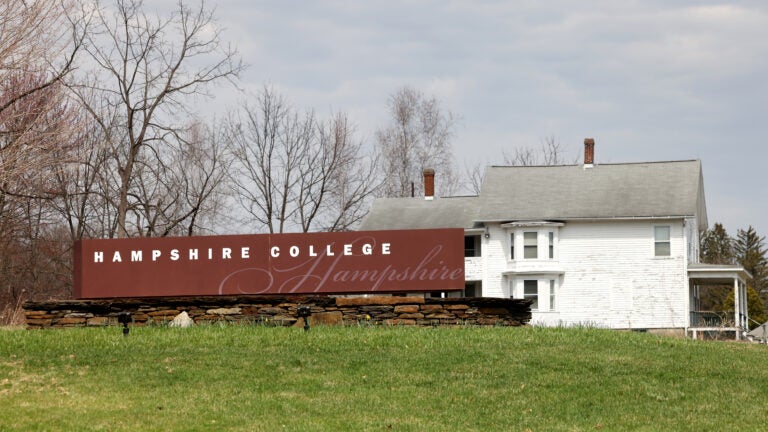
The Help Hampshire Workers Emergency Relief Fund has raised over $470,000 to support the 250 Hampshire College staff and faculty members that were laid off without severance pay following the college’s closure.
On Tuesday, April 14, the College’s Board of Trustees announced that they had “voted to permanently close Hampshire College following the fall 2026 semester” amid financial instability and declining enrollment. The following week, a group of Hampshire faculty and staff established the emergency relief fund to provide need-based financial assistance to their colleagues, many of whom were given June 16 termination dates.
“The effort came together very quickly because we had to, because the need was there,” Lorenzo Conte, the fund’s staff organizer and Hampshire College art gallery director, said. “With folks losing their jobs so quickly and no safety net offered by the college, our goal has been to raise funds expeditiously and then to work with one another to equitably distribute those funds based on need.”
Within the first week of launching, the fund raised $60,000 to support the immediate needs of terminated staff and faculty in partnership with fiscal sponsor, Sundial Initiative Inc., a 501(c)(3) nonprofit run by Hampshire College alumnus Joey Carey.
Conte acknowledged that paying severance to all terminated employees would cost over $1 million, which the college might be unable to support effectively.
“Every dollar, every thousand dollars is direct assistance that we’re able to put in the hands of staff and faculty,” Conte said. “…We’re grateful for that opportunity to make that ask to our community.”
According to a May 26 update written by Conte and posted on the Help Hampshire Workers website, “Initial requests for aid reflected urgent and immediate financial strain, including healthcare expenses, housing instability and eviction prevention, increased insurance costs tied to job loss, childcare, and transition/job-search expenses.”
“There will certainly be people who have immediate needs,” rl Goldberg, the fund’s faculty organizer and assistant professor of queer studies at Hampshire College, said. “…we all lose health insurance in June … we need medication for ourselves and our families, people who need rent support, there are people on this campus who are a paycheck away from living out of their cars and that is utterly terrifying.”
The distribution plan was created by 10 members of staff and faculty, including Conte and Goldberg. Employees were able to fill out an aid request form beginning May 5 through May 20 resulting in 81 members of faculty and staff receiving a collective $140,500.
According to their website, these requests were evaluated by “a small review group, composed of two staff members and two faculty members,” to determine eligibility and the amount of aid an individual would receive. They do not require “detailed justifications” from their coworkers and trust in their expressed need.
“Many staff and faculty came to the college in the same spirit that students did, eager to contribute to this place that has a spirit of experimentation, eager to be a part of a unique community of learners and to uphold the values of Hampshire College,” Conte said. “And we see this Relief Fund as one more effort to live by Hampshire’s values and to invite our community in to support those who are supporting our students right now.”
A second round of aid requests opened May 26 and will close June 10. Around $300,000 is expected to be distributed and any member of Hampshire staff and faculty that have not previously received aid are eligible to make a request. Additionally, “Aid will be distributed in set amounts ($1,000, $1,500, $2,000, or $2,500) based on need.”
After receiving a $250,000 donation from the Joannie Fischer Charitable Fund, the organization increased their original $500,000 goal to $600,000, of which they have raised over $473,000 from over 930 donors as of publication.
“Increasing the goal is a testament to our determination to look out for everyone the best we can, a testament to the goodwill and compassion of our community, but also a reminder of the real depth of this crisis,” Goldberg said in an email.
The relief fund has also established a form for community members to share employment opportunities and information regarding “legal support, financial advising, healthcare navigation, career counseling, temporary housing, childcare, and access to local services.”
Goldberg said that these offers of support have “ranged from individuals offering to review job application materials with staff and faculty, a student offering babysitting to help with childcare this summer for folks in need of that. And those offers … are buoying our spirits in a very difficult time.”
Despite these efforts, uncertainty remains for many Hampshire faculty and staff as they navigate what comes next.
“The academic job cycle is such that job postings start in the end of the summer and most jobs are filled by January or February,” Goldberg said. “Unless we get one-year positions from the four colleges, all of us will be out of jobs in June. For a lot of us, that means being kicked out of academia entirely, which is a pretty tough pill to swallow.”
Conte said that the other four colleges in the Five College Consortium—Amherst College, the University of Massachusetts, Smith College and Mount Holyoke College—have not guaranteed “interviews or placement” for terminated Hampshire College employees.
“While we’ve received community support, that has not materialized in a very clear strategy to offer employees of Hampshire College transfer pathways in the same manner that we’ve worked to construct those for students,” Conte said. “Our staff and faculty have been and are enthusiastic participants in our five-college community, and I know, by and large, folks would love nothing more than to continue contributing to those communities.”
“I’m very optimistic that the four colleges want to help as many of us as they can, because we teach each other’s students and we share resources and we all have the same goal, which is collaborating for education,” Goldberg said.
Emily Gest, Associate Vice Chair for News and Media Relations at UMass, said that the university participated in multiple job fairs at Hampshire College and have “set up a process for impacted Hampshire employees to express their interest in roles at UMass. This information is shared among recruiting staff to support coordinated outreach and review of candidates.”
Representatives from Smith College, Amherst College and Mount Holyoke could not be reached for comment.
“One concern certainly is for people who see teaching as their vocation, as their life’s work,” Goldberg said. “Is there another place where they can do that and teach without being entirely precarious … especially if these are people who have tenure here?”
Hampshire College structures education across three divisions with students often declaring a concentration in their second or third year, considered Division II, and completing a final independent project with a faculty advisor in their last year, considered Division III.
Goldberg said that Hampshire’s unique educational structure, where “people are teaching a lot and doing a ton of advising,” could impact employment opportunities for faculty and staff who were less focused on publishing their own work in favor of supporting students or advising projects.
“There is this anxiety that given the market and what the market is privileging right now, particularly around publishing, if that hasn’t been the focus, because teaching and advising are, what does that mean for people’s prospects? And that’s a very scary question,” Goldberg said.
Goldberg credits the success of the relief fund “to the wonderful Hampshire community of students, staff, faculty, alums, and community members who care about this place, and of course … to the herculean efforts of organizers.”
They stress that there is still “immense and urgent need,” as the Hampshire community continues to cope with the sudden closure.
“The only thing would be just the sincere, sincere hope that the other colleges are able to find places for all of us,” Goldberg said. “Among them…we’re a small community, a vibrant community. We love this community. We all want to stay. So I hope there’s a way that the colleges can pull together to make that possible and at least give us all a year or two to sort of figure out what our next step is.”
Bella Astrofsky can be reached at [email protected].