On the Market
The interior contains little more than four walls, studs, rough flooring, ceiling joists, and rudimentary plumbing and wiring.
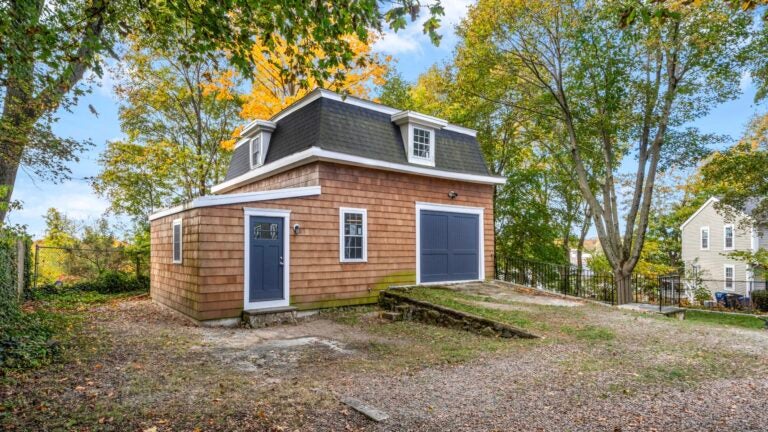
Unit 4 at 8 Pine Street in Hyde Park was originally a carriage house. William Raveis Real Estate
June 1, 2026 | 9:20 AM
2 minutes to read
In Boston, an 1,800-square-foot house for $579,000 is a rare bargain, especially an attractive, free-standing house in a nice neighborhood.
The structure at 8 Pine Street in the Mount Neponset neighborhood of Hyde Park is just that — but there’s a catch. It’s completely unfinished on the inside.
As is, artists could use it as a spacious and private studio; antiques dealers and interior designers would find it useful for furniture storage; it could serve as grand place to keep a collectible vehicle. Or, given permission by the City of Boston (and with some TLC), you could even live here.
The unfinished interior. – William Raveis Real Estate
“It can’t be a commercial enterprise, like a store,” said Christopher Lydon, the realtor with Milton’s William Raveis Real Estate, who is listing the property. “Its legal designation is as a barn. But, if you got a variance from the Zoning Board of Appeals, you could turn it into a really nice residence.”
While it is a solid gambrel-roofed building with a lot of historic charm, it’s just a shell. The interior contains little more than four walls, studs, rough flooring, ceiling joists, and rudimentary plumbing and wiring.
There is a bathtub installed. – William Raveis Real EstateThe unfinished interior. – William Raveis Real Estate
“Often, buyers are seduced by an attractive purchase price. But they need to know that it will involve effort, and they have to have a plan,” said Robb Cohen, a long-time real estate broker with Engel and Völkers in Boston.
In April, a heavily burned Dorchester house that would need to be mostly gutted or torn down sold for $776,000.
That being said, it does present the possibility for the next owners to make it their own. “They can put their own stamp on it, whether as a residence or as a work place,” said Cohen.
The barn that is for sale is a condominium with a monthly fee of $110.
Laid out in 1858, Maple, Oak, Pine, and Walnut Streets were part of a new development named for the area’s various kinds of trees by the Real Estate & Building Company. This barn, unit 4, was built in 1884. By 1912, Hyde Park had become the southernmost part of Boston, but traces of its history remain, including this building. The house it once served is long gone and the surrounding land was subdivided and filled with newer construction. One of those newer buildings is a classic Boston triple-decker; it and the old carriage house now comprise a four-unit condominium complex.
“This property has proved attractive to a lot of people,” Lydon said. “This is a free-standing condominium with a deeded off-street parking spot.”
The unfinished second floor. – William Raveis Real Estate
He believes that the building’s original use was as a horse stable and that it became a carriage house when the population moved from horse-drawn to automotive transportation. Over the years, it retained its wide barn doors and entrance ramp, a side door, and a substantial rubble stone foundation. But it never became a studio or a home.
For a person who needs work or storage space, or who wants to build a home of their own, this could be a rare opportunity.
“But you do have to know what you are doing,” Cohen warns. “You don’t want to build a million-dollar kitchen in a half-million dollar house.”
Regina Cole writes about architecture and design for national and regional publications, with a specialty in historic architecture and the history of the decorative arts.
Address Newsletter
Our weekly digest on buying, selling, and design, with expert advice and insider neighborhood knowledge.