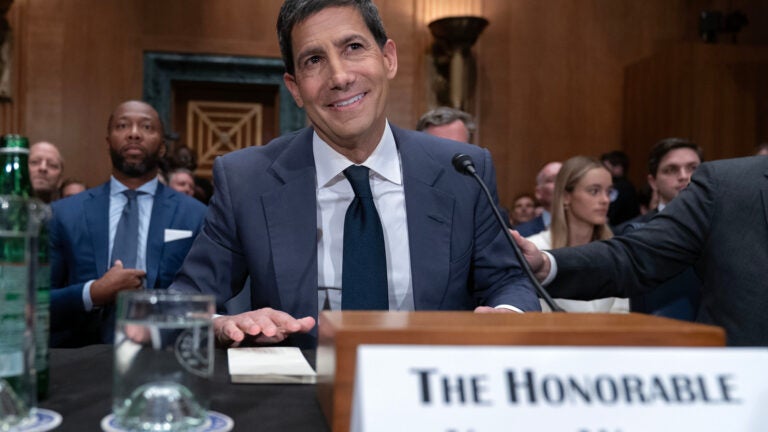
Brendan Carr has turned the FCC into an instrument of Trump’s power.Kevin Dietsch/Getty
Get your news from a source that’s not owned and controlled by oligarchs. Sign up for the free Mother Jones Daily.
In his second term, President Donald Trump demands a loyal bureaucracy that will defend his political well-being. No one better represents this reimagining of the work of government experts than Brendan Carr, the chairman of the Federal Communications Commission. Created by Congress in 1934 to oversee radio licensing and telecommunications, Carr has turned the FCC into a political weapon to silence media voices deemed unfriendly to the administration. It’s Exhibit A of what can happen when an independent agency is hijacked by partisan apparatchiks. Little wonder Trump has praised him as “outstanding,” a “patriot,” and “a very tough guy.”
Carr’s record is frighteningly impressive. Verizon and T-Mobile both ditched diversity, equity, and inclusion practices in exchange for merger approvals from his FCC. Paramount, parent-company of CBS, created an ombudsman at the network to ensure a “diversity of viewpoints” to win Carr’s approval for its merger with Skydance, in effect letting Carr sway news content. Carr also successfully leaned on Paramount to pay Trump off in a suit over a 60 Minutes episode Trump didn’t like. Stephen Colbert called that a “big fat bribe,” after which CBS canceled his Late Show. Then, after all this capitulation, Carr approved the merger. Perhaps most infamously, after ABC late night host Jimmy Kimmel made a joke that Trump didn’t like, Carr threatened that parent company Disney would face the FCC’s retribution if it didn’t fire Kimmel. “We can do this the easy way or the hard way,” Carr warned. It’s hard to imagine a more blatant abuse of government power: Punishing private individuals for their speech. Carr, who just a few years ago tweeted that censoring “late-night comedians…would represent a serious threat to our freedoms,” began a review of ABC broadcast licenses the day after Trump called on Disney to fire Kimmel. After months of bullying, Disney has been pushed to defend its affiliates.
And yet, in a case the Supreme Court is expected to rule on in the coming weeks, the Republican-appointed majority is likely to decide, in effect, more of this, please.
The FCC has traditionally been considered an independent agency. Independent agencies are typically run by a bipartisan board of commissioners who serve fixed-year terms and can only be removed by the president for cause—a setup designed by Congress to insulate them from White House political pressure. Carr is a case in point of the risk. When Trump made him chair, he called him “a warrior for free speech.” What he got was an enemy of a free press—but a warrior for Trump.
Despite this history, the Roberts Court has signaled that it is ready to declare at least some independent agencies unconstitutional. During Trump’s first few months in office, the court’s GOP-appointed majority, against the dissents of their colleagues tapped by Democrats, used their emergency docket to wave through the firings of Democratic commissioners on the National Labor Relations Board, the Federal Trade Commission, the Merit Systems Protection Board, and the Consumer Product Safety Commission. These decisions flew in the face of a seminal 1935 opinion, Humphrey’s Executor v. United States, in which a unanimous Supreme Court had ruled that the Constitution permitted creating independent agencies whose commissioners can only be fired for cause. The court heard oral arguments over Trump’s firing of FTC commissioner Rebecca Slaughter in December, and the GOP appointees appear ready to jettison this 90-year-old precedent upon which much of the modern regulatory state was built.
Trump’s second term has highlighted why compromising independence is harmful.
Independent agencies serve critical functions. Several, including the FTC, the Federal Reserve Board, the Federal Deposit Insurance Corporation (FDIC), the Commodity Futures Trading Commission (CFTC), and the Securities and Exchange Commission (SEC) hold significant sway over the economy. The Fed, in particular, sets interest rates, can print infinite money, loan funds to anyone on any terms, and restrict access to the banking system. It’s obvious that opening the Fed to presidential control by allowing him to fire commissioners without good reason is a dangerous proposition. In fact, the possibility is so threatening to the stability of the economy that the Supreme Court seems intent on keeping the Fed independent, despite its apparent openness to ditching independence at most or all other agencies.
Trump’s second term has highlighted both why compromising independence is harmful—and how current independence is often less than Congress initially hoped. For example, the CFTC, where the president has left four of five commissioner spots empty, has apparently stopped investigating cryptocurrency scams and is refusing to scrutinize betting sites Kalshi and Polymarket, two fraud-fueled industries that have the president’s backing. But Trump’s return to power has also underscored how easy it is to compromise agencies without even a technical promise of independence. Take the country’s health regulators, where it’s all too clear that personal whim, rather than scientific evidence, is guiding new vaccine policies.
Trump’s aspiration to weaponize both independent agencies and executive departments is being implemented by a Supreme Court similarly intent on neutering the administrative state. The Roberts Court has embraced the unitary executive theory, a once fringe argument that the president must control all functions of the executive branch, which should operate as an extension of the president’s will. The theory has justified a fundamental reordering of the Constitution’s separation of powers under the current court, shifting authority away from Congress and to the president and the justices themselves. In a series of opinions, Chief Justice John Roberts has explained his embrace of a unitary executive as a move toward democratic accountability, writing in 2021 that executive power “acquires its legitimacy and accountability to the public through ‘a clear and effective chain of command’ down from the President, on whom all the people vote.” But the Carr-ification of independent agencies is the opposite of democratic.
While the court is likely to overturn Humphrey’s Executor, we don’t yet know whether their forthcoming decision will permit any agencies to maintain the independence Congress designed. Any new rule on the question would create a cascade of litigation over various agencies’ independent status. But we can imagine what could happen if independence gives way to political weaponization and corruption. Amicus curiae, or friend of the court, briefs submitted in Trump v. Slaughter point to the important work independent agencies have done—and how bringing them under direct presidential control risks disaster.
The FTC, the agency whose independence was at issue in both Humphrey’s Executor and the current Slaughter case, fought for cigarette warning labels in the 1960s, stood up to the finance industry by protecting borrowers’ legal rights in the 1970s, and led the way on child digital privacy in the 1990s. But a brief filed by 40 consumer and fair market groups highlights the agency’s capitulation to political pressure since Trump removed its Democratic members last year. Now, the brief explains, “the FTC has failed to take any significant action” on a pending case concerning whether Meta “failed to comply with an existing FTC consent order and misled parents about key privacy settings for children.” To protect children, the FTC has instead prioritized investigating the provision of gender-affirming care for minors.
Presidential control of elections seems particularly anti-democratic .
At the Consumer Product Safety Commission, Trump’s firing of Democratic members has likewise stymied the agency. Dedicated to protecting the public, it once played a key role in banning lead-based paint despite industry pressure. “Given that much of the CPSC’s regulatory activities concern infants and toddlers, politicizing that agency jeopardizes the health and safety of American children,” the consumer groups’ brief says. As at the FTC, the filing continues, “the risk is not theoretical: since the current administration fired three commissioners, the CPSC has delayed long-planned, critical safety rules for water bead toys—rules to address poisoning and choking hazards.”
One area of government where presidential control seems particularly anti-democratic is elections. “A politicized” Election Assistance Commission could, according to a brief submitted by a group of independent agency board members and legal scholars, “certify or decertify voting system hardware and software not based on the quality and security of those systems but based on the political contributions of system vendors” or “vote to add unnecessary and draconian requirements to the federal mail voter registration application form.”
Similarly, the Federal Election Commission administers campaign finance laws, investigates potential violations, and imposes civil fines. A presidentially-controlled FEC could launch investigations into donors to the opposition party, or refuse to enforce campaign finance rules against the president’s party. In fact, the country has already had a taste of this problem, as the FEC has for years been a prime example of a dysfunctional independent agency. For nearly a decade starting in 2010, the agency was deadlocked along partisan lines, resulting in a broad failure to enforce campaign finance rules against illegal conduct and dark money. This was followed by a period in which the agency frequently lacked a quorum, similarly stymieing its ability to function. While those failures broadly undermined the rules governing money in politics, a targeted and weaponized FEC would be even worse.
Early in his term, the Supreme Court allowed Trump to remove the head of the Merit Systems Protection Board, which adjudicates employment disputes between federal workers and their agencies, including allegations of improper political influence in personnel decisions. “A politically compromised MSPB could effectively result in the return of a political patronage system,” the same board members’ brief states, “characterized by ‘not only incompetence, but also graft, corruption and outright theft.’” If the MSPB lacks independence, the entire project of a nonpartisan and expert civil service is at risk.
The interstate transmission of oil, natural gas, and electricity is regulated by the Federal Energy Regulatory Commission, which must approve proposals for pipelines and other energy infrastructure. Though most Americans have likely not heard of the agency, it regulates some $1 trillion worth of energy transmitted around the country according to FERC-set rates. Politicizing this work would give the president incredible financial power. “The President would secure vast direct control over the economy,” an amicus brief from former FERC commissioners warns. “Price-setting power would allow the President to increase profits of favored companies at the expense of consumers who would face higher prices.” Further, “the President could also punish companies that oppose his policies or even raise energy prices in states that support his political rivals.” Even if a president withheld from corrupt interventions, without the promise of a steady market, the ex-commissioners caution that companies likely wouldn’t invest in new infrastructure, causing long-term planning to unravel and imperiling the grid’s future.
The court is increasing presidential control at the same time it empowers uber-wealthy donors.
The independence of other economic regulators is also at stake, including those that oversee interest rates, consumer prices, and market integrity and volatility. So preserving the Fed, as the Supreme Court appears likely to contort itself to do, won’t fully prevent further presidential manipulation of the economy. The Fed isn’t even the only independent agency that affects interest rates. The National Credit Union Administration regulates credit unions like the Fed regulates banks. A NCUA with a partisan agenda could lend aggressively to credit unions, whose assets exceed $2.3 trillion, or lower the amount of money they must keep in reserve. This would increase the money supply, which could bring down interest rates. In that way, a president could use the NCUA to circumvent the Fed and juice the economy ahead of elections.
The Supreme Court already introduced a new level of politicization into financial regulation with its unitary executive-inspired 2020 decision in Seila Law, which ended for-cause removal protections for the single director of the Consumer Financial Protection Bureau. Because the bureau’s director is also a member of the FDIC board, the partisan majority on the FDIC now changes whenever party control of the White House flips. The Seila Law ruling guarantees that both the CFPB and the FDIC, key bank regulators, are controlled by members of the president’s party.
It must be noted that the Supreme Court’s move to increase presidential control over the agencies that oversee so many aspects of Americans’ lives comes at the same time that the justices have increasingly allowed uber-wealthy donors to spend millions in elections. Thanks to the Supreme Court, billionaires accounted for nearly 20 percent of all campaign spending in 2024. That includes Elon Musk, whose nearly $300 million spree on behalf of Trump netted him a job of seemingly limitless power inside the White House. This very term, the justices are considering whether to lift limits on how much political parties can spend in coordination with politicians’ campaigns, which would effectively allow wealthy donors to increase the amounts they can give candidates by routing it through the party apparatus. Thus, the president is gaining control over decisions large and small—from approving major mergers to whether a toy is a choking hazard—at the same time that wealthy Americans have a direct line to the president (and members of Congress) through large political donations.
Trump, whose own wealth has grown by at least $1.4 billion since he returned to the White House, clearly seeks self-enrichment in many forms. Without independence, it’s easy to see decision-making shifting from independent commissioners to well-connected people who enter into a business deal with Trump or dine frequently at Mar-a-Lago.
Independent agencies aren’t perfect, nor are they entirely insulated from presidential control. Congress has allowed the president to designate the chair of many independent agencies, finding it desirable that these agencies should generally work in concert with administration priorities. But removal authority would take that coordination to a new level. Independent agencies are also not immune from corporate capture. One example would be the SEC which, in 2004, under leadership appointed by George W. Bush, made oversight of the largest banks voluntary. The agency later acknowledged this rollback contributed to the financial crisis that took place four years later. In an era of increasing executive authority, presidential self-enrichment, and billionaire-fueled campaigns, the need for independent leadership remains just—if not more—important.
Carr once actually defended FCC independence. But last December, he testified before the Senate that it is not formally independent, citing the 1934 Communications Act which did not protect its members from for-cause removal. This is surely because the Act predates Humphrey’s Executor, and was passed at a time Congress thought removal restrictions had been banned by a previous Supreme Court decision. While Congress added for-cause removal restrictions for Fed governors after Humphrey’s Executor, it never did that for the FCC. Regardless, the FCC has long been considered independent. Its own website long declared it so until, it appears, the day Carr testified that it was not.
These agencies don’t have boundless power; even commissioners under the president’s thumb and working in his service are limited by their agency’s governing statutes and the Constitution’s restraints. As Carr’s critics argue, many of his attempts to silence the media and punish disfavored speech would fail in court. This is a critical point. His ability to suppress dissent and coerce media companies into settling Trump’s specious lawsuits is based on the unwillingness of companies to stand up to the administration when they can pay him off instead. “The goal is to get the companies to capitulate in advance, to the point where the FCC or the administration doesn’t even need to speak,” FCC Commissioner Anna Gomez, the agency’s only Democratic appointee, told Politico last fall. “It’s the threats that are the point.” This is why the weaponization of independent agencies—indeed, all agencies—is so dangerous. To do their jobs properly, agencies must carefully follow the law. But to wingman an authoritarian president, threats alone can do a lot of damage.
Under the unitary executive theory pushed by the Supreme Court, every four years, Americans elect someone who can make virtually all decisions for the entire executive branch. The Slaughter case highlights that theory’s truly undesirable consequences. Should the president decide whether paint contains lead? And if he does, will he make the call because of the science or a political donation? Should the president set energy prices, and have the power to punish certain states with higher electric bills, or to win over voters in others by lowering them? Should the president personally approve major mergers and acquisitions among America’s biggest businesses? And if he does, will decisions be based on what’s best for consumers or his donors? What if the president simply outsources them to a donor, like Elon Musk, whom he’s appointed to some constitutionally dubious advisory role?
At a roundtable of independent agency commissioners in November, Slaughter, the ousted FTC commissioner, explained the importance of independence by invoking a single image. “The image I’m talking about is the one from the inauguration where you saw President Trump not surrounded by heads of state, not by public servants, but by the CEOs of the largest companies in the United States,” she explained. “I looked at that picture and thought, ‘Wow. The FTC is in active litigation against almost every single one of those companies right now.”
“What I think all Americans want and need is to believe that the law—the laws of the United States—will be administered without fear or favor,” she continued. “Specifically, without fear of getting fired for failure to do a favor for the president’s political allies and donors.”
Is that too much to ask?